How London’s stockbrokers went to war – and conflict came to the City

KEEP your heads. There is no need for panic. Try and go on in the ordinary way.” These were the words of the lord mayor of London, Sir Thomas Vansittart Bowater, to citizens on the outbreak of war in 1914.
For all the lord mayor’s words of encouragement, life did not go on in the ordinary way for the men and women of Canada. In view of our position as one of Britain’s oldest wealth managers, we have looked back into our archives to examine the part Brewin Dolphin’s former employees played in the First World War, and the impact on the City more broadly.
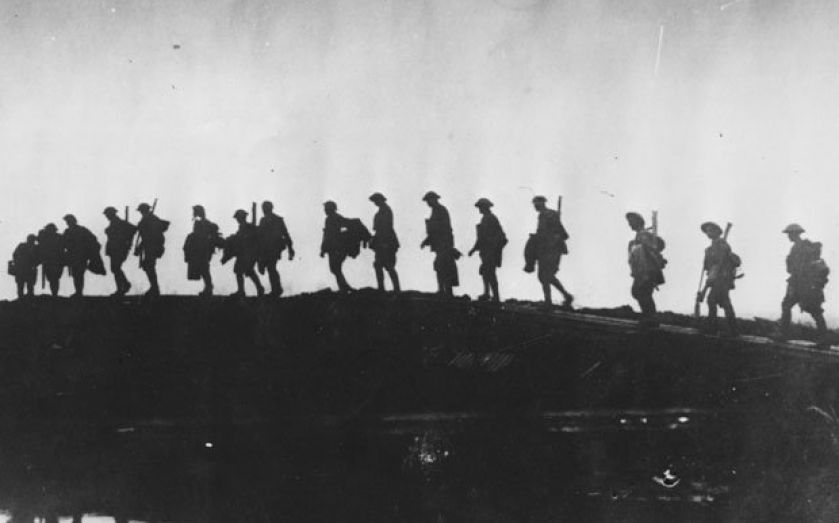
When war was declared in August 1914, over 1,600 City workers joined up to create the London Stock Exchange Battalion of Royal Fusiliers (unofficially known as “the Stockbrokers”). The Tower of London served as one of London’s two recruiting centres for troops, and continued to serve as a military depot throughout the war.
Sir Henry Rawlinson, then director of recruiting, wrote in a letter on 12 August 1914 that “many City employees would be willing to enlist if they were assured that they would serve with their friends”. Recruiting began on 21 August, when 210 men presented themselves. The following day this number increased to 425, to 900 on the 24th, 1,300 on the 25th and reached 1,600 by the 27th.
The City employees who volunteered came from all walks of life; some from the privileged banking families of the day, while others were ordinary insurance, shipping and bank clerks. Those from wealthier backgrounds could have applied for commissions to be officers, but many preferred to avoid the lengthy training this would have entailed. Several partners from Brewin Dolphin, then known as Christie & Brewin, chose to enlist in the Battalion.
The Stockbrokers were sworn in by the lord mayor, who afterwards became honorary colonel. The Battalion received further support from the City Livery companies, who helped finance weapons and instruments to be used during the campaign.
Following a period of training at Colchester, the Battalion was sent to France in July 1915. Over the next three years, its members fought at the Somme, Ypres and against the German Spring Offensive in 1918, before helping to push the Germans back into retreat through France. Four hundred stockbrokers failed to return.
While the Stockbrokers Battalion crossed the channel to mainland Europe, other members of the Brewin business remained on the home front and, in an echo of the lord mayor’s words, tried to proceed with business as usual. This included protecting clients’ assets, with clerks taking home the ledgers in the evenings to ensure that they remained safe from the first ever air bombardments over London by the German Zeppelins.
These Zeppelins, and later bombers, are often overshadowed by the Second World War Blitz in the public imagination, but they nonetheless caused widespread panic, damage and many casualties. Sixty-one Farringdon Road was destroyed by a Zeppelin bomb, and another Zeppelin raid dropped a bomb in Lincoln’s Inn, both too close for comfort for Christie & Brewin, which was then located in Fleet Street. The resulting blackouts were detrimental to both factories and offices, affecting wartime production.
Further, the prospect of war in July 1914 had an immediate impact on the markets. Investors flocked to the Bank of England in the hope of exchanging paper money for gold, liquidity dwindled, and interest rates shot up – a scenario which Mervyn King, former governor of the Bank of England, once likened to the 2008 crisis.
The Stock Exchange closed for six months from July 1914, and although it reopened in January 1915, deals were only permitted between 11am and 3pm. Commercial banks followed the Stock Exchange’s lead, and also shut up shop for a week. The tight restriction on trading, paired with the capital issues embargo imposed by the Bank of England to support the pound during the interwar years, meant that New York increasingly rivalled London as the world financial centre.
The names of the soldiers who lost their lives in the Great War are inscribed on memorials found throughout the City. The hundredth anniversary of the month when Britain joined the war, and the month when the Stockbrokers Battalion was formed, seems a particularly apt moment to reflect not only on their sacrifice, but also on that of all the City workers and inhabitants who left the Square Mile to go to war, but did not return.