Mapping the world’s super-ageing countries: Shock data shows which nations are growing old fastest

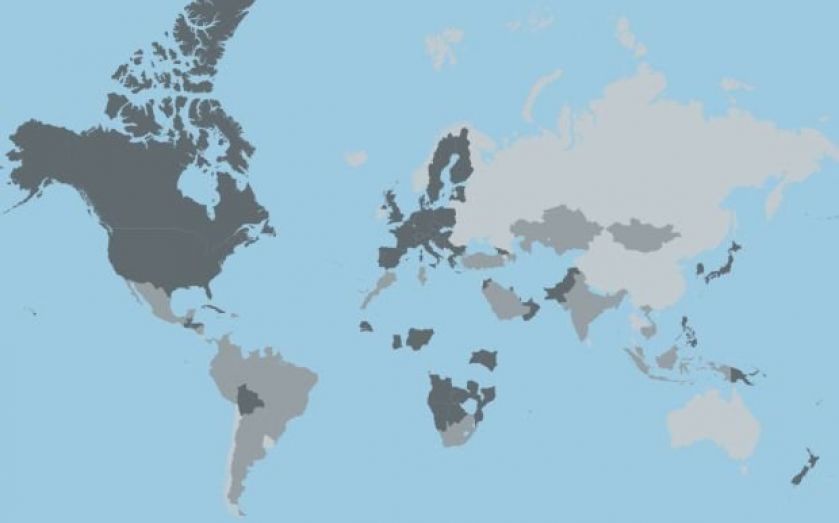
The world is becoming a grey planet.
By the United Nations's (UN) definitions, 60 per cent of the countries rated by Moody's will be ageing in 2015.
By 2020, 13 countries will officially be super-ageing, a huge increase on the three countries that qualify as super-aged today. By 2030 there will be 34.
The UN ranks a country as ageing if seven per cent of its population is over 65, while a super-aged country has over 20 per cent of its citizens above that threshold.
The UK will hit the 20 per cent barrier in 2020 while Japan, Italy, Germany, Finland and Greece will be over that mark by next year.
In the map below the colours are based on next year's percentages. Click on a country to see the data. On the desktop version you can change layers to view the data for 2015, 2020, 2025 and 2030.
To scroll down on mobile, please swipe down on the right hand side of the map.
Ageing is often considered to only be a problem in the developed world, but many developing world countries are already listed as ageing; Argentina, Brazil, Chile, China, Russia, Thailand, and Turkey are already in the bracket, as the map shows.
Countries like Japan and China face huge problems. Japan has the oldest population on Earth, while China's one-child policy has skewed the age demographics. India, on the other hand, looks set to become a huge global economic player by virtue of its youthful population, if it can improve its crumbling infrastructure and remove certain barriers to business.
Ageing will create severe economic problems, according to Moody's. There will be a slowdown in the growth of working age populations when compared to the last 15 years, which will affect labour supply. The working demographic will continue to grow, but by 13.6 per cent instead of 24.8.
The only countries to escape this trap will be "a handful in Africa", while 16 countries will see a decline of over 10 per cent in their working-age population in the same period.
Moody's also sees the ageing world as meaning a reduction in investment:
Population ageing will also reduce household savings rates, which will reduce investment. Academic estimates indicate that a one percentage point (pp) rise in the old age dependency ratio (ie the ratio of population aged 65+ to the population 15-64) will lead to a 0.5-1.2 pp decline in the average savings rate.
These developments, say the researchers, will lead to "significantly lower" economic growth.
The Conference Board estimates that due to aging aggregate annual growth rates will decline by 0.4 pp during 2014-19 and by 0.9 pp during 2020-25 from the 1990-2005 average annual growth rate of 2.9%
The report also offers some solutions to the grey planet. Governments should work towards labour market participation, encourage immigration and incite the influx of capital in order to partially mitigate the problem.
The changing hierarchy
The countries with the highest percentage of people over 65 won't change too much in the next 15 years.
The country on the 2015 list with the lowest percentage of over-65s is the United Arab Emirates, which is joined in the bottom five by three other Gulf states: Kuwait, Bahrain and Qatar. Angola joins them.
Come 2030, Africa will makes up four of the same five spots, with only the UAE hanging in there. Portugal and Hong Kong are ageing quick enough to muscle their way to the top.
As for the United Kingdom, we can expect to have 18.1 per cent of the population over 65 by next year, rising to 18.9 per cent by 2020, 20.0 by 2025 and 21.7 per cent by 2030.