| Updated:
Business lessons from Formula 1: Have you overloaded on talent?

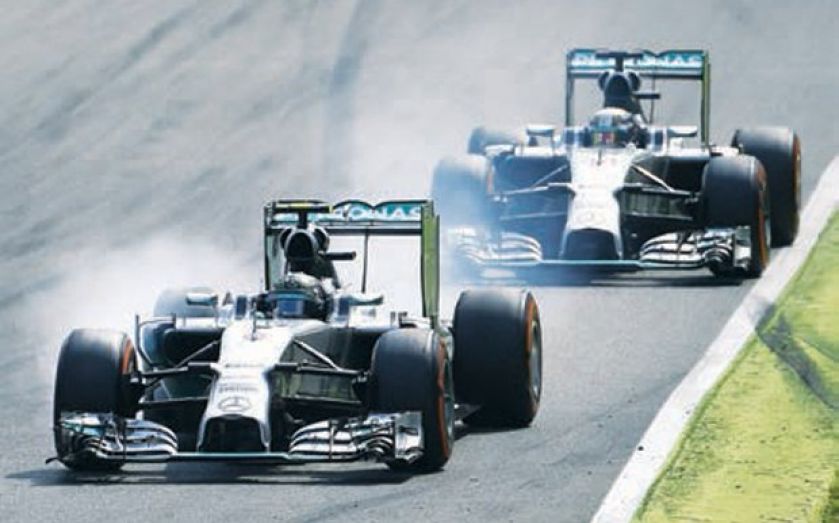
Paolo Aversa explains what Formula 1 can teach business about the perils of having too many star performers.
You pack your team full of high-fliers and wait for profits to take-off. But instead of hitting new heights, the team spirals into a nosedive. The reason? You overloaded on talent. It sounds counterintuitive (surely recruiting the brightest leads to blazing success?), but research tells us that individual performance can plunge when there are too many star performers in a galaxy.
NEED FOR SPEED
After analysing every Formula 1 driver in all races between 1981 and 2010, research led by Cass Business School found that individual driver performance declined in teams with two top ranking drivers. In other words, hiring too many stars can take the shine off performance.
Away from the racetrack, the findings shed light on why teams with high-flying employees do not always hit the heights of their past promise, and why star performers at one firm fade when they are lured to another. A typical mistake in assembling a team is to consider it as a mere sum of the quality of its individual parts. But team success is based on internal coordination and collaboration. Accordingly, when two talented professionals end up in the same organisation, they can turn what looked like a promising partnership into a fight for internal supremacy.
SIZE SQUABBLE
A clash of egos is one obvious reason for the decline of individual and team performance. When there’s more than one rooster in the henhouse, managers can either favour one of the employees – in order to avoid internal conflict – or refuse to side with either – thus promoting internal competition. But neither options entails a positive outcome. The first tends to demotivate both team members as the favoured employee eases off their rivalry, and the ‘defeated’ colleague loses their ambition by no longer being permitted to compete.
In the second case, where the team promotes internal conflict, the resulting antagonism often leads to the failure of intra-team collaboration, eventually triggering an aggressive duel to the detriment of one or both employees. The clash between Steve Jobs and Steve Wozniak in the early days of Apple is a good example. The US technology company looked a promising venture from the start, but Jobs fled after fierce confrontations with his associates.
Jobs’s comeback was only successful because he restarted as absolute leader, and his “team” was focused on making the best out of his genius, rather than being riven apart by the internal competition between two talented leaders.
PERILS OF FAVOURITES
A clash of egos is an obvious hazard for a star-studded team but just as harmful to performance is the inefficient use of resources. In teams with two top dogs, the obvious response is to split available resources equally between the rivals. But attempting to be fair leaves the team hamstrung.
By carefully weighing the impact of favouring one employee over another, teams slow down their decision-making process. In hyper-competitive settings, where teams need to focus their resources quickly and respond to change in the competitive market, getting bogged down in internal politics can sap a team’s energy and performance.
But before you issue P45s to your portfolio of stars, there are ways to manage teams top-heavy on talent. A good strategy is a clear strategy. If you employ two star individuals, you have to make each aware of where they stand from day one. And if their performance still fails to leave the ground, remind them that every ace needs a wingman.
Dr Paolo Aversa is an assistant professor of strategy at Cass Business School, City University London. Why do high status employees underperform? A study on conflicting status within Formula 1 racing was co-written by Aversa, professor Gino Cattani (Stern Business School, New York University) and Dr Alessandro Marino (management department, Luiss University, Rome).
Be more productive
£13.99
If you need to streamline how you work, breaking tasks down into manageable steps, OmniFocus can help. You can organise tasks by goals, synchronise multiple copies of work, and send items from other apps. You can also view your to-do list in a handy map form, turn on notifications and use Siri with the app.