20 years on from 9/11: the waxing and waning of the US-UK ‘special relationship’, from Bush to Biden

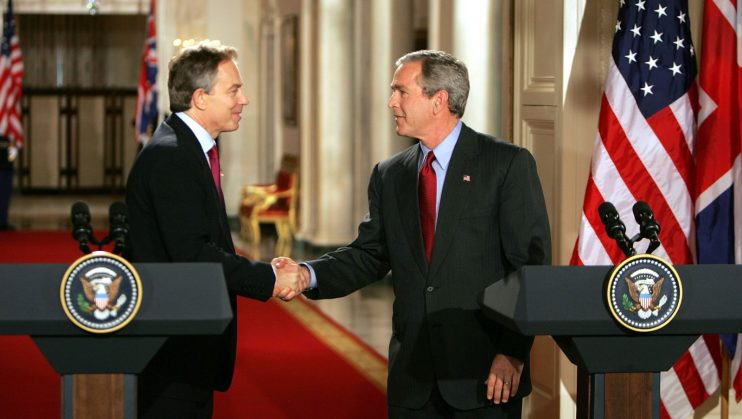
Twenty years on from one of the greatest days of infamy to strike the Western world, the attack on the 9th of September 2001, there are myriad points to reflect on, not least the ongoing heartache it has left on our collective psyche. One of those, though, should surely be the impact that this great tragedy has had on the course of British-American relations, with our two countries joined in lockstep together on the war against terror. The effects have been seismic.
9/11 was an inflection point that shook the world out of the cosy complacency of the 1990s. With the defeat of communism and Cold War tension receding, it was all too tempting for the West to convince itself that the “end of history” was nigh; that we could reap a peace dividend from the absence of an ideological counterweight to liberal democracy and capitalism.
US-UK relations, so resolute during the 1980s, sank to extraordinary lows in the first post-Cold War trauma in Bosnia, where British pusillanimity and American vacillation in the face of the genocide of Muslims in Europe led to strained relations. Even when the ideological bedfellows Tony Blair and Bill Clinton got together to counter Serbian aggression in Kosovo in 1999, there was a sense of uncertainty about where the so-called “special relationship” might be heading, particularly as by all accounts it was Blair dragging a still-reluctant Clinton into action rather than a shared sense of mission.
All this changed when Osama bin Laden’s sycophants flew their planes into the Twin Towers and Pentagon on that fateful morning. Suddenly, ideological conflict had returned front and centre to the international domain, and with it an immediate call to transatlantic action.
George W Bush may have been elected on a domestic policy platform, with foreign policy as a distant afterthought, but there was never any doubt about how a US President of any variety would respond to such an attack on American soil. NATO’s solidarity as a whole was evident with the invocation of Article 5 to support US self-defence. Tony Blair’s role proved pivotal as primus inter pares of the supporting coalition, as evidenced by his forging of one of the more unlikely political double acts in history with the folksy Texan.
And so the die was cast for the next decade of US-UK cooperation. Brothers in blood and treasure once more in Afghanistan and then Iraq, the two sides appeared inseparable, in their sharing of combat operations and casualties.
But beneath the surface, huge change was afoot. The failure of the “forever wars” to end successfully – or even to just end – led to a diversion between the British-American joint mission as practiced on the ground in theatres of war and the importance placed on transatlantic solidarity when it came to statements of intent in other places.
In retrospect, the defining moment in the slow decline of the Special Relationship – at least in rhetorical form – was Barack Obama’s defeat of John McCain in the 2008 US Presidential election.
McCain was the internationalist’s internationalist, who would have inaugurated a new era in British-US cooperation. Obama on the other hand, represented a completely different dynamic in both US and global political outlooks. His administration was about as interested in an enhanced role for the UK as Obama was personally in maintaining the bust of Winston Churchill in the Oval Office.
He and David Cameron may have forged a successful working relationship, but it was no longer on an ideological basis. Over the eight years of Obama, the UK came to the unfortunate realisation on issues ranging from Libya, Syria to Iran that its views were of limited importance to an American partner keen to “lead from behind” and reeling from the repercussions of ongoing overseas conflict in its tumultuous domestic politics.
And then there was Trump. “America First” was born out of the misplaced idea that America overseas was somehow “America Last”, but it also signalled the end of any pretence that the relationship we once knew as axiomatic post-9/11 would return. And with the UK’s domestic politics undergoing their own seismic ructions with Brexit and Corbynism moving the country to a very different place from the UK of 2001, the pattern became fixed.
In truth, the UK and US may only just have left Afghanistan together in a physical sense, but spiritually – and as evidenced in the chaotic and unilateral nature of that withdrawal – we have been absent from each other’s side for some time.
Twenty years on from 9/11, many things have indeed become apparent about the nature of our world. The waxing and waning of the most successful alliance in recent history will prove to be one of the most important. It will be up to the leaders of tomorrow to decide where the relationship goes hereon and whether our tomorrow proves yet brighter than our yesterday.