Skip to content
Tuesday 11 August 2026London --:--Frankfurt --:--Zurich --:--
NewslettersSearchEN · DE
MorningWire

European business, markets and politics

FTSE 100
10,856.70
-0.05%
DAX
26,425.04
+0.38%
CAC 40
8,727.72
+0.02%
STOXX 50
6,561.65
+0.40%
  • Europe
  • Markets
  • Business
  • Economy
  • Technology
  • Politics
  • Opinion
More
GermanyFranceBankingAIEnergyFintechPropertyCapital Markets
  • Germany
  • France
  • Europe
  • Markets
  • Business
  • Economy
  • Technology
  • Politics
  • Opinion
  • DE
Thursday 18 December 2014 5:43 am

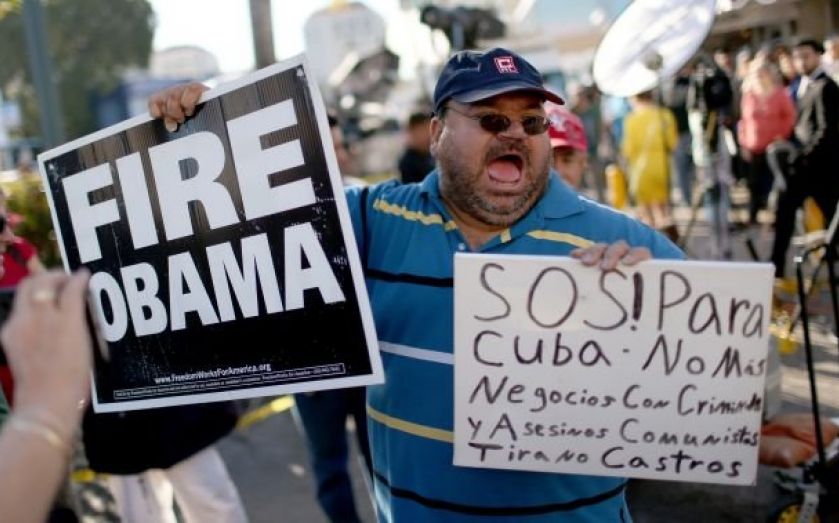
How will the end of the US-Cuba trade embargo affect the two countries?

By: Catherine Neilan

Add as a preferred source on Google

With Russia's economy imploding after several months of economic sanctions (and the small matter of falling oil prices), the timing of the end to a 50-year-old trade embargo between the US and Cuba could not be more interesting. 
 
In the short term, analysts do not expect much impact on either the US or Cuban economies. But there are still some industries in both countries that stand to benefit. 
 
Much of the Communist country's trade is still controlled by the state, and the populace has limited disposable income, so businesses hoping to see a quick boost to imports will probably be out of luck. 
 
“We’re not looking at a large impact on Cuba,” Christopher Sabatini, senior policy director at the Americas Society and Council of the Americas, told International Business Times. “For the U.S. economy, these changes will be minimal, too.” 
 
Cuba's economy is still expected to grow at less than three per cent next year, and the lifting of the trade embargo “doesn't address the multuple distortions and structural hurdles” it faces, Sabatini said. “Cuba has not become an investment paradise.”
 
However, the fact remittances – the amount of money Cuban-Americans can send back to their homeland – have been quadrupled from $500 to $2,000, which could see a huge increase in consumer spending. 
 
 "This particular measure is a sign to promote the sending of money and investment and other kinds of support for the fledgling private economy in Cuba," Jorge Duany, director of the Cuban Research Institute at Florida International University, told the BBC. He notes employment in that sector has already grown to nearly half a million people. 
 
The tourist industry in Cuba stands to benefit as the agreement relaxes travel between the two countries, though not completely.  The new limit for US travellers bringing Cuban goods back home – $400 per person, of which $100 can be alcohol and/or tobacco products (ie rum and cigars) – means that initially at least, there is unlikely to be a huge increase in demand for the country's two most iconic products, but it could well set the ball rolling. 
 
Meanwhile US telecoms firms could benefit in the longer term from the opening up. Obama referenced the fact that Cuba had failed to benefit from technological advances because of the trade embargo. 
 
The BBC also tips US agribusiness as benefiting, given Cuba's relatively high food imports (60-65 per cent of the country's food).

Share this article

  • Facebook
  • X
  • LinkedIn
  • WhatsApp
  • Email

Similarly tagged content:

Sections

  • News

Categories

  • Business

Trending Articles

  • Five-star Mayfair hotel hit with HMRC winding-up petition

  • Nottingham Forest owner Marinakis sues Crystal Palace for defamation

  • Back to basics: Sainsbury’s gradual retreat from the British high street

  • Hargreaves Lansdown orders staff back to office

  • As it happened: Intel, Arm shares slide; Oil climbs higher

More from Morning Wire

  • UK inks trade deal with Switzerland – despite shouting match

    Politics
    UK and Switzerland officials signing a trade deal, highlighting international services agreement and bilateral cooperation
  • Singapore on Thames or the Sick Man of Europe?: The Economics of Brexit Ten Years from the Referendum 

    Opinion
    UK-EU Brexit negotiations meeting with officials discussing trade agreements and policy impacts in a formal conference room
  • ‘Moron premium’ – Westminster turmoil has ‘cost taxpayers £35bn’ since 2022

    Politics
    Westminster Houses of Parliament under clear sky, iconic London landmark representing UK government and politics
  • Interactive Brokers Builds Out One of the Most Comprehensive and Low-Cost Solutions for Accessing Cryptocurrency Available

    Business Wire
  • Interactive Brokers Adds Brazilian Futures through Brazil’s B3 Exchange

    Business Wire
  • UK government backs British business to get slice of £33bn in Morocco World Cup contracts

    Sport Business
    Getty Images logo displayed on a modern digital screen, representing media and stock photography in a business context.
  • Sport documentaries muddle grey area of storytelling vs reality

    Sport Business
    Alex Albon of Williams Racing giving an interview, with a camera crew nearby and Atlassian branding visible.
  • Brits wary of EU summer hols as officials refuse to ease new border checks

    Transport & Infrastructure
    Airport delays in Spain
MorningWire

Independent European business, markets and political news for decision-makers.

Morning Briefing

Europe

  • Germany
  • France
  • Europe
  • UK & Ireland

Business

  • Markets
  • Banking
  • Technology
  • Energy
  • Property
  • Fintech

Editorial

  • Opinion
  • Editorial Policy
  • Corrections
  • Contact

Company

  • About Morning Wire
  • Privacy Policy
  • Terms of Use
  • Cookie Policy
© 2026 Morning Wire Ltd · Published by Morning Wire Media, Bahnhofstrasse 65, 8001 Zürich, Switzerland
Privacy · Terms · Cookies · Facebook