Seven charts explaining what’s going on in Greece right now

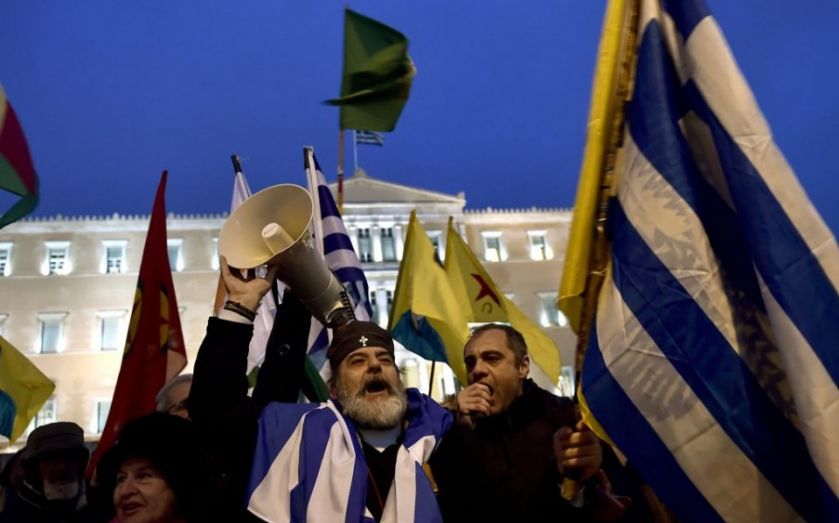
Emergency talks between the new Greek government and finance ministers from 19 Eurozone countries descended into chaos last night, with the group unable to even agree on a joint statement as talks drew to a close.
Today's meeting of European leaders in Brussels is now expected to be particularly awkward.
With Germany vehemently opposed to any kind of relaxation of Greece's debt conditions and an agreement over its bailout looking further away than ever before, relations between German Chancellor Angela Merkel and new Greek Prime Minister Alexis Tsipras are expected to be particularly frosty.
But what's actually happening in Greece? Here's everything you need to know, in charts.
1. The last time we worried about a Grexit was in 2012 – but that was nothing on today

The Greek debt crisis of 2012 prompted fears Greece would default on its debts and exit the Eurozone – although the crisis was narrowly averted when its creditors agreed to give the country two years to meet its target of achieving a budget surplus of 4.5 per cent.
But now the term is back with a vengence, after Tsipras, the leader of anti-austerity party Syriza, decided the terms of the bailout are crippling Greece's economy. You can see why.
2. Total debt as a percentage of GDP is pretty big

The figure is now estimated to be around 177 per cent of GDP. Syriza wants at least a third of that to be written off, but although it is said to have created a 10-point plan to that effect, Eurozone leaders don't seem to be biting.
However, Greece is holding up better when it comes to quarterly figures.
3. Meanwhile, the cost of that debt is increasing

Although the cost of borrowing is nowhere near the 40-odd per cent experienced during the height of the debt crisis, yields on 10-year bonds have crept above 10 per cent in recent weeks. That means the cost of servicing its debt is becoming increasingly expensive.
4. Part of Greece's bailout agreements is to meet budget surplus targets

The Greek government is expected by its troika of lenders – the European Central Bank, the European Commission and the International Monetary Fund (IMF) – to make more than it spends (not counting debt payments).
This year, that's supposed to be three per cent of GDP, or €5.6bn according to maths by the IMF, rising to 4.5 per cent – or €8.9bn followed by €9.3bn – in the next two years.
But as part of the new government's anti-austerity drive, finance minister Yanis Varoufakis wants to cut that to somewhere between one and two per cent.
5. Government revenues have actually fallen since 2012

But the same IMF report shows that despite a harsh austerity programme, the Greek government's income has actually fallen since the debt crisis, and is unlikely to rise back to the same level until 2017.
As the report is from last year, the figures from 2014 onwards are projections.
6. … and Tsipras wants to call a halt to Greece's privatisation programme

Having made €4.1bn between 2011 and 2014, government privatisations had been expected by the IMF to raise another €8.5bn for public coffers over the next three years.
7. Meanwhile, growth is still anaemic

Figures released by the OECD in November last year forecast growth of just 0.8 per cent last year, rising to 2.3 per cent this year. For Tsipras, the challenge will be to boost that figure as much as possible, in order to reduce crippling unemployment, which still stands at close to a quarter of the population.