Skip to content
Friday 14 August 2026London --:--Frankfurt --:--Zurich --:--
NewslettersSearchEN · DE
MorningWire

European business, markets and politics

FTSE 100
10,772.67
-0.56%
DAX
26,299.74
0.00%
CAC 40
8,650.56
0.00%
STOXX 50
6,545.47
0.00%
  • Europe
  • Markets
  • Business
  • Economy
  • Technology
  • Politics
  • Opinion
More
GermanyFranceBankingAIEnergyFintechPropertyCapital Markets
  • Germany
  • France
  • Europe
  • Markets
  • Business
  • Economy
  • Technology
  • Politics
  • Opinion
  • DE
Thursday 27 February 2014 7:19 am

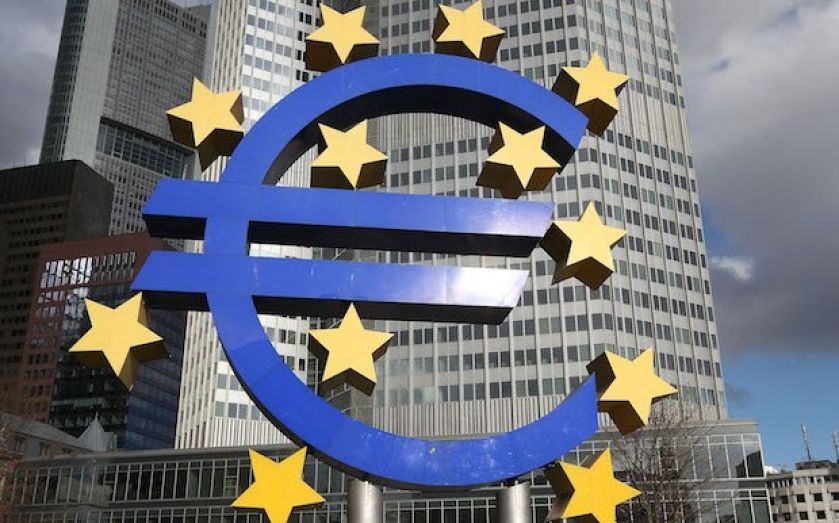
The €400bn question: Will the Eurozone go for QE?

By: Harriet Green

Add as a preferred source on Google

A Eurozone quantitive easing (QE) programme is now anticipated by BNP Paribas, one of France’s biggest banks. It follows Fathom Consulting, which has been suggesting a similar scheme since January.

BNP Paribas suggest the programme would be around €300-500bn (£246-410bn) – small in comparison to schemes in Japan, the UK and US, but a major step for the European Central Bank (ECB), bound by the political concerns of a multi-national union. 

Both organisations agree that the ECB should aim for German bonds, with BNP Paribas saying that capital-key weighted purchases would achieve this, as over a quarter of a Eurozone QE programme would be distributed to Germany. It lays out what a €400bn QE policy might look like.

BNP Paribas suggests that German debt should effectively be removed from the market: “The ECB would push investors into other assets, which would probably lower risk premia.” Fathom Consulting also “see great merit in a programme skewed towards outright purchases of German government debt.”

The cases made for QE

Terrible nominal growth

Even assuming that the natural trend growth is quite low, with real GDP growth of 1-1.5 per cent, and inflation of 1.75-2 per cent, this would imply 2.75-3.5 per cent nominal GDP growth. If the Eurozone had grown at such a rate since 2009, BNP Paribas shows that output would have been €475-760bn higher.

Debt sustainability

Fathom highlights the fact that below-target inflation will make servicing debt, not just for small peripheral economies, but for some of the union’s largest nations.

It does not take outright deflation to pose an existential risk to the single currency. Current market pricing suggests that Italian inflation is expected to average 0.6-0.7 per cent over the next three years. If realised, that would be sufficient to put Italian debt, as a proportion of Italian GDP, on an unsustainable path.

A €1.6 trillion money supply shortfall

Eurozone money supply growth is now by far the lowest of the largest advanced economies.

The growth rate in M3, for example, has been running below (generally well below) the ECB’s former reference value – of 4.5 per cent year on year growth – since mid-2009… In the period from mid-2009 to end-2013, the cumulative increase in M3 should have been in the region of 20 per cent, on the basis of the former reference rate. In reality, M3 rose by around four per cent. The implied shortfall equates to around €1.6 trillion, or some 17 per cent of GDP.

Similarly, the ECB’s balance sheet has actually fallen considerably, dropping even further as a portion of GDP, back towards levels last seen before Draghi was governor.

Share this article

  • Facebook
  • X
  • LinkedIn
  • WhatsApp
  • Email

Similarly tagged content:

Sections

  • News

Categories

  • Business

Related Topics

  • Eurozone

Trending Articles

  • Revolut takes flight with launch of new airport lounges

  • It’s not just Jason Arday, most of sociology is a scam

  • IT consultant ordered to pay £50,000 after being accused of stealing Soho House members’ personal details

  • Grandparents fund university degrees to avoid inheritance tax net

  • Five-star Mayfair hotel hit with HMRC winding-up petition

More from Morning Wire

  • Astrazeneca explores $400bn megadeal with US rival 

    Markets
    AstraZeneca building exterior with logo, glass facade, UK flag, and wildflowers in foreground.
  • Bank of England to hold interest rates as oil price surge threatens UK economy

    Economics
    Bank of England building on Threadneedle Street, London, showcasing its historic architecture and financial significance
  • Astrazeneca share price tumbles on $400bn megamerger talks

    Investing
    Astrazeneca headquarters with logo, reflecting commitment to reduce US medicine prices after Trump administration pressure
  • RS2 Financial Services GmbH Selected to Participate in ECB Digital Euro Pilot

    Business Wire
  • As it happened: UK stocks cool after Astrazeneca drags; Trump and Iran clash over peace talks

    FTSE 100 Live
    Donald Trump speaking at a desk, gesturing with hands, wearing a dark suit and red tie.
  • Revolut will become $1 trillion company by 2035, says early VC backer

    Fintech
    Revolut London office glass facade with prominent R logo reflecting cityscape, highlighting modern fintech design
  • ‘Social value’ procurement rules are an absurd waste of time and money

    Economics
    Tunnelling for the Euston link finally kicks off this week.
  • Why even gilts are outperforming the once unstoppable Magnificent 7 this year

    Markets
    Depiction of the Magnificent 7 tech companies experiencing financial decline, with stock charts showing negative trends
MorningWire

Independent European business, markets and political news for decision-makers.

Morning Briefing

Europe

  • Germany
  • France
  • Europe
  • UK & Ireland

Business

  • Markets
  • Banking
  • Technology
  • Energy
  • Property
  • Fintech

Editorial

  • Opinion
  • Editorial Policy
  • Corrections
  • Contact

Company

  • About Morning Wire
  • Privacy Policy
  • Terms of Use
  • Cookie Policy
© 2026 Morning Wire Ltd · Published by Morning Wire Media, Bahnhofstrasse 65, 8001 Zürich, Switzerland
Privacy · Terms · Cookies · Facebook