Skip to content
Monday 14 September 2026London --:--Frankfurt --:--Zurich --:--
NewslettersSearchEN · DE · FR
MorningWire

European business, markets and politics

FTSE 100
10,707.67
+0.54%
DAX
25,408.09
-0.63%
CAC 40
8,117.89
-0.76%
STOXX 50
6,261.97
-1.00%
  • Europe
  • Markets
  • Business
  • Economy
  • Regulation
  • Politics
  • Opinion
More
GermanyFranceEU InstitutionsCompetitionPublic AffairsBankingTechnologyEnergy
  • Germany
  • France
  • Europe
  • Markets
  • Business
  • Economy
  • Regulation
  • Politics
  • Opinion
  • DE
Wednesday 08 September 2021 2:00 pm  |  Updated:  Wednesday 03 November 2021 3:09 pm

A service economy and shrinking workforce is the driving force of low economic growth

By: Paul Ormerod

Add as a preferred source on Google
UK Hospitality Suffers Skills Shortage
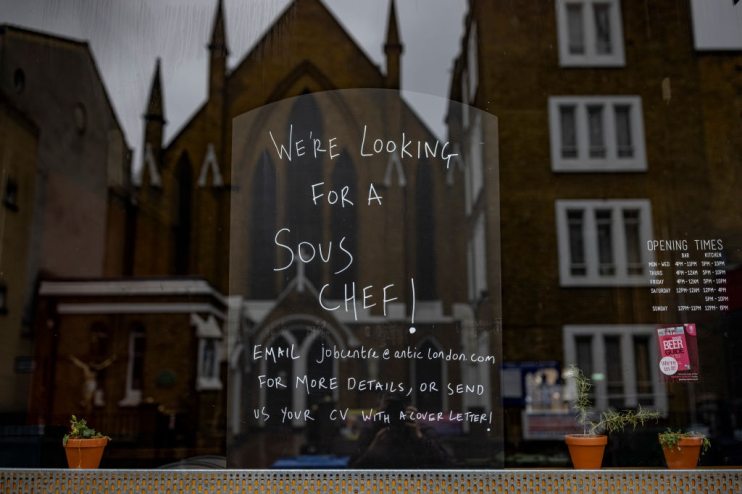
A noticeboard advertising a vacancy for a sous chef is seen in the window of in Deptford, South London, England. (Photo by Rob Pinney/Getty Images)

Extinction Rebellion’s fortnight of protests have only hardened existing beliefs and positions on both sides of the debate.

But a book by Dietrich Vollrath of the University of Houston suggests that there may be much broader support for a low or even zero growth agenda than even XR might imagine.

Vollrath does not address this question directly.  His work is an attempt to explain why economic growth in the West has been so feeble over the past 10 or 15 years.

The title of the book summarises Vollrath’s message: “Fully Grown: Why a Stagnant Economy is a Sign of Success”.

In the decade or so since the financial crisis, GDP growth in the Western economies has been unprecedentedly low by historical standards.  

Most policy makers and commentators view this with concern. However, the author argues that we should not be worried.  On the contrary, for him, it is an unequivocally Good Thing.

This is because, in Vollrath’s view, very low growth can be explained by the preferences of individuals.  Implicitly, in the West we have already chosen the path of low growth.

His analysis is based on the standard growth model in economic theory.  Growth in output depends upon growth in the two main inputs into the productive process – labour and capital,  along with innovation.

Read more

Manufacturers overcome gloomy economy as output surge continues

Manufacturing sector faces mounting tribunal pressures amid economic uncertainty

Vollrath’s main argument is that there has been a dramatic slow down in the amount of labour which is being used to produce goods and services.

Vollrath uses the more technical term “human capital”.  He constructs a sophisticated index, which suggests that its value has even fallen since 2000 in the United States.

A key reason for this is that people increasingly prefer more leisure rather than more income by working– a point highlighted by the current debate about working from home after the pandemic.

The improvement in women’s rights decades ago enabled women to choose both to have smaller families and to go out to work. The expansion of the latter by the Baby Boomers has come to an end in the 21st century. And smaller families have led to lower growth in the  workforce.

Vollrath also revives an important argument made over 50 years ago by Nobel Laureate William Baumol.  It is inherently easier to raise productivity – and therefore growth – in the manufacturing sector than it is in services.  

But increasingly, we choose services rather than goods.  This switch slows growth down.

There are several serious counter arguments which Vollrath dismisses too lightly.  For example, we may be suffering a monumental and persistent hangover from the financial crisis, which is just depressing our animal spirits, as Keynes once put it.  National account statisticians may not be placing enough value on innovative products such as smartphones.

But it is nevertheless an intriguing book.  The collective consequences of our individual choices on what we spend our money on, how many hours and weeks we want to work, and how many children to have – these all translate eventually into very low growth.  Have we all done XR’s work for them?

Read more

Give London power to level up the rest of the country

Business professionals in formal attire engaged in a lively discussion at a corporate meeting in a modern office setting.

Share this article

  • Facebook
  • X
  • LinkedIn
  • WhatsApp
  • Email

Similarly tagged content:

Sections

  • Opinion

Categories

  • Opinion

Trending Articles

  • Wetherspoon boss: ‘Not up to Burnham’ to choose who is on the high street 

  • Reform hits back at Tory plan to ‘abolish inheritance tax’

  • Four interest rate hikes loom despite surprise economic growth

  • Lotus, Porsche and Corvette: the best sports cars to buy in 2026

  • FTSE 100 Live: Tech stocks lead City rally; Oil at four-month high

More from Morning Wire

  • Manufacturers overcome gloomy economy as output surge continues

    Industrials
    Manufacturing sector faces mounting tribunal pressures amid economic uncertainty
  • Give London power to level up the rest of the country

    Opinion
    Business professionals in formal attire engaged in a lively discussion at a corporate meeting in a modern office setting.
  • Iran war could ‘halt growth’ across UK economy 

    Economics
    Andy Burnham, Mayor of Greater Manchester, in a dark suit and glasses, listening intently at a wooden table.
  • UK economy stuck in ‘slow lane’ as business investment to slump 

    Economics
    Westminster Parliament building under a clear sky, showcasing its iconic architecture in a news context.
  • 22 months of cuts: Jobs crisis deepens despite growth boost 

    Economics
    London has defied national trends as job postings in the capital rose.
  • UK economy to ‘reverse gains’ as construction drags growth

    Economics
    Retail sales slowed in September
  • Four interest rate hikes loom despite surprise economic growth

    Economics
    Andrew Bailey, Governor of the Bank of England, speaking at a press conference with the logo in background.
  • Hammersmith Bridge is a test for Burnham’s place-based growth

    Opinion
    Hammersmith Bridge closed in 2021 with fencing, banners, and traffic cones blocking access to the walkway.
MorningWire

Independent European business, markets and political news for decision-makers.

Morning Briefing

Europe

  • Germany
  • France
  • EU Institutions
  • Europe

Business

  • Markets
  • Business
  • Economy
  • Regulation
  • Competition
  • Public Affairs

Editorial

  • Opinion
  • Editorial Policy
  • Corrections
  • Contact

Company

  • About Morning Wire
  • Privacy Policy
  • Terms of Use
  • Cookie Policy
© 2026 Morning Wire Ltd · Published by Morning Wire Media, Bahnhofstrasse 65, 8001 Zürich, Switzerland
Privacy · Terms · Cookies · Facebook