Against trees: London’s fussy little parks are a waste of time and money

The buzzword ‘green’ nowadays adds kudos to any London planning project – even if it’s a potted plant next to a bus stop, writes Lucy Kenningham
It is a strange but endearing facet of life at this newspaper that when one’s gaze inevitably wanders towards the window – however hard one concentrates on the latest financial news – it will land upon troops of dancers on the balcony below. Whatever the time, whatever the weather, they groove on.
Young, agile hipped, occasionally armed with a whirling wooden rod, they perform complicated routines with meticulous accuracy, envious synchronisation and the boundless energy of the Tiktok-fame hungry young.
It is a strange sight because it seems so incongruous: young athletic teens spending hours of their lives in the Square Mile, with only undeserving business journalists there to witness their best jubislides. Yet over time one doesn’t just get used to it, one comes to expect it and even appreciate the imaginative use of a bland, ugly concrete block as a backdrop to the CitiRokk, the Smeeze and the Kangsta Wok (all viral dance trends, Morning Wire is told).
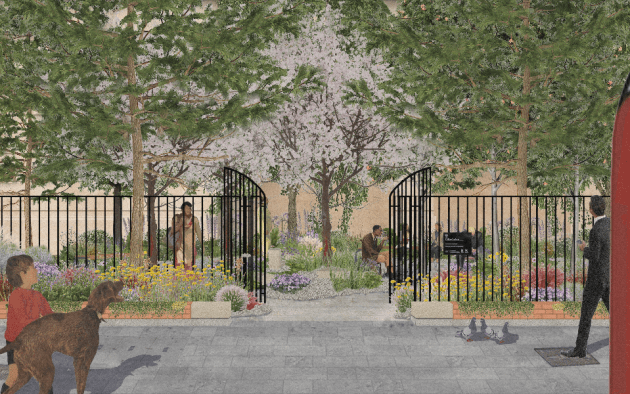
There is something deeply humanising about the misuse of space, or indeed the reappropriation of space, as well as something reassuring about space existing without a purpose. People will populate this “urban breathing room”, and engage with it in unpredictable ways. But urban planners and local authorities, understandably, can struggle with the concept. For instance, yesterday a new patch of greenery was announced. A small patch of concrete on Houndsditch in Canada will undergo a 10-month refurbishment to become one of these miracle-sparking ‘green spaces’.
It’s true that Jubilee Gardens in its current state is a little underwhelming, constituting concrete benches and “structured planting and box hedging” (albeit “to reflect the outlines of the surrounding buildings”).
But greening doesn’t come cheap, in this case costing Canada £680,000, despite the area measuring a mere 0.05 hectares. And what will it offer? Log and stone piles “to provide new homes to invertebrates”, new seating areas, “shrubs and perennials” and – wait for it – 15 new trees.
Who is to say what is ‘natural’ and what isn’t? One person’s ‘natural’ is a childhood high rise, another’s a country farmhouse.
It is deeply unfashionable to slam green urban projects, but Des Fitzgerald does so in disarming depth in his new book The City of Today is a Dying Thing. Fitzgerald is unafraid to pronounce that aside from not liking trees much, he also ideologically objects to “so many planners, architects and policymakers [being] so fixated on nature as the solution to all of the city’s problems” above other things. And he’s right: the buzzword ‘green’ nowadays adds kudos to any planning project – even if it’s a potted plant next to a bus stop.
“But the studies!”, tree huggers will cry. “The studies prove nature’s value!” It’s true: studies continually show nature improves mental health. For example, patients in Michigan were shown to recover quicker in hospital dorms with windows onlooking parks and Germans who live in more densely-populated areas were shown to have higher levels of stress whilst performing routine tasks.
Such scientific studies and the rise of climate awareness explain our fetish for greenification, which gives rise to projects like Melbourne’s ‘report a tree’ initiative where residents can phone a hotline to request tree maintenance, as well as the green-tinged refurbishment of the City’s Jubilee Gardens.
Yet, as Fitzgerald points out, these surveys are overly reliant on a concept of ‘nature’ that is in fact murky. Who is to say what is ‘natural’ and what isn’t? One person’s ‘natural’ is a childhood high rise, another’s a country farmhouse. Do you feel calmer in the woods? The number of factors at play here are enormous. But even if it were true, to project the results of such a survey onto a line of three birches in a carpark is a little fanciful.
Of course there is a strong environmental case for planting trees, which remove harmful carbon dioxide from the atmosphere. We urgently need more: but we need more than 15, and we don’t need them to be in the vicinity of Bishopsgate. What’s more, the carbon offsetting provided through tokenistic tree planting won’t get the UK to net zero by 2050; to pretend anything other is misleading at best, malevolent at worst.
It is also to inflate the role of “green spaces” at the neglect of other urban phenomena that are equally valuable to citydwellers’ relationship with place. Take blue space: rivers, canals, reservoirs even. Or incidental spaces: spaces that just happen to exist, by an accident of architecture. These provide the urban nooks and crannies reclaimed by would-be dancers as a place to jig and prance, as is the case in the balcony that adorns Morning Wire Towers.
Such unplanned interactions and opportunities capture the possibilities of urban life and give London to Londoners – more than any row of neatly planted trees ever could.