AI bubble will burst unless businesses can grow 25 times the size of Amazon

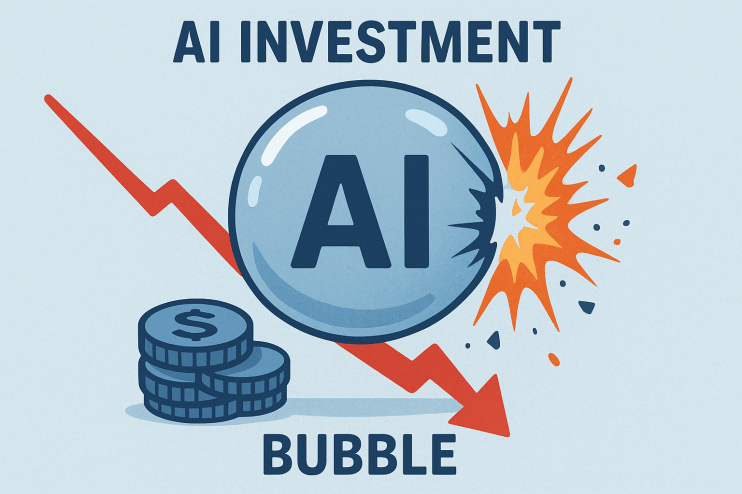
When numbers get large enough they cease to make sense, and the scale of investment in AI is already dwarfing the dotcom bubble, says Chris Clothier
Scarcely a day goes by without a new announcement of a huge sum of money to be spent on AI. In early October, Open AI, the company behind ChatGPT, announced a partnership with AMD worth “tens of billions of dollars”. Just before that they announced a deal with Nvidia for $100bn and back in September a deal with Oracle to spend $300bn. These are just OpenAI’s deals. The so-called Hyperscalers – Google, Amazon, Microsoft, Meta and the like – are expected to collectively spend around $500bn per year over the next few years on the build out of AI infrastructure.
We find this all very worrying.
Our first concern is a historical one. Every technological boom in history was accompanied by overinvestment which resulted in a massive misallocation of capital. The results have been similar on each occasion. Society benefited twice over, first from the deployment of a new technology (canals, railways, bicycles, automobiles, telecoms) and second from the oversupply which meant that the costs of that new technology to the end consumer was lower than it would otherwise have been. Those benefits came at the expense of investors who – mostly – did much worse.
It appears that these mistakes are being repeated. The scale of investment is truly astronomical dwarfing the Dotcom bubble. At its peak during the internet / telecoms boom of the late 1990s the annual capex in those sectors was $150 bn per year, roughly equivalent to “only” $300bn today.
Basic maths
We can do some basic maths to get a sense of what revenues would be needed to support the current investments. Assume that the collective spend is $500bn annually through to 2030. That means a cumulative spend of $3 trillion. Assume, charitably, that these assets will have an average life of 10 years. By 2030 that means the annual depreciation charge will be $300bn per year. Companies like Google Cloud and Amazon Web Services (AWS) are already providing AI compute. It seems reasonable to assume their business models offer a reasonable template. So that would suggest operating margins of 20-30 per cent of sales, depreciation of 10-15 per cent, with the balance as operating expenses (55-70 per cent). In turn that implies required revenues of $2-3 trillion per annum by 2030.
When numbers get large enough, I struggle to make sense of them. What does $2-3 trillion actually mean? Well, AWS is the market leader in the provision of cloud computing. It is also one of the most successful corporate “start-ups” in history. It was launched in 2006 and currently has revenues of around $125bn. So, to justify the investment would require growing new businesses the size of 16 to 24 times AWS’s in a little over 5 years.
Another way of thinking about it is through the prism of US GDP. Today it stands at around $30 trillion, $2-3tn represents between six and 10 per cent of GDP. Where would this spend come from? There are three possible sources. First, it displaces spend from other parts of the economy. Were this to happen then we should expect businesses outside tech in the US to suffer low or no growth as consumer and business spending is diverted.
Second, AI might be used to cut costs by displacing labour. Fretting over losing jobs to innovation is as old as the discipline of economics. Yet historically, such fears have been overblown: the farm and factory workers of yesteryear become baristas, personal trainers and software engineers of today. But a displacement on such a scale in such a short time would be unprecedented and therefore painful. The newly unemployed would doubtless find work eventually, but it would take time.
The third possibility is that the advent of AI results in a step-change in the economic growth rate which, in turn, finances the large expenditures required by the industry. That is what AI proponents hope. We are more skeptical. It reminds me of Robert Solow’s quip that “you can see the computer age everywhere but in the productivity statistics”.
What is more likely is that none of these outcomes happen and instead AI revenues dramatically disappoint. The public companies doing the spending on capex generate huge amounts of free cashflow. They will probably continue to generate lots of free cashflow from their core businesses in the future. So markets may overlook any misadventures just as they overlooked the $45bn that Meta spent on the “meta-verse” which, today, is essentially worthless. So this need not be an economic catastrophe. As Jeff Bezos observed this is a “good bubble” by which he meant that – unlike financial manias – the chips purchased, and the data centres built, will eventually be put to good use, even if they produce a poor financial return.
But there are two reasons for caution. First, by several estimates, AI related data centre spend is the only thing keeping US GDP in positive territory. If revenues disappoint and spending is curtailed then US growth could slow rapidly. Second, such disappointment would likely flow through to equity prices. With the US savings rate at historically low levels and private allocations to equities high, even a modest set-back in equity markets could result in a large reduction in end demand.
Chris Clothier is co-CIO and co-manager at CG Asset Management