Alex Salmond obituary: The Scottish firebrand who shook up British politics

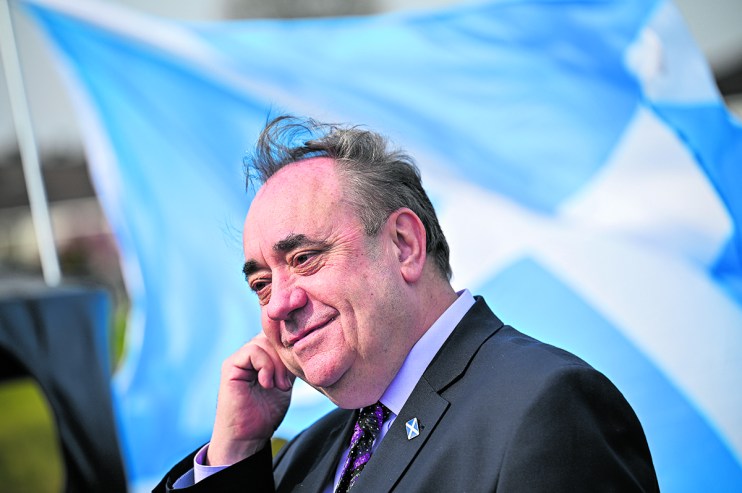
Alex Salmond (1954-2024)
Alex Salmond was the dominant figure in Scottish politics of the past three decades. He led the Scottish National Party for 20 years, was the first pro-independence First Minister of Scotland and brought about a referendum on the Union which ended his front-line career but put to bed any lingering notion that a separate Scotland was unimaginable.
Alexander Elliot Anderson Salmond could easily have been a figure of the Scottish establishment. The child of civil servants, he read economics and mediaeval history at the University of St Andrews before joining the Government Economic Service in 1978. Two years later, he moved to the Royal Bank of Scotland as an economist, where he specialised in the burgeoning oil sector.
He was already a prominent Scottish Nationalist. He had joined the party at university, when a row with his then girlfriend, the secretary of the Labour Club, ended with her telling him “If you feel like that, go and join the bloody SNP!” The next day he did. Salmond began on the left of the party, a founding member of the socialist and republican 79 Group, which was created after the SNP’s drubbing in that year’s general election. Only in his 20s, he was standing shoulder to shoulder with figures like Margo MacDonald, the party’s outspoken depute leader, and the articulate academic and theorist Stephen Maxwell.
The 79 Group disbanded in 1982. For a minority party, however, Salmond’s intelligence, fluency and ease with the public were impossible to ignore, and in 1987 he defeated the incumbent Conservative to become MP for Banff and Buchan. Later that year became the SNP Senior Vice-Convener.
The truth was that Salmond was a generational talent. In 1990, aged only 35, he was convincingly elected leader of the SNP, and saw the party increase its support at the 1992 general election and then double its seats in 1997. His most important step, however, was to put the SNP’s weight behind Labour’s plans for devolution and the creation of a Scottish Parliament: pro-independence fundamentalists rejected it as a milquetoast substitute, but Salmond saw the longer game.
In 1999, Salmond joined 34 other nationalist MSPs in the new parliament and became Leader of the Opposition, with Donald Dewar as First Minister. He unexpectedly quit in 2000, but his anointed successor, John Swinney, proved lacklustre and announced in 2004 that he would step aside. Despite initial denials, Salmond sought the leadership a second time and won with more than three-quarters of the vote.
He could be self-confident to the point of bumptious, overbearing and demanding, and his judgement was far from consistent or reliable. But he was a supremely gifted communicator who made it look easy, and, perhaps the greatest ability of all, he showed that politics could be fun, light-hearted, and yet achieve major change.
In 2007, he returned to Holyrood and the SNP narrowly beat Labour to top the Scottish Parliament election, with 47 seats to 46. With the informal support of the Scottish Greens, Salmond became First Minister of a minority administration. The country was now led by a government which favoured independence, an outcome devolution was supposed to have obviated. At the next election in 2011, the SNP won a majority of seats in the Scottish Parliament, an institution engineered to enforce coalitions, but 69 MSPs and 1.8 million votes were unanswerable.
This was Salmond at his zenith. At 56, he was sans pareil, master of party, government and parliament, adored by nationalists, grudgingly admired by his opponents. Scottish Labour cycled through a succession of uninspiring leaders—Wendy Alexander, Iain Gray, Johann Lamont—while the Conservatives were only just righting themselves after the catastrophe of 1997. In 2012, Salmond agreed with Prime Minister David Cameron a legal framework for a referendum on Scotland’s constitutional future, setting the date for 18 September 2014.
What is now memorialised as “IndyRef” was always going to be make-or-break. Salmond could hardly duck the challenge, nor did he want to, and the potential prize was the most glittering: winning would have made him the Father of Scottish Independence, the man who ended the 400-year Union. But a dubious and unconvinced electorate voted to remain, and he took it on the chin, swiftly announcing his resignation. “For me as leader my time is nearly over but for Scotland the campaign continues and the dream shall never die.”
Alex Salmond left office just shy of his 60th birthday. He returned to Westminster but seemed out of sync with the times, and was defeated in 2017. For the first time in 30 years, he held no elected office. He began an ill-advised venture with Russian state-controlled television channel RT, The Alex Salmond Show, and in 2018 resigned from the SNP to contest allegations of sexual misconduct during his time as First Minister. A legal battle became ugly: he was found not guilty but accused senior SNP figures of conspiring against him, and his relationship with his one-time protegée and deputy, Nicola Sturgeon, was shattered irreparably.
In 2021, Salmond co-founded the Alba Party, a pro-independence, nominally social democratic organisation which was striking for the size of its ‘big tent’. It was a last attempt at relevance but proved an electoral flop, scraping 1.7 per cent of the vote at that year’s Scottish Parliament election. However faded the SNP’s prospects were and are, the electorate simply saw no point in Alba.
Salmond’s death brings to an end a sad diminuendo for a man who will undoubtedly be remembered as the leading figure in late 20th and early 21st century Scottish politics. There is no-one else to touch him, not Donald Dewar or Ruth Davidson or even Nicola Sturgeon. In 1987, he was one of three SNP Members of Parliament; in 2014, after seven years as First Minister of Scotland, he persuaded 45 per cent of Scottish voters to support leaving the United Kingdom. No other nationalist leader has enjoyed his popular appeal or charm, his reach beyond the narrow political sphere or his success within the democratic framework.
“Wee Eck” was not always an easy man. He could be self-confident to the point of bumptious, overbearing and demanding, and his judgement was far from consistent or reliable. But he was a supremely gifted communicator who made it look easy, and, perhaps the greatest ability of all, he showed that politics could be fun, light-hearted, and yet achieve major change.
Today’s Scottish National Party, nearing 20 years in power in Edinburgh, with all its strengths and weaknesses, is Salmond’s creation. His fall from influence may have begun a decade ago, but his death makes Scottish politics slightly smaller and greyer. Devolution, counter-intuitively, narrowed the confines of public life, and no party has yet found a figurehead of the same scale and expanse.