Are wages or profits to blame for the inflation crisis?

A lot of energy has been wasted on finding the source of the near two-year long global inflation surge.
It has resembled a cathartic process to help families and businesses come to terms with how damaging the cost of living crisis has been.
First Bank of England governor Andrew Bailey drew scorn for demanding workers rein in their wage demands.
Then supermarkets bore the brunt of public uproar. Banks have been criticised and the government has judged petrol providers to be overcharging.
Then there are the so-called fat-cat profiteers, who have been using the guise of inflation to beef up their margins.
It shouldn’t be forgotten that Vladimir Putin ultimately holds most of the responsibility for pushing inflation to multi-decade highs.
But just who is at fault? The workers? The greedy companies? And are we in a “wage/price” spiral?
What’s actually been happening to wages?
Inflation is essentially a tax on household finances. Just as a rise in VAT raises the price of products, inflation increases the cost of everything.
In such an environment, consumers can become complacent.
A pay rise is always nice to have. In fact, in the UK, lots of people have been getting some decent ones, with average pay up around six per cent in the first three months of this year, according to the Organisation for Economic Cooperation and Development (OECD).
But workers can suffer from what is known as “money illusion,” when they think a raise makes them better off. Many people may have been conned by this trick over the last couple years.
When accounting for inflation, salaries in the UK actually dropped closer to three per cent. Across the OECD in the first quarter, they shrank around four per cent in the same period.
How have profits performed?
Any company faces the same dilemma: how to select a mix of inputs to make things that maximises profit.
Among the largest components of that mix is labour. Workers often represent the largest share of a firm’s bills, and their price has been rising.
Just one country, Ireland, in the OECD group saw labour costs fall when comparing the quarter before the pandemic to the start of 2023. In Britain, labour costs increased a little under 20 per cent over the same period.
% change in profits and labour costs from end of 2019 to start of 2023
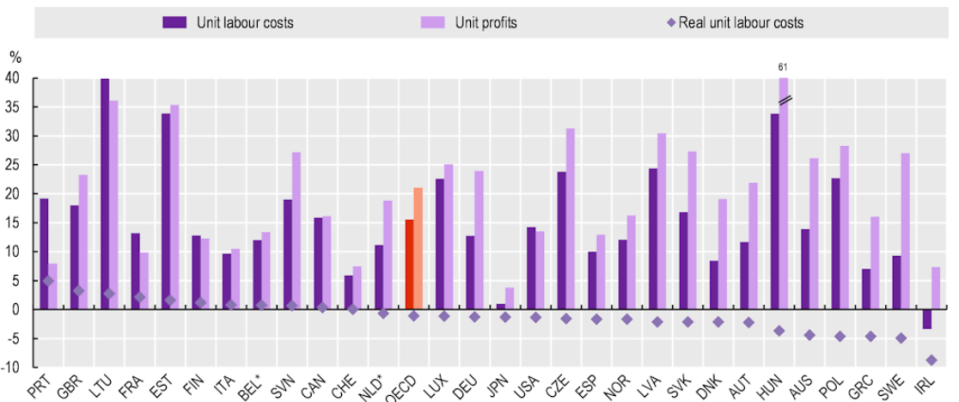
What this essentially means is that – holding all else equal – workers are getting a larger share of their respective countries’ income compared to before the pandemic.
All else is rarely equal, though. The share of output allocated to profits in the OECD has actually risen much faster than the share given to workers since the onset of the Covid-19 crisis.
Across the rich country bloc, profits have climbed over 20 per cent while labour costs have risen about 15 per cent. The respective numbers in the UK are about 24 per cent and 18 per cent.
And, when accounting for inflation, workers in nearly every OECD country where data is available are cheaper to employ than they were three years ago.
Are wages to blame for rising inflation?
Rising wages and profits is unusual. Typically, when one increases, the other falls.
It suggests that “profits have made an unusually large contribution to domestic price pressures,” as the OECD put it in their latest labour market snapshot.
This is especially true in Europe, where the OECD estimates “most of the increase in domestic prices in the second half of 2022 and first quarter of 2023” has been caused by higher profits.
Is a wage/price spiral likely?
Accelerating salaries are generally a sign of coming inflation, which is why the Bank of England and other monetary authorities have been so keen to caution against excessive pay demands.
They can generate the dreaded “wage/price spiral,” where businesses lift prices in response to higher staff costs, prompting their workforce to demand further compensation.
So far though, there is “no indication of signs of a price-wage spiral” taking hold, according to the OECD.
Instead, there may be room for businesses to hand out pay increases – especially to their lowest paid workers – from higher profits “without generating significant additional price pressures,” the rich country group said.