Are we in the age of the ‘permacrisis’?

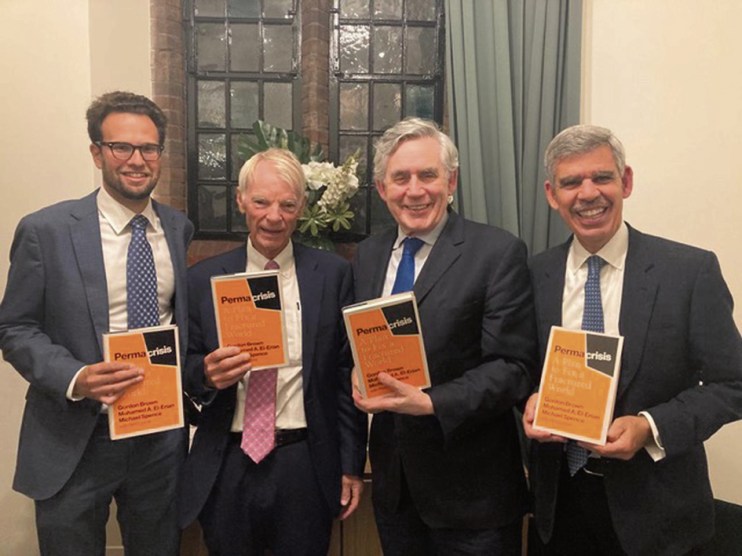
Nobel Prize winning economist Michael Spence and leading economic commentator Mohamed El-Erian tell Morning Wire about the age of the ‘permacrisis’ as they release their new book with Gordon Brown.
The global economy is rapidly changing. Failing to recognise the deep-rooted changes that are reshaping the underlying economic framework will have deep and long-lasting implications for global growth.
That’s the argument of a new book – Permacrisis: A Plan to Fix a Fractured World – co-authored by ex-Prime Minister Gordon Brown, Nobel-prize winning economist Michael Spence and leading economic commentator Mohamed El-Erian.
As Spence told City A.M., “we think we’re in a fairly fundamental and relatively rapid regime change in the global economy”.
This rapid regime change creates crises, and lots of them. From financial blow-ups to de-globalisation and from climate change to Covid, the world has been hit by a whole catalogue of once in a generation shocks.
El-Erian explained that the word Permacrisis captures the sense that “every time we emerge from one crisis there’s another one waiting for us around the corner”. The policy failure is to see these crises as disconnected.
The spate of crises are not random pieces of bad luck, preventing the global economy returning to a steady state of stable growth and low inflation. Ageing populations, trade fragmentation and the “expensive pattern” of friendshoring all pose significant headwinds to growth, not to mention the existential challenge posed by climate change.
As Spence said, “the mistake is to miss the underlying trends”.
El-Erian, who was one of the first to suggest the economy was adjusting to a ‘new normal’ post-financial crisis, said policymakers have failed to recognise that “we’re living in a structural world, not a cyclical world”.
The trends described in the book have dramatically changed the relationship between supply and demand.
or years after the financial crisis, the world was defined by a deficiency in demand. Now, however, the global economy is facing supply constraints as made abundantly clear by the post-pandemic surge
in inflation.
But policymakers failed to appreciate the change because they had not focused on structural changes. When inflation took off, El-Erian said policymakers dismissed it as “simply a cyclical blip”, using “that awful word transitory”.
In a supply-constrained world, Spence said inflation is “a threat lurking in the background”.
And this poses risks to a global economy which has grown used to low and stable inflation. “Mindsets tend to lag the change, which creates the conditions for accidents of a variety of kinds,” Spence said.
Take inflation. Having been too slow to hike interest rates, central banks around the world then embarked on one of the most aggressive tightening campaigns in history. The speed at which rates were hiked has then raised implications for financial stability, with the US going through its worst banking crisis since 2008.
The cause was a failure to manage interest rate risk, which El-Erian said was “very problematic” because it was an issue that should have been “right in front of the Federal Reserve”.
Despite all the headwinds the global economy faces, Spence, El-Erian and Brown remain optimistic.
In their view, the potential for technology such as AI to bring about a surge in productivity means that the global economy does not necessarily face slowing growth.
While the headwinds to global growth might be more powerful in the short run, Spence said “its a time horizon question… these technological tools that we talk about look to me to be pretty powerful.”
The book highlights that AI can perform a whole variety of basic tasks more effectively than humans can.
They stress that AI will ‘augment’ rather than replace hundreds of thousands of jobs around the world.
And its not just AI that can help spur productivity. The ongoing transformation of life sciences as well as the energy transition provide meaningful routes by which the global economy can break out of its low productivity cycle.
“We truly believe that you can put in place a set of measures that change the direction of travel, and establish a foundation for virtuous cycle,” El-Erian said.
In order to secure this boon, the authors argue that global governance needs to be reinvigorated.
As an example, big tech firms, which dwarf many countries, are essential to ensuring that the benefits of AI are spread evenly. As Spence pointed out “they’re the only people with the computing power to trade in the current generation of large language models”.
To ensure the benefits are distributed evenly, El-Erian stressed that “dynamic regulation” was needed which could “keep up with and enable” technological advances, while “minimising the risk”.
More broadly, Brown, Spence and El-Erian argued that global institutions – such as the World Bank and the IMF – needed to be reformed, both to contain rising geopolitical tensions and to secure inclusive growth.
Permacrisis, by Gordon Brown, Mohamed El-Erian, Michael Spence and Reid Lidlow is out now, £25, Simon & Schuster