Art review: Ai Weiwei at the Royal Academy

Ai Weiwei’s profile is so high, the stories of his struggle against the Chinese regime so ubiquitous, that you might be surprised to learn there’s never been a major UK exhibition of his work.
The Royal Academy rights this wrong with a show collecting pieces from 1993 onwards, the period after he ended a decade-long spell in New York to return to China. In this time Weiwei had become one of the world’s most recognisable artists, had been placed under house-arrest, imprisoned, accused of tax-fraud and generally made a nuisance of himself. Predictably, these works focus on his ambivalent relationship with his home country and a regime that appears to want to both claim his talent and silence his voice.
This double-think is perfectly encapsulated in the story of Weiwei’s ill-fated second suburban studio, built outside of Shanghai in an attempt to emulate the success of its Beijing sibling. The local authority encouraged its construction, offering to meet the costs, only to immediately bulldoze it for breaching planning laws. Weiwei organised a joint housewarming/demolition party (which he missed after being placed on house arrest) at which 800 guests dined on fresh crab. In one of the few overtly humorous works on display – it has, after all, been a singularly humourless few years for Weiwei – 800 plastic crabs are heaped in a pile as a wry tribute.
Most of the works are less direct, often relying on the backstory of their raw materials for their impact. A forest of dead trees in the courtyard is built from disparate pieces of wood foraged from the mountains of Southern China, representing the melding of disparate parts of Chinese culture into an uneasy whole; planks of wood carved into the shape of the Chinese border are taken from dismantled Qing dynasty temples; a 90 tonne pile of steel construction “rebars” was salvaged from the site of the Sichuan earthquake (a giant, austere spreadsheet accompanying it lists the names of 5,196 students who were killed by the quake).
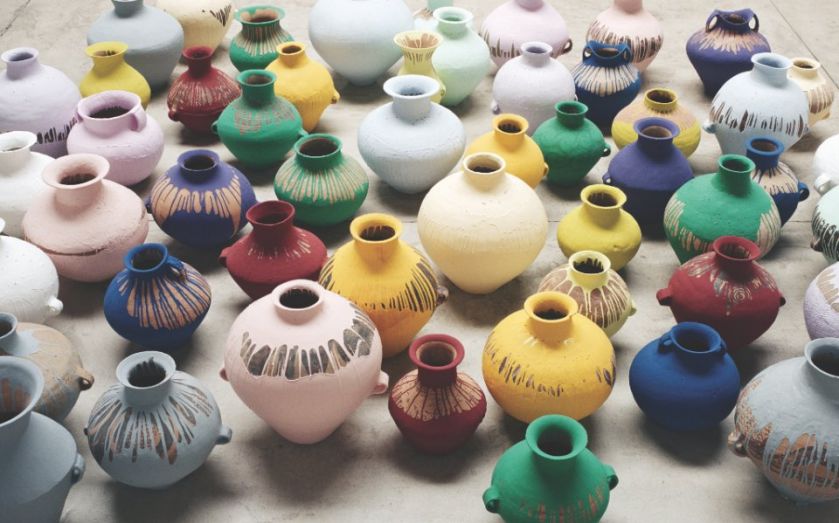
These pieces are highly collaborative – behind the scenes videos show hundreds of assistants helping to create them (the rebars, for instance, were each beaten around 200 times to return them to their original shape). There’s a distant echo of Warhol and his Factory; dozens of people creating works that explore contemporary iconography – one piece even sees Weiwei daub the Coca-Cola logo over a Han Dynasty vase (circa 200-220ad). But where Warhol fetishised the wholesale cultural change of the 1960s, Weiwei laments the destruction of the past (Weiwei would despise the comparison, by the way – he says his only major influence is Duchamp).
Some of these larger-scale installations, while bubbling with meaning and subtext, feel emotionally flat, a little too self-consciously academic. His smaller, more playful works hit harder: a series of photographs that show Weiwei dropping a Han Dynasty urn, or a shelf of glass jars housing the ground-up remains of neolithic pottery dating from 5,000-3,000bc – both blunt but powerful messages about the destruction of a nation’s cultural heritage.
Weiwei’s work is at its best when it gets personal. The final room of the exhibition features six dioramas, built at half-scale, featuring identical reproductions of the cell he spent 81 days locked inside. The attention to detail is incredible, from underwear piled in the wardrobe to the plastic sheets that cover the walls and furniture. Sullen guards watch as Weiwei eats, sleeps, showers, uses the toilet. It’s visceral, angry, the starkest possible illustration of how dissident voices are being silenced. It’s a fitting end to a collection of works by an artist who has become an even more powerful symbol than the objects he creates.