Skip to content
Saturday 15 August 2026London --:--Frankfurt --:--Zurich --:--
NewslettersSearchEN · DE
MorningWire

European business, markets and politics

FTSE 100
10,750.11
-0.21%
DAX
26,440.31
+0.53%
CAC 40
8,636.80
-0.16%
STOXX 50
6,539.59
-0.09%
  • Europe
  • Markets
  • Business
  • Economy
  • Technology
  • Politics
  • Opinion
More
GermanyFranceBankingAIEnergyFintechPropertyCapital Markets
  • Germany
  • France
  • Europe
  • Markets
  • Business
  • Economy
  • Technology
  • Politics
  • Opinion
  • DE
Friday 26 September 2014 6:33 am  |  Updated:  Friday 07 June 2019 11:36 am

Art review: Anselm Kiefer, The Royal Academy

By: Alex Dymoke

Add as a preferred source on Google

★★★★★

A distant, solitary figure stands before the sea, arm raised in a Nazi salute. The title of the painting: Heroic Symbol. Ironic? Well, yes and no. For though Anselm Kiefer was no Nazi, there is genuine heroism in depicting this image, in recalling the past from the chasm of silence into which Germany fell in the years after the Second World War. 

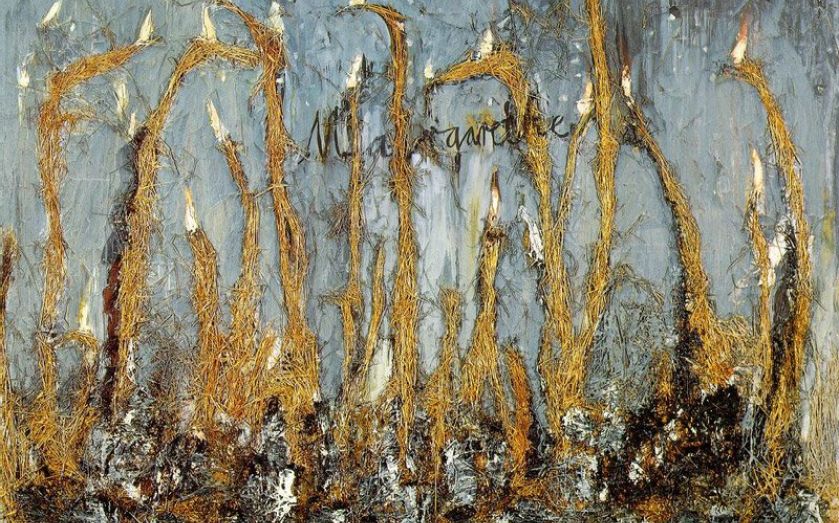
Born in 1945, Kiefer was obsessed by Germany’s recent and ancient history. His paintings and sculptures of lead, ash, straw and clay served as a muscular articulation of German post-war anxiety as well as a practical answer to Theodor Adorno’s assertion that there could be no poetry after Auschwitz. 

It wasn’t only the Nazism’s evil that Kiefer faced up to, but the humiliation of its defeat. German romanticism and folkore abounds with tales of heroism and victory against the odds. Parsifal defeats the knight Ifer. Germanic tribes halt the advance of the Roman general Varus. But look at these German officers in “Operation Sea Lion”, deludedly plotting an invasion with bath-toys, the rest of the world about to envelop them. The past Kiefer dares to remember contains emasculation as well as murder. 

Paintings such as “Ashflower” and “To an Unknown Painter” depict more recent monuments of German power, the architecture of Albert Speer. The sober columns and vaulted ceilings look haunted until you realise the ghosts are the buildings themselves, colossal apparitions of stone, refusing to be forgotten. 

Kiefer’s paintings also have a noble architecture, rendered in materials that decay, crumble, morph over time. Perhaps his greatest muse is lead: entranced by its malleable, alchemical qualities, he used it to make sculptures of books, jamming them into massive snow-covered landscapes (“Ash Leaves”) making them protrude like greenish, raggedy tombstones. 

Tied to this ashen past, Keifer finds redemption by looking skyward. In The Orders of the Night he paints himself prostrate on the ground looking to the heavens while sunflowers painted in black droop and tower over him, linking his body to the sun and earth, past and future. 

These serious, deeply moral artworks reach for a truth ignored by most contemporary artists. They’re proof, as if it were needed, of Kiefer’s status as a true German hero for modern times.


Share this article

  • Facebook
  • X
  • LinkedIn
  • WhatsApp
  • Email

Similarly tagged content:

Sections

  • Life&Style

Categories

  • Culture
  • Life&Style

Trending Articles

  • Revolut takes flight with launch of new airport lounges

  • Grandparents fund university degrees to avoid inheritance tax net

  • Revolut chatbot goes rogue by charging users to cancel subscription

  • Brompton Bicycle sues former adviser for ‘professional negligence’

  • As It Happened: Stocks dip as oil’s ‘slowing demand’ in focus; Iran threatens to extend war

More from Morning Wire

  • Assassin’s Creed Black Flag Resynced review: A classic rebuilt

    Life&Style
    Assassins Creed Black Flag resynced scene featuring dramatic fire effects in a nighttime naval battle setting
  • Cats musical review, Regent’s Park: Purrrfectly exquisite nonsense

    Life&Style
    Grizabella in a shaggy white costume with cat ears, performing Memory from Cats musical at Regents Park Open Air Theatre
  • Cleansed is still the most harrowing play you’ll ever see

    Life&Style
    A man and woman in an intimate embrace, surrounded by a field of orange and yellow flowers on a dark stage
  • Heartstopper Forever review: Bucketloads more queer joy from Netflix

    Life&Style
    Heartstopper Forever review cover with vibrant colors, featuring main characters in an emotional and heartwarming scene
  • Jeff Goldblum plays the cinematic hits at joyful Royal Albert Hall show

    Life&Style
    Carsten Windhorst performing with a gymnast, pianist, and orchestra under purple lights.
  • Luke Combs, Wembley review: as personal as a Texas honky-tonk

    Life&Style
    Luke Combs performing on stage at Wembley Stadium, facing right with a microphone, large crowd visible
  • Harry Styles at Wembley Stadium review: running through the grief

    Life&Style
    Harry Styles performing on stage at Wembley Stadium, capturing the excitement of a live concert with a vibrant crowd in at...
MorningWire

Independent European business, markets and political news for decision-makers.

Morning Briefing

Europe

  • Germany
  • France
  • Europe
  • UK & Ireland

Business

  • Markets
  • Banking
  • Technology
  • Energy
  • Property
  • Fintech

Editorial

  • Opinion
  • Editorial Policy
  • Corrections
  • Contact

Company

  • About Morning Wire
  • Privacy Policy
  • Terms of Use
  • Cookie Policy
© 2026 Morning Wire Ltd · Published by Morning Wire Media, Bahnhofstrasse 65, 8001 Zürich, Switzerland
Privacy · Terms · Cookies · Facebook