Skip to content
Tuesday 11 August 2026London --:--Frankfurt --:--Zurich --:--
NewslettersSearchEN · DE
MorningWire

European business, markets and politics

FTSE 100
10,840.00
-0.21%
DAX
26,273.07
-0.19%
CAC 40
8,708.27
-0.20%
STOXX 50
6,535.93
0.00%
  • Europe
  • Markets
  • Business
  • Economy
  • Technology
  • Politics
  • Opinion
More
GermanyFranceBankingAIEnergyFintechPropertyCapital Markets
  • Germany
  • France
  • Europe
  • Markets
  • Business
  • Economy
  • Technology
  • Politics
  • Opinion
  • DE
Wednesday 03 December 2014 9:50 am  |  Updated:  Friday 07 June 2019 6:39 pm

Autumn Statement 2014: What does George Osborne’s stamp duty reform actually mean?

By: Billy Ehrenberg

Add as a preferred source on Google

In an Autumn Statement firmly aimed at courting the popular vote, George Osborne today announced a complete overhaul of the stamp duty system – the elephant in the residential market for a decade. Estate agents said the old system wasn't progressive enough, and unfairly taxed home buyers.

The cherry on Osborne's stamp duty cake was to remove the slab system. Before today’s change, a house worth £250,000 would have been taxed at one per cent, while a house sold for £250,001 would be taxed at three per cent.

The new system is similar to the income tax framework, where in the £250,001 example, the buyer would pay the lower rate on the £250,000 and the higher rate on the extra one pound. The changes will therefore hit higher-priced properties and lessen the burden on those buying cheaper homes.

In recent years, estate agents have argued bitterly in favour of changes to the system The £250,000 boundary at which stamp duty rises from one to three per cent hasn’t changed since 2000. House prices are around 139 per cent higher now, forcing homes into higher bands.

What's more, under the old system London prices accounted for over two fifths of the total: 42 per cent of stamp tax receipts came from the capital. A look at the banded framework shows why.

Purchase price of property

Rate of SDLT

£0 – £125,000

0%

£125,001 – £250,000

1%

£250,001 – £500,000

3%

£500,001 – £1 million

4%

Over £1 million – £2 million

5%

Over £2 million

7%

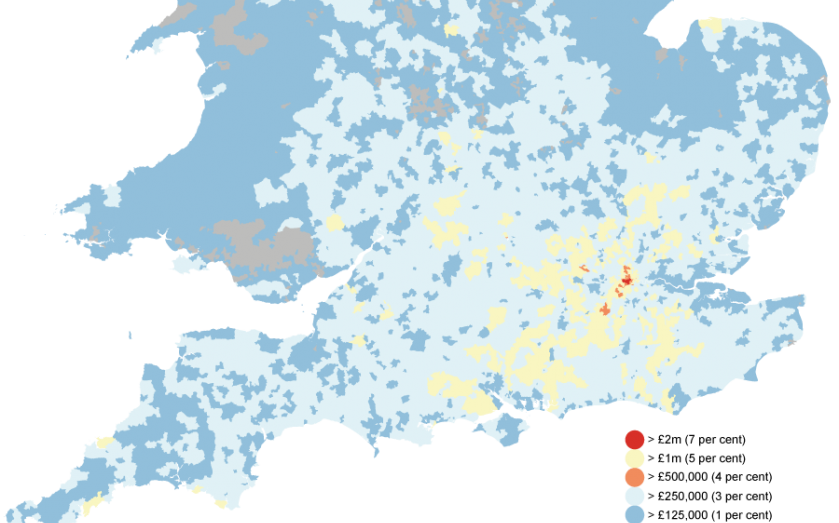
Data by upmarket estate agent Savills shows the average value of a house by ward. By mapping the average house price in each ward and colouring it by Stamp Duty Land Tax (SDLT) band, it becomes obvious why London is such a stamp duty gold mine.
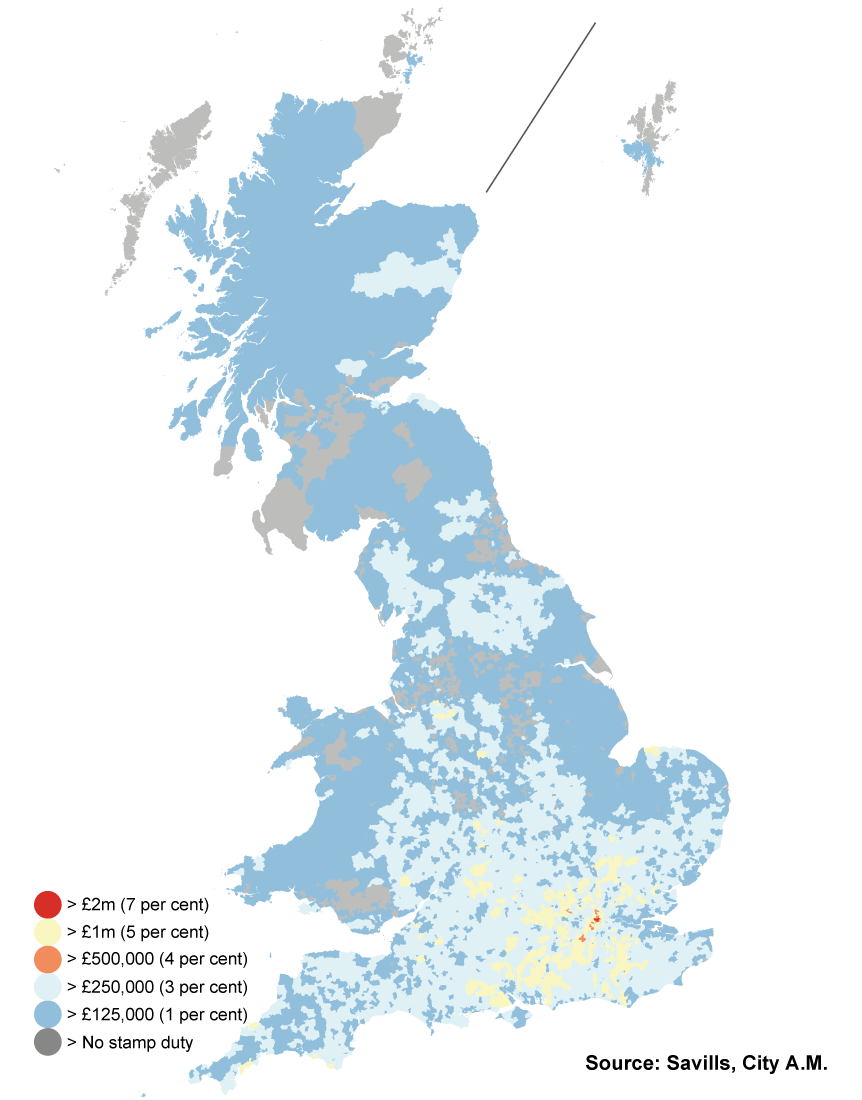
In the wider South East, there are more higher-priced properties, but it is in London where the highest rate payers are found. Only 10 wards in the UK hit the old top end value, and they were all in London.

Osborne's changes represent a massive shift. The new system will mean any house valued at up to £125,000 will pay nothing, while houses up to £250,000 will pay two per cent. Purchases between £250,000 and £925,000 will incur a fee of five per cent. Over £950,000 buyers will pay 10 per cent, while homes over £1.5m will command a stamp duty of 12 per cent.

Purchase price of property

Rate of SDLT

£0 – £125,000

0%

£125,001 – £250,000

2%

£250,000 – £925,000

5%

£925,000 – £1.5m

10%

Over £1.5m

12%


Share this article

  • Facebook
  • X
  • LinkedIn
  • WhatsApp
  • Email

Similarly tagged content:

Sections

  • News

Categories

  • Business

Related Topics

  • Autumn Statement 2015
  • George Osborne
  • People
  • UK house prices

Trending Articles

  • Trump speaks up for Infantino at last as Fifa boss fights world football rebellion

  • Heathrow overtaken by Istanbul as Europe’s busiest airport

  • Housebuilder Bellway calls for ‘immediate’ cut to stamp duty

  • Burnham to crack down on vape and betting shops 

  • London AI car firm records surge in revenue on demand for driver-tracking software

More from Morning Wire

  • Burnham can prove he’s pro-business by scrapping stamp duty on shares

    Opinion
    Andy Burnham, Mayor of Greater Manchester, in a professional setting.
  • Industry hits out at rumours as No 10 denies plan to abolish stamp duty and council tax

    Politics
    Two women view property listings in an estate agents window, one takes a photo with her phone. Real estate, stamp duty.
  • Housebuilder Bellway calls for ‘immediate’ cut to stamp duty

    Property
    Barratt Redrow said it remained "confident" in its medium-term target of 22,000 homes a year.
  • London house prices fall again as property slowdown drags on

    Property
    Two people looking at real estate listings in an estate agents window, showcasing properties for sale.
  • House prices slump as Iran war and interest rates hit demand

    Property
    The price paid for first homes has surged 7.1 per cent in a year
  • Wealthy Brits fear Burnham tax consequences

    Personal Finance
    Andy Burnham, Mayor of Greater Manchester, speaking at a podium with microphones.
  • Top Tory slams ‘ivory tower’ financial regulators as takeover bids blight London Stock Exchange

    Markets
    Shadow business secretary Andrew Griffith has said he would make it easier for small businesses to open bank accounts. (Photo by Dan Kitwood/Getty Images)
  • We should all get behind this wealth tax

    Opinion
    LONDON, ENGLAND - JUNE 01: A general view of a house along Kensington Palace Gardens, which has been named as Britain's most expensive street on June 1, 2011 in London, England. Many of the mansions are occupied by billionaire businessmen, embassies and ambassadorial residences. (Photo by Oli Scarff/Getty Images)
MorningWire

Independent European business, markets and political news for decision-makers.

Morning Briefing

Europe

  • Germany
  • France
  • Europe
  • UK & Ireland

Business

  • Markets
  • Banking
  • Technology
  • Energy
  • Property
  • Fintech

Editorial

  • Opinion
  • Editorial Policy
  • Corrections
  • Contact

Company

  • About Morning Wire
  • Privacy Policy
  • Terms of Use
  • Cookie Policy
© 2026 Morning Wire Ltd · Published by Morning Wire Media, Bahnhofstrasse 65, 8001 Zürich, Switzerland
Privacy · Terms · Cookies · Facebook