Skip to content
Monday 14 September 2026London --:--Frankfurt --:--Zurich --:--
NewslettersSearchEN · DE · FR
MorningWire

European business, markets and politics

FTSE 100
10,650.44
+0.39%
DAX
25,568.56
+0.82%
CAC 40
8,179.77
+0.78%
STOXX 50
6,325.13
+0.90%
  • Europe
  • Markets
  • Business
  • Economy
  • Regulation
  • Politics
  • Opinion
More
GermanyFranceEU InstitutionsCompetitionPublic AffairsBankingTechnologyEnergy
  • Germany
  • France
  • Europe
  • Markets
  • Business
  • Economy
  • Regulation
  • Politics
  • Opinion
  • DE
Friday 05 November 2021 6:00 am  |  Updated:  Friday 05 November 2021 10:29 am

Back to basics: Why Tesla is not like Google and Apple, and it will never be

By: Julian Birkinshaw

Add as a preferred source on Google
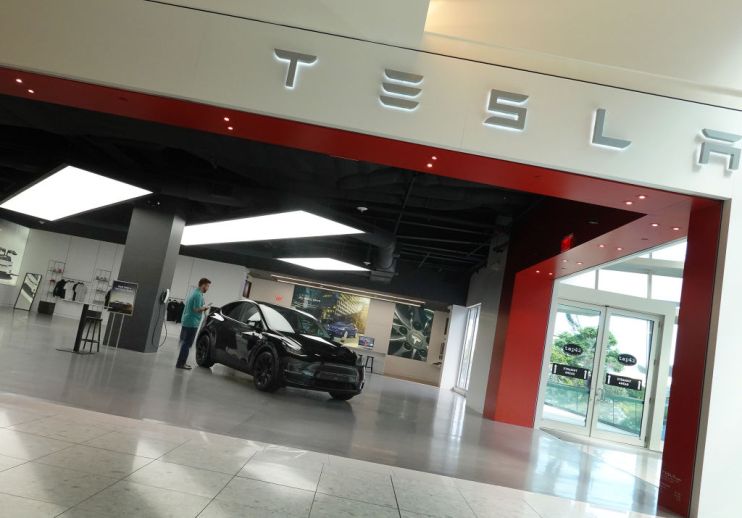
Electric Car Maker Tesla Reports Record Quarterly Earnings
Tesla has joined the trillion-dollar club, but it has a very different business model than all the other members. (Photo by Joe Raedle/Getty Images)

Tesla’s market value broke the $1tn mark on 25th October, turning the car-maker into the sixth company to join that exclusive club together with Alphabet, Amazon, Apple, Microsoft and briefly Facebook. But it is so easy to get caught up in the hype that we sometimes forget basic economics. Many commentaries have been outlining “Tesla’s plan for world domination” and share-owners around the world have bought into these stories. The problem is that they fly in the face of everything I have learned about business.

The other members of the trillion-dollar club are platform companies selling information-based services – Apple is the partial exception, with its iPhone. Tesla has impressive technology, but it’s a product company, selling a physical commodity. This matters for three reasons.

Firstly, Tesla doesn’t benefit from network effects. Platform companies become more valuable the more people use their networks: Google’s search engine attracts more advertisers when more people use it. The value of your Tesla, however, doesn’t increase because your friends also own Teslas.

Tesla’s marginal cost of production is significant. According to economic theory, the fixed costs of creating an  operating system like iOS are billions, but the variable costs per user tend towards zero. Physical products are different: there are huge fixed costs in developing a new car, but the variable costs are also large. Building larger car factories provides economies of scale up to a point, but if you make the factory too large there are diseconomies of scale, because of the complex coordination required.

Finally, Tesla doesn’t benefit from customer lock-in. We may not like using Windows, but it would be so tiresome to switch to iOS that we stick with Microsoft. What are the switching costs for car owners? Pretty negligible – you can switch from a Tesla to a Volkswagen with a few minutes of familiarisation.

Put these three points together, and it should be clear that Tesla is operating with a very different economic model to the digital giants. Firms selling information-based products and services live in a world of increasing returns to scale. The only thing stopping them is government regulation. Firms like Tesla live in a world of decreasing returns to scale. Diseconomies of scale kick in eventually, and the lack of switching costs creates more scope for new entrants. Competition, not regulation, is what keeps companies in check.

Just take a look at the market for battery-powered cars today. Tesla came up with a breakthrough design, giving cars enough range to make them viable. But over the last decade every large car manufacturer has poured money into the sector, and they may have already caught up. In the UK, for instance, Mercedes claims the longest range (the EQA can cover 485 miles without a charge, the Tesla S 405 miles). Tesla’s electric vehicles may still offer the best all-round option, but this is a super-competitive market. It doesn’t end up with one or two dominant firms – it ends up as an oligopoly with maybe four or five major players in each region.

Tesla has transformed the car industry – and in a good way. It has forced the big established players to raise their game. But it is operating in a very different part of the business world – the world of decreasing returns – and this means the economics of industrial production will eventually catch up with it. In sum, we shouldn’t buy any sort of comparison of Tesla to the big digital giants.

Read more

Google to pay £260m to settle ‘unfair’ pricing class action lawsuit

Googles modern Kings Cross headquarters showcasing innovative architecture in Londons dynamic tech district

Share this article

  • Facebook
  • X
  • LinkedIn
  • WhatsApp
  • Email

Similarly tagged content:

Sections

  • Opinion

Categories

  • Opinion

Trending Articles

  • Wetherspoon boss: ‘Not up to Burnham’ to choose who is on the high street 

  • Badger Beer maker Hall & Woodhouse doubles profit ahead of tie-up with James May

  • Four interest rate hikes loom despite surprise economic growth

  • Primark sales slip as owner dresses up retailer for demerger

  • Lotus, Porsche and Corvette: the best sports cars to buy in 2026

More from Morning Wire

  • Google to pay £260m to settle ‘unfair’ pricing class action lawsuit

    Lawsuit
    Googles modern Kings Cross headquarters showcasing innovative architecture in Londons dynamic tech district
  • Championship club QPR selling stadium naming rights… on LinkedIn

    Sport Business
    Loftus Road stadium with THE GO-OUT LOFTUS STAND sign, floodlights, and sprinklers on the pitch.
  • Wetherspoon boss Tim Martin attacks government’s ‘unfriendly’ attitude to business

    Politics
    Wetherspoon chairman Tim Martin smiling in a red sweater outside a pub with ON THE FIVE sign
  • Revolut founder’s wealth set to balloon amid talks of share award at $500bn valuation

    Fintech
    Revolut CEO Nik Storonsky speaking at a business conference, wearing a suit and tie, addressing financial innovation.
  • Apple shares slip as iPhone price hikes steal foldable’s thunder

    Tech
    Hands holding an iPhone Duo, a foldable smartphone displaying widgets and app icons on a white background.
  • Apple gears up for fresh legal fight with government

    Lawsuit
    Apple unveils new products at recent event showcasing innovative technology and sleek design to global audience
  • Google backs publisher model as Apple considers price tag for news

    Media
    AI copyright laws
  • Apple and Google defend safety records as UK clamps down on explicit teen content

    Tech
    Smartphone screen displaying a folder of social media app icons including Facebook, Instagram, WhatsApp, and YouTube.
MorningWire

Independent European business, markets and political news for decision-makers.

Morning Briefing

Europe

  • Germany
  • France
  • EU Institutions
  • Europe

Business

  • Markets
  • Business
  • Economy
  • Regulation
  • Competition
  • Public Affairs

Editorial

  • Opinion
  • Editorial Policy
  • Corrections
  • Contact

Company

  • About Morning Wire
  • Privacy Policy
  • Terms of Use
  • Cookie Policy
© 2026 Morning Wire Ltd · Published by Morning Wire Media, Bahnhofstrasse 65, 8001 Zürich, Switzerland
Privacy · Terms · Cookies · Facebook