Bank of England holds rates, boosts stimulus by £100bn

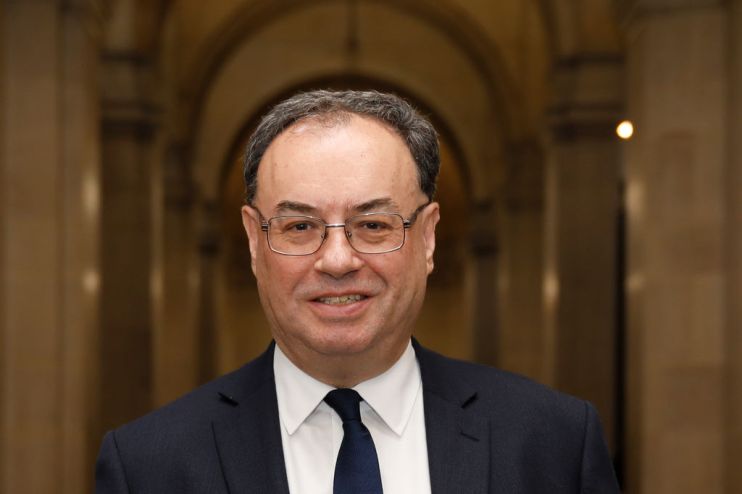
The Bank of England has held interest rates at a record low and will expand its bond-buying programme by £100bn to help to steer the British economy through the “unprecedented” crisis caused by coronavirus.
At its June meeting, the BoE’s Monetary Policy Committee (MPC) voted unanimously to keep the main interest rate at a record low of 0.1 per cent, and voted 8-1 to increase its stimulus package.
Read more: FTSE 100 inches higher in anticipation of additional BoE stimulus
BoE chief economist Andy Haldane was the only member of the MPC to vote against increasing the stimulus measures.
The £100bn boost will take the Bank’s total stock of asset purchases to £745bn. The central bank said it would spend all the extra £100bn on government bonds but would slow the pace of its purchases, saying it expected to complete the programme by the end of the year.
Announcing the measures, the MPC said that recent data suggests that the fall in global and UK GDP in the second quarter “will be less severe” than predicted at its May meeting.
“Although stronger than expected, it is difficult to make a clear inference from that about the recovery thereafter. There is a risk of higher and more persistent unemployment in the United Kingdom,” the committee said in its report.
“Even with the relaxation of some Covid-related restrictions on economic activity, a degree of precautionary behaviour by households and businesses is likely to persist. The economy, and especially the labour market, will therefore take some time to recover towards its previous path,” the MPC added.
Minutes from the meeting said that downside risks to the global outlook remain, including “from the spread of Covid-19 within emerging market economies and from a return to a higher rate of infection in advanced economies”.
There was no mention of negative rates in the minutes from the June MPC meeting — a policy option governor Andrew Bailey recently said the Bank was considering for the first time.
Vicky Pryce, chief economic adviser at CEBR, said that the BoE resorting to negative rates “would probably have made very little difference and although possibly justified by falling inflation way below target would have unduly unsettled the markets and also sterling”.
“The question will be what more may be needed later in the year or even next year if finances continue to be strained if the economy remains below par and tax and other revenues do not recover as fast as hoped,” she added.
Economists had almost unanimously predicted that the Bank would keep the main interest rate steady and focus on expanding quantitative easing (QE) to shore up the British economy and stabilise financial markets.
The BoE slashed its base rate to 0.1 per cent and launched a £200bn asset purchase programme in March and as the coronavirus pandemic ravaged the British economy. But the central bank has already spent much of this additional firepower as it soaks up much of the government’s Covid-19 borrowing.
Bond-buying still BoE’s most powerful tool
Governor Andrew Bailey recently said that the Bank is considering cutting interest rates below zero for the first time in the BoE’s 325-year history, but said a review of the policy would take time.
This leaves bond buying as the Bank of England’s most powerful option to help steer the British economy through the coronavirus crisis, which saw the economy contract a record 25 per cent in March and April.
By buying up so much debt — almost all of it issued by the government — the BoE is keeping a lid on borrowing costs paid by businesses and consumers, as well as the public sector.
The central bank is also battling to steer inflation back to its two per cent target after it sank to a four-year low of 0.5 per cent in May.
Read more: Bank of England lookahead: Bailey set to ramp up QE but avoid negative rates
Naeem Aslam, chief market analyst at Avatrade, said all eyes would be on Bailey’s statements at the press conference later as investors “try to make their opinion on what the Bank’s assessment is about the economy”
“Given the fact that the Bank has only increased the asset purchase program in line with the market, perhaps, the Bank’s view is not that dovish,” he said.