Bank of England’s Huw Pill: Brits ‘need to accept’ they’re poorer

Huw Pill, the Bank of England’s chief economist, said today that Brits “need to accept” that they are poorer as a result of higher inflation.
The rate of price increases has outpaced wage growth for nearly two years, engineering the tightest squeeze on living standards in recent memory.
Inflation has been hanging in the double digits since August last year, currently standing at 10.1 per cent, and above the Bank’s two per cent target since the early stages of summer 2021.
Pill’s comments will be seen as the latest tin-eared response to the crisis from the Bank, which is tasked with keeping inflation at two per cent.
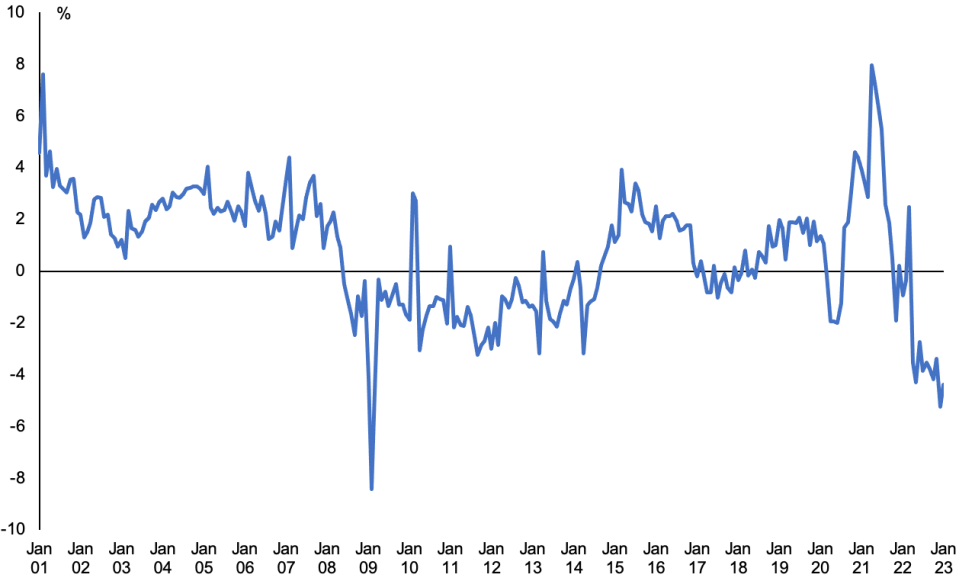
Governor Andrew Bailey has previously been criticised for telling Brits not to ask for pay rises. Latest figures show real wages – which take off the rate of price increases from pay growth – dropped over four per cent.
Real wages have been deeply negative for more than a year (pay growth net CPI inflation)
“What we’re facing now is that reluctance to accept that… we’re all worse off, and we all have to take our share to try and pass that cost on to one of our compatriots, and saying we’ll be alright, but they will have to take our share too,” Pill said.
“That pass the parcel game that’s going on here… is generating inflation, and that part of inflation can persist.”
Economists at the Bank are worried that is workers try to bid up their wages to protect their finances from inflation and businesses raise prices to shield profit margins, high inflation will become a permanent fixture of the UK economy.
Pill was speaking to the ‘Beyond Unprecedented’ podcast, produced by Columbia Law School.
The chief economist also addressed criticism of the Bank’s handling of inflation, admitting the Old Lady of Threadneedle Street was not alive to the dangers of gummed up global supply chains and the effect that would have on pricing.
“If we had understood supply chains better than we did. We could have probably understood that this was going to be a more difficult process than we anticipated,” he said.
His comments come as another member of the Bank’s rate setters, Ben Broadbent, a deputy governor, hit back at critics who claimed the monetary authority’s bond buying programme was overly generous and pumped up inflation.
Addressing an event at Britain’s oldest economic think tank, the National Institute of Economic and Social Research. Broadbent said “broad money grew more than twice as rapidly” in the years leading up to the global financial crisis in 2008 “than in the decade or so after”.
“Average inflation, in both periods, was close to two per cent,” he added. At its peak, the Bank’s quantitative easing programme held nearly £900bn of government and corporate assets.
Pill and the rest of the nine-strong monetary policy committee (MPC) – the group of people in charge of setting borrowing costs in Britain – have bumped interest rates higher eleven times in a row in response to the price surge, sending them to a post-financial crisis high of 4.25 per cent.
While that is expected to help trim inflation substantially this year, alongside falling energy prices, it has tighten the squeeze on families’ finances.
Higher borrowing costs make it more attractive to save and more expensive for businesses to invest which, in theory, brings down inflation by reducing spending. The MPC is expected by markets to send them to a peak of five per cent.
This monetary tightening from a central bank tends to raise unemployment, which pushes down on inflation by sucking demand out of an economy and taming wage increases. It generates what economists call “slack,” essentially free resources.
Pill has previously said unemployment needs to go up to crack down on inflation.
Pill, a former Goldman Sachs banker, said the MPC need to see an increase in joblessness to “reassure” them that inflation is headed back towards their two per cent target.
He agreed that the so-called “natural rate of unemployment”, a phenomenon in economics that tries to pinpoint the level of joblessness needed to ensure inflation doesn’t spiral out of control, has climbed due to a reduction in the UK’s economic potential since the pandemic.