Belfast is beautiful but its peace walls convey the scars of brutal recent history

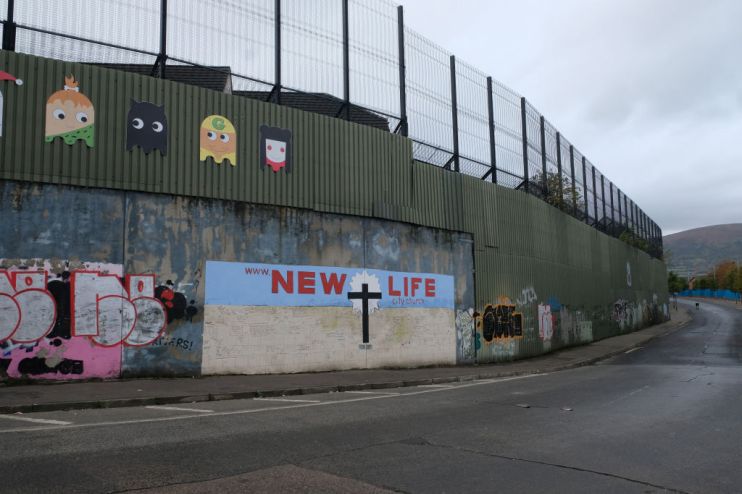
The scars of the Troubles are visible in the physical barriers that divide Belfast’s citizens in two, writes Lucy Kenningham
Every evening in Belfast, gates at the interface barriers on the Shankill and Falls roads are shut by 6pm. A wall that is three times higher than that which divided Berlin still separates the citizens of Northern Ireland by religion. Certain other gates along the line are closed at 7pm (Townsend St) and 10pm (Lanark Way) – interested parties can head to Reddit for the full compilation of closing times.
Residents can still find their way around the imposing structures but these walls are a powerful symbol of the enduring division and fear literally dictating the geography of the city.
No wonder, you could say. Most people in Northern Ireland remember at least part of the 30-year long conflict during which over 3,500 people died – half of these being civilians. The battle between Republicans, who want a united Ireland, and Loyalists, who want to remain part of the UK, was formally ended only in 1998.
The scars of the Troubles, which were so called due to the tradition of saying “sorry for your troubles” to the deceased’s kin at a wake, run deep. Northern Ireland has a 25 per cent higher rate of mental illness than England and one of the highest suicide rates in Europe.
So Northern Irish folk still live amongst the walls. The very first of these were temporary and constructed in the 1920s, but most were built after 1969 at urban interface areas in Belfast. Unlike the Berlin Wall, which was a singular line cutting the city in half, on a map Belfast’s walls are haphazard strikes and dabs. And crucially, unlike Berlin, the walls were not torn down, symbolically, when the conflict ended.
To the contrary. The walls have only increased in number and height since the peace agreement in 1998: in the early 90s there were some 18 partition walls; in 2017, there were 59. They have been erected in the places that are most vulnerable to violence – 67 per cent of deaths during the sectarian violence happened within half a kilometre of a now-standing wall.
These days murals illustrate many of the concrete interfaces, representing scenes from the Troubles from either side of the dispute. Black taxi cabs take tourists around, for a very modern (and moving) urban history tour.
Should the walls be brought down? Eventually, yes. But residents of Belfast are not clamoring for their removal – rather, they see them as a safety device.
Belfast is not the only city dividing its citizens: Mostar, Jerusalem, Nicosia and Mitrovica all have walls up too.
What is striking about Belfast’s is how incongruent they are with the rest of the UK. For it remains a strange reality that even history buffs living in England or Wales can go through the entire education system without ever having learned a thing about Northern Ireland, the other Ireland or the very recent conflict known as The Troubles.
The curriculum cannot, of course, contain every interesting period of history. But to fail to mention the most recent armed conflict on UK soil, one that was only formally ended in 1998, seems like a pretty gaping omission. Especially when the political consequences are still so rife today (and we could probably do with a little bit less around WW2 and rationing).
The brutal truth is that the UK’s neglect of Northern Ireland in its education system speaks to a wider English attitude to the province (and also compounds it). Last year Yougov found that 60 per cent of the English public did not care whether Northern Ireland remained part of the UK or not.
Yesterday’s news that a new post-Brexit agreement has finally been reached is welcome: it should boost the Northern Irish economy and restore the Stormont executive, ending a two-year boycott destabilising the country. But the gates on the peace walls will continue to close and open, and tourists will continue to visit and marvel at the fact that in one of the world’s most open and liberal countries, a physical wall exists to cut a city into sections.