Best of travel: We visit Peru in search of an anaconda

To tide us over until we’re able to travel again, we’re republishing classic travel stories from our archives. This week we revisit Steve Dinneen’s trip to Peru in search of a monstrous snake.
•••
On my first morning on the Amazon the sun was my alarm clock, lighting up my room through gigantic floor-to-ceiling windows overlooking the river. As I came to, blinking through the fug of the previous night’s pisco sours, pink dolphins broke the waters around the boat and storks perched on piles of floating driftwood. It was 5am – the joys of jet lag – and the rain forest was already in full swing. Spider monkeys leapt through the canopy, kingfishers had adopted their vantage points and sloths were just sort of hanging around, as is their wont.
But this trip wasn’t about spotting adorable sloths or extravagantly-plumed birds (though I saw plenty of both). No, I had come to find an anaconda in its natural habitat. I was aboard a four day Aqua Expeditions cruise, which combines rough and ready rainforest exploration with the most lavish maritime accommodation this side of a super-yacht (including a fine on-board chef who rustles up Peruvian specialities all day long).
My trip began in Iquitos, a remote colonial city that is only accessible by plane, or a very, very long boat ride (if this is the only leg of your journey to Peru, you’ll need to spend at least a night in Lima.) From there I followed the Amazon to the Ucayali river, its largest tributary, before looping back to Iquitos.
One of the great joys of being in such an isolated, unexplored corner of the world is being able to soak in the sheer size of the place – you can travel for days and feel like you’ve made no progress at all, the forest and its river seemingly unfolding ad infinitum ahead of you.
This is the primordial sludge from which crawled countless species that exist nowhere but this jungle – many of them never seen by human eyes. Every chance I got I’d sit on the deck, drinking coffee and watching the world chug by. Truth be told, I could have happily done that for the entire trip.
But there were expeditions to be undertaken, which meant familiarising myself with the small boat – “skiff” – that would be my carriage into the depths of the jungle. From there I embarked on several brisk jaunts on foot, gawping at beetles the size of my fist and termite nests bigger than my entire body. You’d be well advised to go trekking in the morning, when the mosquitos are still groggy after the previous night’s feasting; later in the afternoon they’re ferocious and no amount of Deet will deter them.
My guide, a local from a now disbanded tribe, suggested a spot of fishing. The catch of the day: piranha. The rivers are thick with them – up to 60 different species – although very few will attack a human. Not a live one, anyway. For bait I used strips of raw beef, off-cuttings from the previous night’s dinner. Using a simple bamboo rod I cast my line and waited. One girl in my group obviously knew something I didn’t, pulling up a piranha after piranha – bright orange things with a ferocious overbites of razor-sharp teeth, snapping all the way up. She’d reel them in, unhook them and toss them back like it was nothing. Every time my line tightened I’d pull it up to find the meat had been stripped away. Eventually I landed a mean looking specimen that snapped menacingly until my guide returned it to the water.
Next up: swimming. Ha! Very funny. But no, really: swimming. “The piranha won’t bite you,” said the guide. “It’s the ghost fish you should be worried about, but you don’t tend to find them in this river…” The ghost fish is a particularly unpleasant creature; less than a millimetre wide it is said, perhaps apocryphally, to swim up your urethra and hook onto you bladder, causing intense pain and eventually death. Very reassuring.
Swimming, however, was one of the highlights of the trip; the water is dense as soup and warm as a jacuzzi. Once you’re underwater you can’t see your hand in front of your face and if you dive more than a couple of metres below the surface everything goes inky black and icy cold; I was too much of a coward to probe any further under – who knows what’s down there.
At night the river is more alive than ever. Crickets and frogs chirrup and riddup at each other and unknown beasts crash through the canopy overhead. We took the skiff up several winding tributaries, the boat brushing up against thickets of reeds where frogs in shades of neon and leopard print hopped from leaf to leaf and rainbow-coloured bugs darted from the glare of the flashlight. I was looking for something bigger, though: a cayman.
Finding one is easy – shine a torch at the river bank and every now and then you’ll see a pair of amber dots wink back at you. Evolution may have bestowed the cayman with an armoured hide but it didn’t anticipate the invention of the flashlight. Actually catching one, though, is tricky. Their instinct is to remain still until the last possible moment, meaning you can approach one, but even the relatively small specimen I found put up a hell of a fight until it realised the game was up. Once the guide had a firm grasp, it relaxed somewhat, regarding me with casual malice, before it was set back in the river; one swipe of its tail and it vanished under the murky water.
But three days of searching had failed to yield an anaconda, or any snakes at all, for that matter. On the final day I sped past wildlife that had seemed fascinating only days ago. Storks? Meh. Kingfishers? Old hat. Monkeys? Sure.
It was looking bleak. My guide was hopping on and off the boat, exploring likely hiding spots, kicking forlornly at rotting logs and piles of damp reeds, to no avail. We were about to head back when he spotted something. Peering at a spot of river bank that looked exactly like every other inch of river bank, he whispered: “Anaconda, anaconda, anaconda. Big one.” The other skiffs – and, crucially, the other guides – swung in; it takes more than one person to catch an anaconda and I wasn’t about to volunteer.
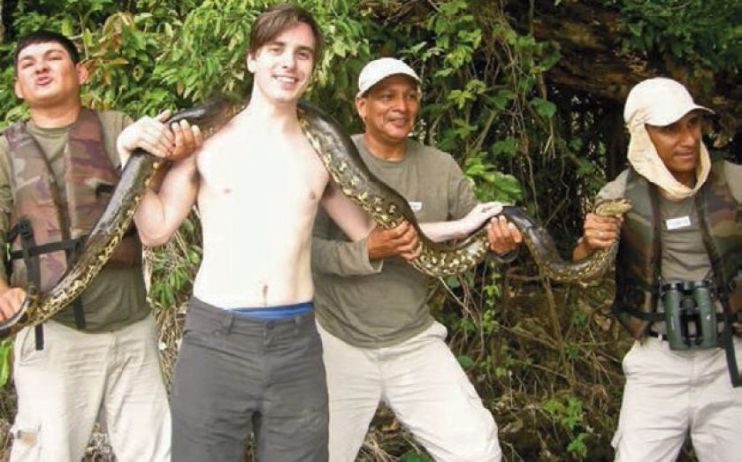
Two of them jumped onto the bank and stuck their hands into an innocuous-looking pile of leaves, emerging with a gigantic mouth bearing stubby, hooked fangs (anaconda are non-venomous, the fangs are used to keep you close while it crushes the life out of you). They slowly hauled its sinewy, glossy bulk from the water, the thing hissing and thrashing like an angry cat. Once three guides had supported its weight – it was three and a half metres long, around half the length of a truly massive specimen – I leaned in for the obligatory triumphant photograph before it was released, unscathed, into the water.
At least that was the plan – the snake had other ideas. Instead of gliding off into the Amazon, it made a bee-line for the skiff, leaving me with the unenviable choice of remaining on the vessel with the enraged snake, or jumping into the water from which we had just fished a 3.5 metre anaconda, neither of which was very appealing. It was livid; this was my punishment for getting my photo taken with it – now it was going to sink its fangs into my leg and crush me to death. Thankfully a guide dived from the river bank and knocked it off course into the river.
My last night on the boat was spent the same way as my first, enjoying the benefits of Peru’s national drink, pisco sours. I was celebrating finding an anaconda. Mission accomplished.