Bitcoin reminds us to question where is, and how safe is, my money?

Life, as we know, is a constant lesson. Strangely, some lessons, no matter how painful, seem hard for many of us to grapple, learn and change our behaviour. However, maybe, just maybe, the collapse of FTX (estimated to have left a $8billion liablity) is making investors question: “Where is, and how safe is, my money?”
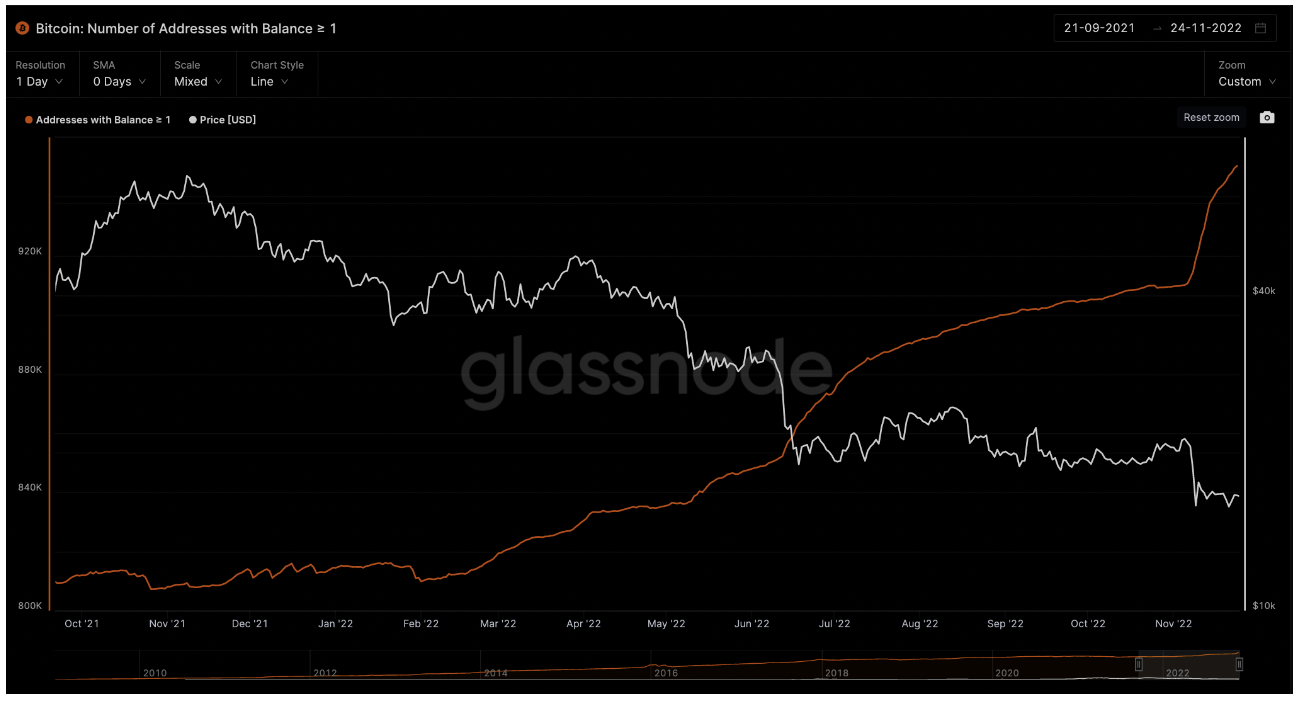
There has been a surge in the number of digital wallets owning more than one Bitcoin – organisations or individuals that have more than $16,000 in the cryptocurrency, for example. In theory, these holdings could be explained away as investors looking to buy into Bitcoin. U.Today recently pointed out: “The last time it was that heavily oversold, the largest cryptocurrency rallied by more than 500% within just five months in the first half of 2022.”
Number of wallets holding Bitcoin surges
Source: Glassnode
There is another possible explanation, and that is that holders of Bitcoin have not been necessarily increasing their holdings (nor have new investors flocked in) as presumably the price of Bitcoin would have risen. But the way that Bitcoin is held is changing. There has been a fall in the amount of Bitcoin that is held by exchanges, for example – holders seem to not be willing to trust centralised exchanges (CEX) but would rather store their Bitcoins in their own wallets – otherwise known as self-custody, or in a non-custodial manner.
Cryptocurrency exchanges such as FTX (which was a CEX, as indeed Binance and Coinbase are) are similar to banks in that, whether their customers are depositing cryptos or cash in a bank account, they are, in effect, creditors to the exchange/bank.
This means that in the event of a bankruptcy, depositors will only be paid after the CEX or bank’s debts have been cleared (excluding any government investors protection limits). Unfortunately, there have been a number of banks that have caused stress and financial loss and, in part, many of the runs on banks have been due to some of the practises of which FTX is guilty – that is, using other people’s money to make bets that turn sour (e.g. the 2008 subprime crisis) or simply being a loss in confidence, something the FED called a “liquidity crisis” which resulted in market panic in 1930 as overseas depositors in US bank accounts tried to convert bank deposits to gold. Just as FTX has recently faced, banks have experienced times when they have been unable to meet the demand from their depositors/creditors to have their cash returned, or in FTX’s case – their cryptos.
To be fair, though, it would seem that FTX was not exactly being administered in a prudent manner. As FTX’s new CEO, John J. Ray III, wrote in a court filing: “Never in my career have I seen such a complete failure of corporate controls and such a complete absence of trustworthy financial information as occurred here.”
Bitcoin: exchange balance and net positions

Source: Glassnode
Given the size of the losses as a result of the FTX fiasco, one wonders if we will, in effect, see a clamour for greater self-custody and, ironically, a return to bearer securities. In the past, the owners of a security – be it a share in a company, a land title for real estate, a debt instrument such as a corporate or government bond, etc – would present/bear/offer their security to a buyer when they wanted to sell.
In the same way, for thousands of years most trade was carried out on a face-to-face basis with a farmer swapping his chickens for a bushel of wheat or a sack of corn for a handful of silver coins. However, instead of returning to a barter system, which some believe is on the resurgence, technology is enabling us to have our assets held securely in our own wallets.
As we increasingly digitise our lives and indeed our investments and possessions, it is possible to store our assets and move them around – not physically – but digitally. The advantage of this is that we do not need to trust a third party – a CEX, bank or custodian, for instance – nor do we need to pay for this type of service.
As well as our physical assets, such as our homes, cars, equites, mutual funds and cash, we are also seeing art, jewellery, clothes and other apparel all being converted into a digital twin via the use of NFTs. This means that we now have the ability to store and trade our possessions digitally. It is not merely tangible physical assets, but also intangible assets that blockchain-powered platforms are able to store and allow us to monetise; intangible assets such as our medical records right through to big pharma looking to carry out research, or our driving and shopping habits to advertisers, etc.
Therefore, in a strange way there does appear to be some evidence that Bitcoin holders have learnt a lesson and been spurred into action to take back control by questioning “Where is, and how safe is, my money?”
Rather than trusting and relying on a third party, they seem to want their holdings held directly by themselves in their own wallet.
This trend is undoubtedly a powerful lesson to central bankers as they look to potentially issue CBDCs. If it is possible to hold your money a central bank, why would you want to deposit it with a p commercial bank and thus be exposed to their lending and investment practices? If a CBDC were to be available to retail users, what role would commercial banks have?
So maybe at least some Bitcoin holders have learnt a lesson and others equally ought to take heed. After all, do you know how safe your investments really are?