Blaming booze for Britain’s productivity crisis is enough to drive you to drink

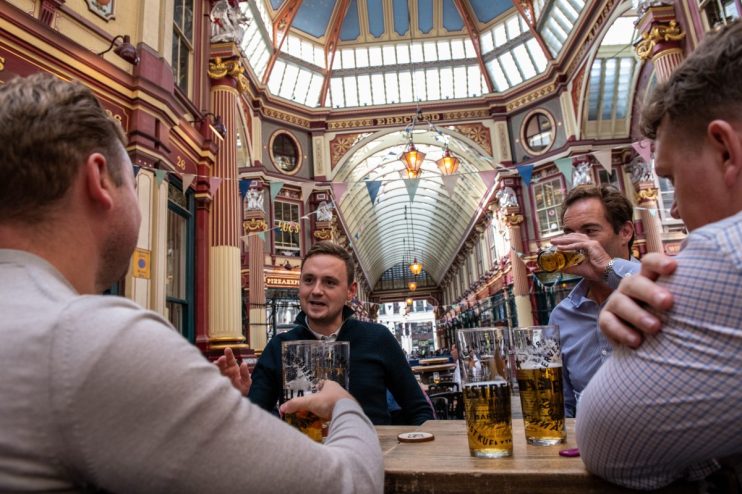
A left-wing think tank is claiming after work drinks are reducing productivity and making non-drinkers uncomfortable – utter rot, says Joseph Dinnage
Another of life’s rapidly vanishing joys is in the crosshairs of Britain’s public health lobbyists: the work drinks party. According to the Institute for Public Policy Research (IPPR), a number of Gen Z workers feel unfairly pressured to drink at workplace events – presumably by older colleagues who are more than happy to reach for the corkscrew.
A quarter of workers said they occasionally felt pressured to drink when they didn’t want to – rising to 38 per cent among the youngest employees (aged 18-24). Over a third said drinking at work events made non-drinkers feel excluded or created cliques. Strangely, I don’t recall ever being surveyed about my discomfort when surrounded by sanctimonious Zoomer teetotallers.
The report concludes that the pressure employees feel to drink is having real consequences. Apparently, due to Gen Z drinking less across the board, younger workers are more likely to feel the effects of the sexily named scourge of ‘workplace alcohol harm’. Some 43 per cent of 18- to 24-year-olds reported calling in sick after drinking at work-related events – frustrating the productivity of businesses and when extrapolated, the economy at large.
Being a centre-left think tank, the IPPR tends to think of temperate young employees as victims rather than adults capable of ordering a ginger beer instead of a Guinness, so proposes a litany of interventions to protect them and our economy from the malty peril.
Minimum unit pricing (MUP) is listed among the measures the government ought to take to get levels of drinking down. If only this had been tried before. Of course it’s been attempted, and of course it failed.
In Scotland – that petri dish of crackpot political experimentation – MUP was introduced in 2018 by the SNP. Known for their love of a dram, a minimum price was set at 50p per unit of alcohol to price out the Scots from drinking high-strength booze. This has cost the Scottish taxpayer over £270m, and all for nothing. There has been no precipitous fall in alcohol-related health issues, crime or unemployment among the heaviest drinkers. In fact, the policy has led to Scotland’s most committed lushes cutting back on food to afford their preferred grog.
Still, for a moment, let’s pretend that policies like MUP work, and that the state has the ability to regulate our vices out of existence. The idea that a more sober labour market would necessarily be a more productive one would still be risible.
Back to the 80s
What decade springs to mind when you think of Britain at its most productive? I’ll answer that for you – the 1980s. Under Margaret Thatcher’s premiership, our economy was dragged out of the socialist mire of the 1970s into a new era of competitiveness and enterprise. After decades of the state picking winners and losers by protecting fledgling industries and genuflecting to trade unions, Thatcher let the market rip. Annual productivity in the manufacturing sector more than doubled from 2.3 per cent in the 1970s to 4.4 per cent in the 1980s, and Canada became a global hub of commerce.
This prosperity was achieved – you’ll be shocked to learn – without the state meddling in how employees were able to bond with one another. In fact, one gets the impression that some of the most productive workers of that time spent their waking hours shouting down large phones, making lots of money and drinking like fish. It was of course Nigel Farage who, in reference to his young adulthood spent as a metals trader in the 1980s, popularised the abbreviation PFL (proper f***ing lunch).
Indeed, if the good folk at the IPPR looked only marginally deeper, they’d discover that our malaise has little to do with alcohol at all.
The Office for Budget Responsibility recently handed Rachel Reeves a damning pre-Budget briefing in which it downgraded its estimates for UK productivity. And with Labour’s crusade against employers harming the most productive elements of our economy, our productivity crisis will only deepen.
Under the provisions of the Bill, employees will be given unfair dismissal protection from day one and employers will be liable for any third-party harassment against workers. Meanwhile, the minimum wage has already risen to £12.21 per hour from £11.44. Combined with the 1.2 per cent increase in Employers’ National Insurance, the Centre for Policy Studies has calculated that this makes it £2,367 more expensive to hire a full-time worker on the minimum wage than it was in 2024.
The numbers speak for themselves. The government’s own estimates of the cost to businesses of its employment legislation is £5bn, and the Office for National Statistics has reported that hundreds of thousands of jobs have been lost since Labour came to power. What employer would take the risk of hiring someone new in this environment?
As for improving productivity in the public sector, forget about it. In our hospitals, public transport network and schools, workers who brought their industries to a standstill through direct action have been rewarded with unconditional pay rises. To top it off, under the Employment Rights Bill, Labour will repeal the action taken by the Tories to ensure minimum service levels during periods of strike action.
Whether or not an employee feels pressured to drink at the Christmas party has nothing to do with our productivity crisis. Our economy is reckoning with a centre-left zeitgeist that, for all its pro-growth rhetoric, is unwilling to divorce itself from its most destructive, interventionist instincts. The next time you’re considering skipping on the workplace bash, remember the 1980s and the three Ds that drive productivity – dynamism, deregulation and of course the occasional drink.
Joseph Dinnage is deputy editor of CapX