Boris Johnson needs to tread a path back to a free market economy and focus on facilitating investment

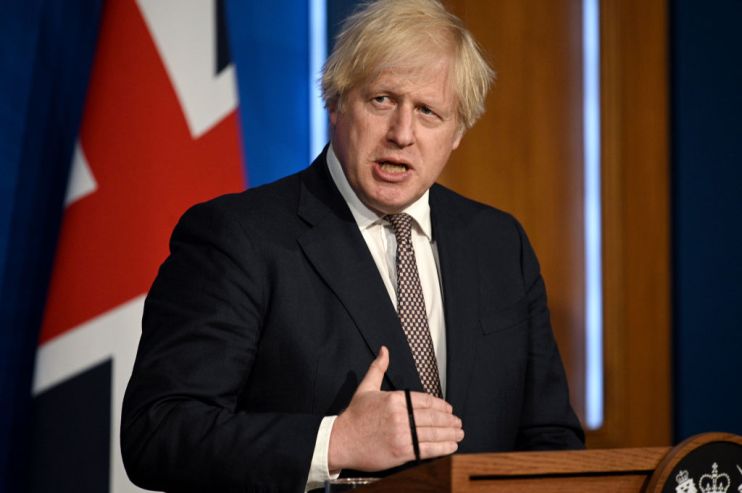
Boris Johnson has always been difficult to classify in ideological terms. Ten years ago, he was a small-state economic and social liberal who identified as a One Nation Conservative. His City Hall rival Ken Livingstone initially feared he was “the most hardline right-wing ideologue since Thatcher” but later concluded he was “a fairly lazy tosser who just wants to be there”.
In pursuit of victory in the Brexit referendum and then to the keys to Downing Street, the prime minister has tacked to the right, with one veteran observer describing him as a “British Gaullist”. He has certainly embraced nationalist rhetoric and used the home secretary, Priti Patel, as a talisman of tighter controls on immigration and a robust approach to law and order.
Economically, he has been defined by the Covid-19 pandemic, which struck less than a year into his tenure as prime minister. Rightly or wrongly, the government’s response to the economic impact of the pandemic has been to act now and worry about the consequences later: borrowing and spending has been lavish, with the Treasury running up a tab of £299 billion in the first year of the crisis and pouring out £100 billion to support jobs through initiatives like the furlough scheme. This was at a time when the income from taxation fell through the floor.
As part of the government’s plan to generate a post-Covid recovery, significant levels of public spending have been announced. Last autumn Chancellor Rishi Sunak said he would spend £600 billion over four years on infrastructure such as roads, railways and broadband, and the Treasury’s guide to investment decisions, the Green Book, will be amended to favour projects which contribute to “levelling up”. All of this is quite a departure for a party which in 2019 attacked Jeremy Corbyn’s election manifesto for irresponsible spending and pie-in-the-sky, interventionist economic projects.
In a crisis, principles can come at a premium, and Covid-19 has certainly been a crisis; but free marketeers with a preference for a small state can be forgiven for feeling uneasy at the government’s frenetic largesse. Further down the line, there will come a reckoning of who has to pay for the sky-high borrowing we have seen—and that will always, sooner or later, come down to a choice between raising taxes and cutting spending—but even before that there is the unsettling empowerment of the government as the driver of investment and economic growth.
Conservatism rests in no small part on the notion that, all things being equal, the private sector, private enterprise, private capital, are the best and most efficient vehicles for building prosperity. In the 1980s, this was expressed obviously through the privatisation of state-held assets like British Telecom, British Airways and British Steel: the evidence seemed clear that nationalised industries were inefficient, costly and ponderous. The subsequent growth of many of these businesses, and the explosion of share ownership, seemed to vindicate the direction of travel.
This is not to say that the government should play no role except as a distant, Olympian overseer.
What Johnson and his economic team are missing is the exercise of a power which is peculiar to government and peculiar in its potential to effect change: the power to convene. It may not seem like much, but the ability of national governments to communicate with even the largest multinational corporations, to have their voices heard (and their calls taken) by Facebook or BlackRock or ExxonMobil, can have a transformative effect. Best of all, this ability comes at no cost.
The government needs to see itself as an enabler of enterprise. It recently contributed £100 million to persuade Nissan to plan a huge new facility in Sunderland; it is throwing its weight behind similar projects in Coventry and Northumberland. Moreover it is the role of government to oversee investment from a strategic point of view. But it should know its limits. It is better by far to leverage its influence over the private sector than pick up the shovel or the trowel itself.
The scheme to connect the nation by high-speed broadband is a case in point. Although the government recognises that some uneconomic sections of the project will require financial support, the overall plan is for the private sector to take most of the strain, and, rightly, derive most of the initial financial reward. The government’s expected benefit is the strategic one of a country with reliable, high-tech infrastructure, while private enterprise—and therefore the economy as a whole through taxation—benefits in terms of customers and profits.
This is not an easy balance to strike. Ministers can be tempted by the direct impact of government spending, but they should restrain themselves and think about the longer term. This is about highlighting opportunities and facilitating cooperation. The government is not arranging a marriage between compliant and obedient participants: rather it is creating the atmosphere in which romance can naturally—and profitably—blossom.