Boris Johnson’s final claims and statements: Former PM’s last speech fact-checked

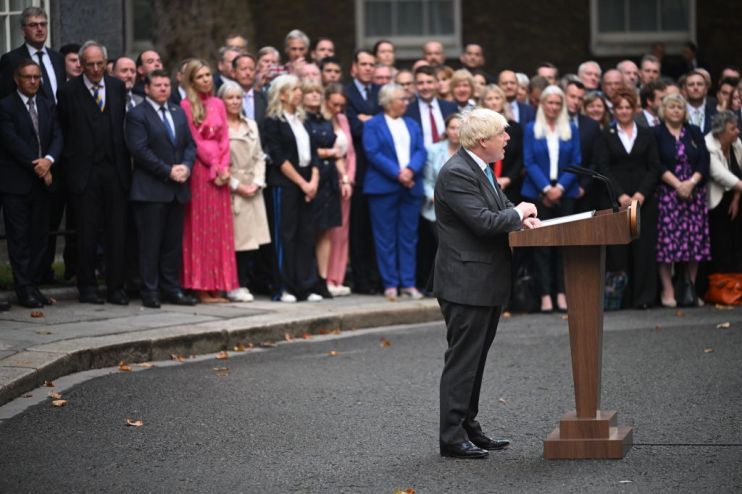
This morning Boris Johnson gave his final public address as Prime Minister on the steps of 10 Downing Street, before travelling up to Balmoral to hand his resignation to the Queen.
During today’s speech, Johnson repeated many of the claims he has made so often over his premiership, including on the Covid-19 vaccine rollout, hospital building and crime.
Full Fact took a look at the different statements, and fact-checked the speech for Morning Wire
“70 per cent of the entire population got a dose [of the Covid-19 vaccine] within six months, faster than any comparable country”
The initial rollout of the Covid-19 vaccine in the UK certainly happened quickly. However, Mr Johnson wasn’t quite right to claim that 70 per cent of “the entire population” received a dose within six months.
The first dose was administered in the UK on 8 December 2020. Six months later, on 8 June 2021, 40,710,319 people had received one. This represented 70.8 per cent of “the population aged 12 and over”, but around 61 per cent of “the entire population”.
According to figures collected by Our World in Data, the UK’s fellow G7 and OECD member Canada had given at least one dose of the vaccine to 62.4 per cent of the population on 8 June 2021.
Some other smaller, and so arguably less comparable, countries, including Malta, Bahrain, the Seychelles, the UAE and San Marino, had also vaccinated a higher share of their populations.
However, these figures depend on the accuracy of each country’s population estimates, which are always uncertain, meaning that close comparisons are not necessarily reliable. And far fewer people in Canada had received both doses by 8 June 2021, compared with the UK.
“We are delivering on those huge manifesto commitments making streets safer – neighbourhood crime down 38 per cent in the last three years”
The category of “neighbourhood crime” was first referenced by the Home Office in 2020, and refers to four specific types of crime: domestic burglary, vehicle-related crime, theft from the person and robbery.
Number 10 has confirmed to Full Fact that Mr Johnson’s claim that neighbourhood crime is “down 38 per cent” is based on a comparison of Office for National Statistics (ONS) figures from the Telephone-operated Crime Survey for England and Wales for the year ending March 2022, and the Crime Survey for England and Wales for the year ending June 2019.
This comparison shows that over this period there was a 38 per cent reduction in neighbourhood crime, but the total number of crime incidents, including fraud, fell only 1 per cent over the same period.
The number of police recorded crimes over the same period increased by approximately 5 per cent. However the ONS has noted that these figures may not be reliable, as they do not cover unreported and unrecorded crime.
“Delivering on those huge manifesto commitments… 13,790 more police on the streets”
It’s true that the latest figures from the Home Office show that 13,790 more police officers have been recruited in England and Wales as part of the government’s uplift programme.
This is part of a commitment to recruit 20,000 additional officers, which was made in the Conservative manifesto for the 2019 general election.
The figure of 13,790 represents an overall headcount, which means it includes people recruited to work part-time. The number of new full-time-equivalent police officers may be slightly lower.
On the other hand, the figure does not include people recruited by police forces using other sources of funding, such as council tax precept increases. The government says a further 516 additional officers have been recruited with other funding.
Official statistics show that the number of full-time-equivalent police officers (not including British Transport Police) stood at 140,228 at the end of March 2022.
This compares with a low point of 122,405 in 2018 and a high point of 143,769 in March 2009, in the data we have going back to 2003.
These figures don’t include other police staff, police community support officers or special constables. They have also not been adjusted to take account of rising population or changing crime rates.
“We will have … 40 new hospitals by the end of the decade”
This is a long-standing claim from Boris Johnson that we looked at in detail back in July. Since 2019 he has variously claimed that the government is building “48 new hospitals” or “40 new hospitals” by 2030. But whether that’s accurate depends on exactly how a “new hospital” is defined.
The government has announced funding for 40 new hospital building projects, and includes in its definition of a “new hospital” replacements for existing hospitals, new wings or buildings for existing hospitals and major refurbishments.
However many have taken issue with this, with health think tank the Nuffield Trust instead defining a “new hospital” as a “new building on an entirely new site”.
Using this definition, the BBC found that, of the 40 projects, there are three “new hospitals” (two general hospitals and one non-urgent care hospital).
A Department of Health and Social Care (DHSC) spokesperson told Full Fact in July that the government was “on track to deliver 40 new hospitals by 2030”.
There are also questions over the timescale of the building projects as well as how they are defined.
In November 2021 the Health Service Journal reported that the infrastructure watchdog had downgraded its assessment of the New Hospitals Programme to “red”, indicating the project “appears to be unachievable”. The DHSC told us in July that this report was inaccurate.
“Putting record funding into our schools”
School funding is devolved, so the UK government only sets the funding for schools in England.
It’s true that in cash terms the total amount of funding for schools for those aged between 5 and 16 is the highest it’s been, by some margin. In 2022/23 £53.5 billion is allocated to schools, compared to £35 billion in 2010/11.
But comparisons of school funding over time usually factor in inflation, to take account of rising prices, and spending per pupil, to take account of the total number of children being taught. Doing this gives a more complicated picture.
According to the government’s school funding statistics, adjusted for inflation funding per pupil was “broadly flat” between 2010/11 and 2015/16 at just under £6,400 in 2021/22 prices, before falling in real terms, then rising slightly overall to £6,780 in 2022/23 (again, in 2021/22 prices).
In its 2021 review of school funding, the Institute for Fiscal Studies (IFS) projected that between 2009/10 and 2024/5, “there will be almost no overall real-terms growth in school spending per pupil”.
Finally, “Unemployment [is] down to lows not seen since I was about ten years old and bouncing around on a space hopper”.
While we have repeatedly pointed out Mr Johnson’s misleading use of labour statistics over the last year, for which he has been criticised by the Office for Statistics Regulation, this particular claim is true.
The unemployment rate is currently 3.8%, the joint-lowest level since late 1974. That’s when Mr Johnson was, indeed, 10 years old (though we’ve no information on his use of space hoppers).