Three key changes that underpin the new Brexit deal

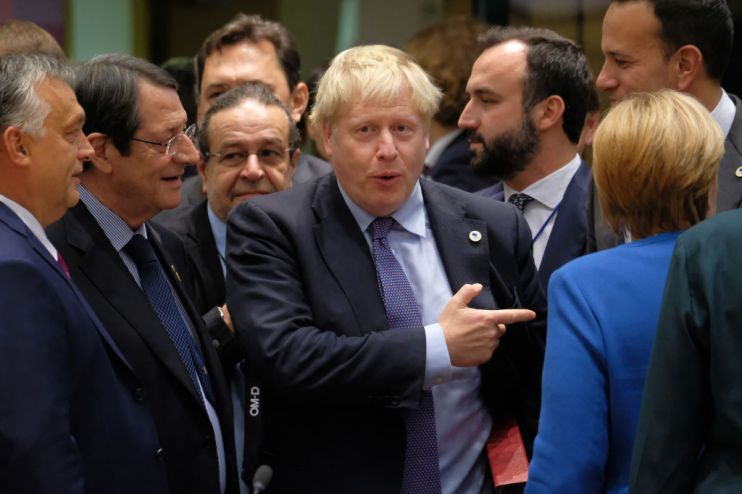
Prime Minister Boris Johnson has defied his critics to negotiate a new withdrawal agreement for Brexit.
Much of the opposition to the previous deal, struck by Theresa May, centred on the controversial subject of the border between Northern Ireland and the Republic of Ireland.
The EU Commission has published a 64-page document detailing the revised text, which overhauls the so-called Irish backstop.
But what exactly has changed?
Read more: Brexit breakthrough: How the City responded to the deal
1. Breaking the backstop
The sticking point of Theresa May’s deal was the backstop arrangement – a setup designed to avoid a return to a hard border between Northern Ireland and the Republic of Ireland.
Under the original proposals, the UK would have remained in the EU customs union. This “all-UK” backstop would have remained in place on a temporary basis, until a new trade emerged to replace it.
This plan was unpopular among many Brexiters, as it did not represent a clean break from the bloc. The UK could only end the backstop arrangement with the EU’s consent, meaning the EU would still have the power to block the UK’s departure.
Moreover, the UK would not be able to set its own tariffs and strike trade deals with other countries while the temporary arrangement was in place.
Under the new proposals, the whole of the UK will leave the customs union. This will allow the UK to secure free trade agreements with other countries.
The new setup is entirely specific to Northern Ireland, and will mean the region remains aligned to a limited set of EU rules.
Crucially, the customs border will now be between Great Britain and the island of Ireland, rather than between Northern Ireland and the Republic of Ireland.
This means incoming goods will be checked at Northern Irish ports, not at the internal border.
So, the default is that EU tariffs will be applied on goods entering Northern Ireland from Great Britain, or from the rest of the world.
There are, of course, exceptions to this. If it can be proved that the goods will not pass into the Republic of Ireland, no tariffs will apply.
Likewise, the tax will not apply to ordinary people. For example, if you move house from London to Belfast, you will not be charged to transport goods.
There will also be a rebate system. If goods are considered “at risk” of moving into EU territory, tariffs will be applied. But if they never leave Northern Ireland, the government will grant a refund. A joint committee will be set up to determine which goods fall within this category.
Essentially, the measures will create a dual tariff system at the Northern Irish border, where the default is EU tariffs, but exceptions apply.
Sam Lowe, senior research fellow at the Centre for European Reform, describes the deal as “Chequers for Northern Ireland”.
2. VAT overhaul
In addition to trade tariffs, goods moving across borders can be subject to VAT, a tax added to purchases.
Under the new proposals, VAT will apply to goods in Northern Ireland, but not to services.
However, Northern Ireland would be able to have different VAT from the rest of the UK, allowing it to align its rates with the Republic of Ireland.
This would ensure smooth movement of goods, and also mean that there would not be an unfair disparity of prices on different sides of the border.
But this tax split between Northern Ireland and Great Britain could put a spanner in the works. In a joint statement, DUP leader Arlene Foster and deputy leader Nigel Dodds said there was still a “lack of clarity” over VAT.
Read more: Pound hits five-month high after Boris Johnson announces Brexit deal
3. Stormont Lock
Another hurdle for Theresa May’s withdrawal agreement was an apparent lack of consent for Northern Ireland, with Johnson branding the deal “undemocratic” and vowing to give Stormont a say.
The new proposals give Northern Ireland the chance to vote on the agreement. If the deal is passed by a simple majority, the arrangement would continue for another four years before another vote is needed. If it is passed by a larger majority, this would be extended to eight years.
Conversely, if the Assembly votes against the deal, there would be a two-year cooling off period in which new measures would need to be secured.
What remains the same
- The UK will continue to abide by EU rules until at least the end of 2020 to enable businesses to adjust. This could be extended by one or even two years.
- The UK will still pay a so-called divorce bill, which is now expected to be roughly £33bn.
- The rights of EU citizens in the UK, and UK citizens in the EU, will be guaranteed.
Main image credit: Getty