Britain knows how to seed a scaleup. But can it back one all the way?

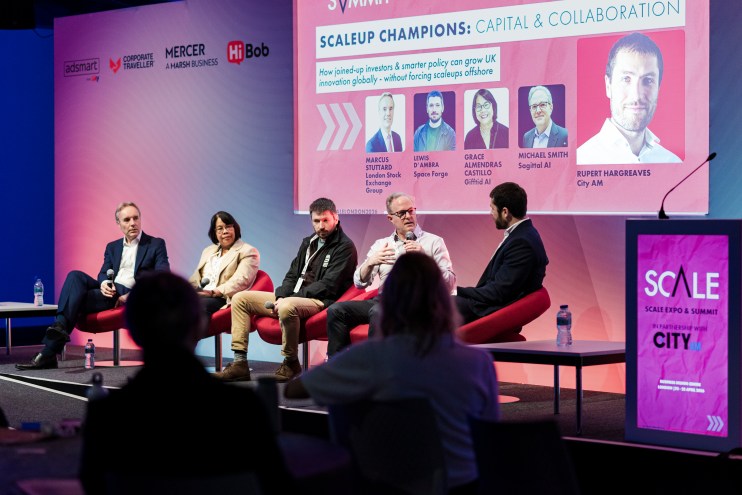
How do we keep high-potential tech founders headquartered in Britain, instead of watching them drift offshore, taking their growth stories with them? This question was posed to the Head of AIM & UK Primary Markets at London Stock Exchange Group (LSEG), and a panel of tech founders at SCALE Summit in London.
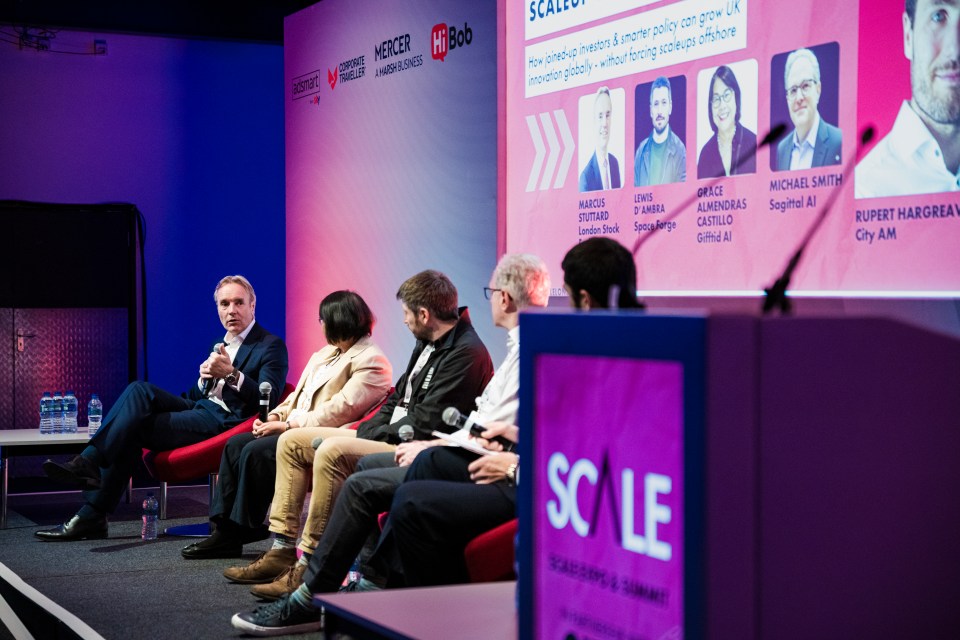
On 23 April at London’s Business Design Centre, Rupert Hargreaves, Morning Wire’s COO stepped on stage to chair a conversation between Marcus Stuttard, Head of AIM and UK Primary Markets at the London Stock Exchange, Grace Almendras Castillo, founder and chief executive of Gifftid AI, Michael Smith, co-founder of Sagittal AI, and Lewis D’Ambra of Space Forge, the space manufacturer which raised £22.6m in 2025 – the largest Series A in UK space tech history.
The issue Hargreaves raised is one I hear from founders constantly: “The biggest criticism is that UK small businesses or scaleups can’t access funding, or they find it difficult to access funding in the same way a startup in America might do,” he said.
I’ve sat through enough panels on UK scaleup funding to know how most of them go: a polite acknowledgement that Britain is good at seed-stage support, followed by a long list of reasons why everything gets harder after that. Securing the investment needed to compete and internationalise from a UK HQ continues to be a common scaleup struggle, creating pressure for them to relocate, often ‘Stateside’.
Here’s what’s actually changing, and what still needs to be done about it.
The start is not the problem
All four panellists agreed the UK’s starting conditions are genuinely strong. We’re not suffering from a broken ecosystem – far from it. Smith, whose company builds AI agents for software development teams, said the “talent to cost ratio here is exceptional” and praised the UK’s regulatory approach as “go slow to go fast.”
D’Ambra was also complimentary about the UK’s regulatory pathways: “Even when you submit an application, you can still talk to the regulators, you can still move things forward,” he said, contrasting it with more rigid “submit and wait” systems elsewhere. He also rates the UK when it comes to access to institutional capital. “Access to grants, funding, and R&D pots of money make it a really really good place to start collaborating with universities, building up that R&D to get your business ready to start scaling rapidly.”
Almendras Castillo, who moved to the UK under the Global Talent visa after building and selling a company in the US, called the ecosystem “a secret advantage” for founders. “I couldn’t believe that in less than two years I built the product here,” she said. She has since chosen to headquarter Gifftid AI, and hold its IP, in the UK rather than Canada or the US.
She argued that many modern SMEs are “IP rich” with signals of readiness that go beyond financial metrics. What the UK’s ecosystem of universities, accelerators and public funds needs, she saysm, is a clearer mechanism to interpret those signals and match founders with the right kind of capital. Through Gifftid AI, she’s working on creating that mechanism. “It’s the ability to act on those signals that counts”, she said, “rather than sitting in policy.”
Stuttard, who leads the LSE’s work with private companies around the country, confirmed the UK undersells what we’ve got. “We have all of the raw ingredients that we need for huge success,” he said, pointing to roughly 40,000 visible scaling businesses in the UK and a package of grants and loans, EIS, R&D tax credits and government–backed support from Innovate UK and the British Business Bank, that overseas peers “look at with real envy.”
The gap is in the middle
The UK serves many seed stage founders well, and also large, established companies, but what about everyone else in between?
Smith says founders here end up paying VC-level prices for capital that comes with debt-level caution. “It’s surprising to me how people want to see a million pounds ARR before they give you a million pounds investment”. Unlike in the US, where investors back the vision: “They can see what’s needed, can see that you’ve got enough traction to get going, and that’s enough to get them to throw money at the problem.”
D’Ambra agreed that the earliest stage of funding, through schemes like SEIS and EIS, is “really, really good in the UK,” and said support exists at the top end too. It’s the bit in the middle where things start breaking. “How do you jump from a small business that’s just starting out up to a big scaled-up company? That is the question I think we really need to focus on and tackle.”
Most of Space Forge’s private capital comes from outside the UK. Its largest single cheque came from Germany, and the bulk from the US. D’Ambra put it down to risk appetite as much as anything else: “They’re more willing to take that risk and jump forward”.
“How do we anchor ourselves properly in the UK? The more UK private capital I can get in, the easier that argument is to make,” D’Ambra said.
Domestic capital, not just global capital
Stuttard’s argument is that the UK’s ability to attract overseas investment is a strength worth keeping, but with domestic capital sitting alongside it, not instead of it. “It’s a structural advantage in the UK that we attract so much overseas investment,” he said. “The point here isn’t to try and limit that. It should be just to make sure that our own domestic investors are cornerstoning and underpinning our domestic businesses.”
He explained how pension fund regulation is shifting away from a pure focus on cost and UK attitudes need to keep shifting towards taking more risks. “We can’t regulate risk out of the economy because if we do, we’re not going to get growth,” Stuttard said.
“For too long pension funds have been regulated just on cost rather than thinking about what’s the long-term return,” Stuttard continued. “There have been what look like some fairly technical changes that will have a massive impact over the coming years. In the longer term, if we invest in our businesses, as a society, we’ll get a much greater reward”.
As things stand, we’re “doing all the hard work as individuals and as taxpayers to de-risk businesses for overseas investors to benefit,” Stuttard said.
The solutions
It’s clear that the UK has plenty of capital and plenty of support infrastructure, just not enough connecting the two.
Almendras Castillo has built her company, Gifftid AI, around exactly this gap. “There are a lot of universities funding advanced learning, a lot of accelerator programs and supportive systems, but to connect capital with that infrastructure there’s got to be a routing mechanism”. Gifftid AI has developed a tool that matches a given business with the right type of capital, whether that’s venture funds, impact funds, private capital or programmatic government funding.
D’Ambra had a specific request for government, a few months before Jonathan Reynolds was appointed by Andy Burnham as Secretary of State for Business, Innovation, Science and Trade. “When you’re building a startup, it’s like building a car whilst also trying to drive the car,” he said. “What I need the government to do is to build a road in front of me” with access to infrastructure, access to funding through public procurement, grants and R&D support, and regulation that keeps pace.
Founders, keep it simple
Stuttard offered founders one piece of advice above all others: clarity. “Be able to tell a really clear story – not about your company and its technology – but about the growth opportunity for investors, and keep it really simple,” he said.
For Almendras Castillo, the key to fundraising is to “be very specific on the signals that align with the investors that you’re speaking with”.
Smith’s advice was to be willing to walk away from the wrong money. “The faster you can get to a no, the better off you are,” he said. “You can tell in the first ten minutes whether they care about you.”
How do you think the UK can improve access to international markets and capital, and stop offshoring our breakthrough ideas? This conversation will continue at SCALE Manchester, where the founders living this problem will connect with the investors and policymakers who can help fix it. Join us on 25 November 2026. Find out more and register here.