Build back better? No, let’s build back smarter and take carbon out of construction

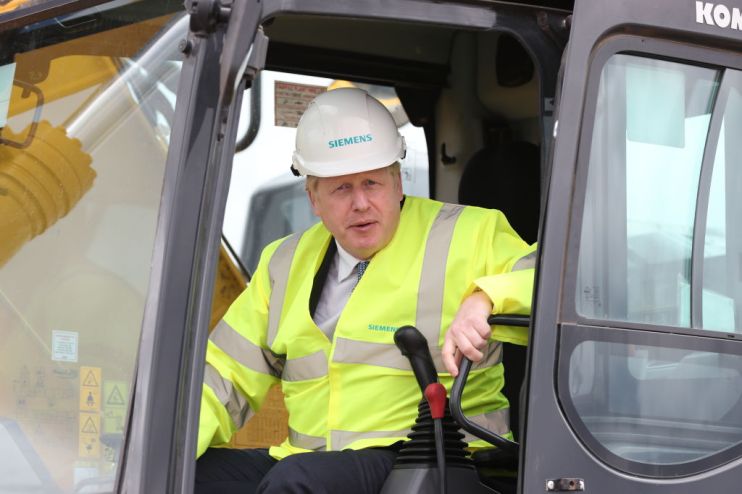
Boris Johnson has set out his plans to “build back better”, and major changes have recently been announced to planning regulations to enable faster decisions on planning applications.
It sounds like a developer’s paradise. But construction already accounts for nearly two fifths of UK carbon emissions, so where does that leave the government’s equally vaunted ambition to achieve net zero carbon emissions by 2050?
The Covid-19 pandemic has focused our minds not only on eradicating the virus but also on other existential threats like the impact of climate change. There is a global consensus that we must use every means at our disposal to limit carbon emissions from fossil fuels.
Read more: We need a carbon border tax to get Britain to net zero
There are less than 1550 weeks until 2050, the government’s target of net zero carbon emissions, and the clock is ticking. I am chairing a working group for the National Engineering Policy Centre to work out how to best achieve this — and we have looked first at construction.
The UK needs to improve its infrastructure and build more housing, and we need the jobs and inward investment these will create. But we must measure and record the long-term carbon cost of these projects against incredibly ambitious targets, so I prefer “build back smarter” as a mantra for the industry.
Our group has found that the capability and tools already exist to create a construction industry that can deliver a low-carbon built environment, but they are not in mainstream use. As an industry, we need to shift the focus to improving our existing infrastructure and embedding low-carbon design as standard for new projects. But if we don’t do this with the current wave of construction, it will be too late to meet the 2050 targets.
At the same time, government procurement must challenge us to do better by requiring and incentivising low-carbon design, and introducing whole-life carbon targets to make us measure and be accountable for the true environmental cost of what we build.
It can be done. A cross industry-government agreement to set ambitious energy consumption targets for new buildings, like the one adopted in Denmark, would be a perfect starting point.
Read more: Boris Johnson unveils £350m to fuel decarbonisation of industry
We should also think about the kinds of buildings that we are going to need in the future. The Met Office is already forecasting that 2020 is likely to be the hottest year on record, and as summer heatwaves become more frequent we may want air conditioning or other cooling systems. This should be planned into building design now. New buildings could be constructed with passive cooling measures such as heat-absorbing materials or better shading systems, as well as energy-efficient technologies like air-source heat pumps that can both heat and cool.
We must also look at how we can cut emissions from existing buildings, especially in Central London where high density housing and lack of green space create a heat island effect. I am particularly passionate about the potential of retrofitting to help reduce our carbon impact. Refitting an existing building is more carbon-efficient than knocking it down and starting again.
For example, 1 Triton Square was designed by Arup for British Land in the 1990s — 20 years later, we have updated the building to save the equivalent of 40,000 tonnes of carbon dioxide, doubling the office area and achieving a BREEAM Outstanding sustainability rating. Once complete, it will provide an environmentally responsible, socially active workplace for 4,000 people.
Read more: A CEO’s guide to reaching net zero carbon emissions
As we decarbonise, we must make cities more liveable for the people in them. If government sets the standard by placing people front of mind, the private sector will follow, creating spaces that are comfortable, inclusive, provide better living space and improved air quality.
Adopting lower carbon construction practices will be challenging, so we need to think strategically. This means serious incentives for low-carbon buildings, not just procurement at the lowest cost. The pandemic has brought together the construction industry to speak with one voice, and we should capitalise on this industry cohesion to embed low-carbon in the government’s infrastructure investment programme, so that the construction industry can lead the transition to a low-carbon UK.
Decarbonising the construction industry is a wicked problem with many facets, but it is in the industry’s gift to make the urgent, transformative changes needed — if we get the right incentives and policy direction from government.
Main image credit: Getty