Business has never been a man’s world – meet the women who bankrolled history

A new history challenges the myth that business was “just for men” by uncovering the forgotten stories of powerful female entrepreneurs, bankers, and industrialists who have been crucial to building global prosperity throughout the ages, writes Victoria Bateman
Hidden away inside the British Museum is a little-known collection of women’s business cards dating to the 18th century. It includes the card of Ann Askew, a London-based shoemaker, emblazoned with a large boot and the text “next Door to the Three Tuns and Rummer”. The address might seem unusual to us today, but in a time before street numbers had become widespread, her shop would have been identifiable by the boot symbol which hung above her doorway. Not only does the card tell us that she sold “all sorts of shoes, boots, and slippers” it also tells us that she exported them overseas. Ann Askew was not unique. Historic business cards of female entrepreneurs reveal numerous women fan-makers, hat-makers, toy-makers, printers, jewellers and tea sellers. The economy, it seems, has never been “just for men”.
And yet when we think about the past, we suppose that men were the ones bringing home the proverbial bacon, sustaining their wives and children on the money they earned working in fields and factories or as butchers, bakers and candlestick makers. We imagine that men dealt with money while women dealt in something else entirely – the love that makes the world go around. We assume that business – at least until the second half of the 20th century – was exclusively for men.
In my new book Economica: A Global History of Women, Wealth and Power, I show how wrong this view of the past really is, and present a new and more accurate economic history of the world – one that journeys through our most glittering civilisations and all of the major economic revolutions – but told, for the first time, from the point of view of not just men, but women as well. I show how women hunted alongside men in the Stone Age, how women wove the cloth that acted as the currency of trade during the Bronze Age, how women built pyramids alongside men in ancient Egypt, how women helped to plumb the ancient city of Rome, how women brewed beer in medieval London, and how women worked in mining during the Industrial Revolution.
While men like Henry Ford, JP Morgan and Warren Buffett loom large in business history, their female counterparts have been consigned to at most the footnotes of history. In Economica I shine the light on the unsung female entrepreneurs, bankers and industrialists who helped to build modern day prosperity, and without whom our economies would be far less prosperous.
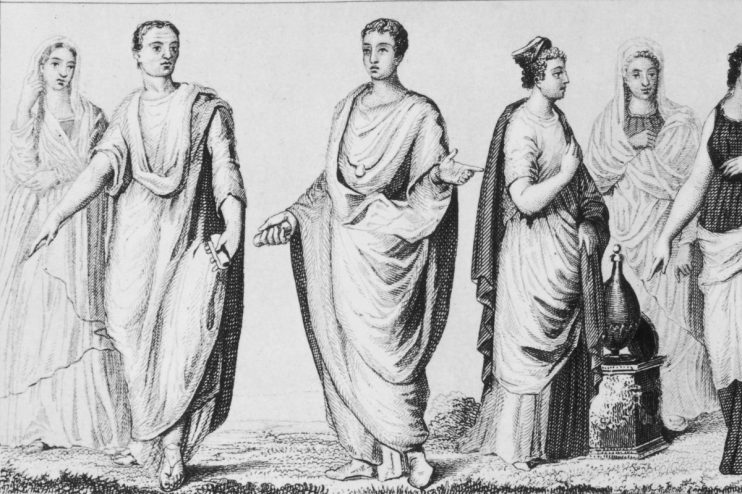
They include Julia Felix, who was a shining example of self-made success in Roman Pompeii. Descended from freed slaves, and with questionable parentage (described as the daughter of ‘spurious’), she built a property empire that consisted of baths, a bar, shops and apartments. Whereas upmarket property was, historically, decorated with images of famous battles or mythological scenes, at the heart of Julia’s recreational and entertainment complex were murals representing business life. Positioned in the atrium, and visible to bathers, diners and drinkers alike, was a 20m-long frieze packed full of everyday market scenes. We see the transportation of goods by mule and cart, the sale of cloth and bread and a good deal of window shopping (albeit without the windows). By making market activity the artistic highlight of her building, Felix elevated the everyday world of business. This tells us that those who frequented Felix’s mall would not have been offended by commerce and had likely made their way in the world not through military or political means – as was typical of the elite class – but instead through success in business. Unlike ancient Athens, where both women and commerce were looked down on in equal measure, the Roman world was much more conducive to both economic growth and women’s participation.
The eventual collapse of the Roman Empire was followed by the Middle East entering its golden age, helped by one particular businesswoman: Khadija, one of the wealthiest merchants in the oasis town of Mecca. In the sixth century, Mecca was a bustling centre of trade. From Syria in the north to Yemen in the south, travellers flooded into the town from far and wide, creating opportunities for buying and selling everything from gold, frankincense and myrrh to pearls, cloth and spices. Making the most of Mecca’s geographic location, Khadija operated a sizeable fleet of camels – a trading caravan – that moved animal skins, leather and cloth across the Arabian deserts. To help take care of her camels, she employed a young man by the name of Muhammad, who was known for his honesty and hard work, and she went on to propose marriage. Later, while contemplating in a cave on Mount Hira near Mecca, Muhammad reportedly came face to face with the Angel Gabriel and began to receive the revelations of Allah. Khadija became his first convert, and her financial, as well as emotional, support was crucial to the spread of Islam.
The silk roads
Through the Silk Roads, Islamic merchants traded with another of the world’s most prosperous regions at the time: China. Silk – produced by Chinese women – was (as the name suggests) the currency of the Silk Roads. All traded items – which included incense, gold, silver, livestock and slaves – were priced in terms of bolts of silk, which comprised 40ft-long pieces of strong and lustrous silken fabric that could be folded into a lightweight package. The Chinese state promoted the motto “Men plough, women weave” and taxes were commonly collected in the form of both grain and cloth. Women were also instrumental when it came to the development of silk’s biggest competitor: cotton cloth. It was a woman named Huang Dao Po – who ran away from home at the age of 10 in order to escape an arranged marriage – who developed new technologies, such as the treadle-operated spinning wheel, which raised productivity and transformed the financial prospects of Chinese women. Indeed, in some regions of China, a woman’s weaving could generate more money for a family than a man’s agricultural work.
By the 18th century, European manufacturers were (finally) catching up with China, and London was in the midst of a financial revolution. While the streets and lanes of the City were filled with smartly dressed men – wearing top hats and carrying briefcases – a woman by the name of Priscilla Wakefield was on a mission. Just north of the City, in Tottenham, she established the first bank for women and children, opening up the world of banking to ordinary people rather than just the wealthy elites. Her first saver was a 14-year-old orphan girl, who made a deposit of just two pounds. From as little as a penny, any woman or child could open a savings account at Wakefield’s bank, and their deposits were in turn invested in government bonds, allowing Wakefield to pay interest of around five per cent. Instead of running her bank from a grand building, Wakefield set up a table in a local school, advertising where she could be found in the local press. In response to popular demand, in 1804 Wakefield extended her bank accounts to men.
At this time, women were also making inroads in the stock market, so much so that by the end of the 19th century, a third of railway investors were women. Over in the US, a woman by the name of Hetty Green was fast becoming America’s first female tycoon. Green grew up around her elderly grandfather and, since his eyesight was starting to fail, as a child was tasked with reading out to him the prices of stocks and shares from the daily newspaper. At the age of eight, she made her way alone into the nearest town – New Bedford in Massachusetts – where she opened a bank account with her pocket money. This was just the start of Green’s financial career: by the time she passed away in the early 20th century, she was worth $100m ($2-6bn in today’s money). Her investments included real estate, mines, railroads and government bonds. But rather than recognising Green’s financial genius, the press nicknamed her the ‘Witch of Wall Street’ – a soubriquet far more disparaging than anything directed at her male peers. Despite her wealth, Green lived a relatively austere life, refusing to become a ‘socialite’ and instead enjoying time with her family (and her dogs). When questioned by a reporter on the source of her success, she replied that it was common sense and hard work: ‘I buy when things are low and nobody wants them. I keep them until they go up and people are crazy to get them. This, I believe, is the secret of all successful business.’
Rather than recognising Green’s financial genius, the press nicknamed her the ‘Witch of Wall Street’ – a soubriquet far more disparaging than anything directed at her male peers
As I show in Economica, history is filled with enterprising women who built successful businesses and made their fortunes, but whose contributions have been regularly overlooked, minimised or disparaged. The more we recognise history’s female merchants, bankers and industrialists, the more we can see that business is not – and never has been – just for men.
Dr Victoria Bateman is an economic historian, historical consultant and Fellow of the Royal Historical Society