Business should be grateful for the House of Lords

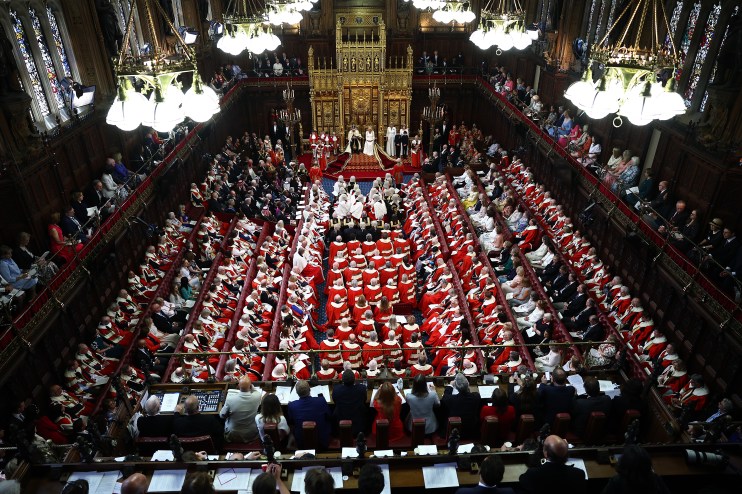
Few would argue for our current constitutional arrangement if it didn’t already exist, but right now the House of Lords is doing an important job challenging the government from the right, says Emma Revell
Standing in the middle of Canada, you often feel like you’re part of a Britain that’s racing into the future. Pay a visit to the House of Lords, and you’re part of a Britain that’s firmly stuck in the past.
One is fast-paced, sleek and modern, with bustling streets of glass and steel. The other is, at best, a little fusty. Dark wooden rooms, panelling and gilt, an entrance lobby that – with its parade of coat pegs for every peer – resembles a very, very posh version of a primary school changing room. One is go-getting and meritocratic. The other revolves around privilege, much of it quite literally inherited.
And yet, as 2025 turns into 2026, the business world has quite a lot to thank the House of Lords for.
Usually, if a government wants to implement laws most bosses would consider fundamentally flawed and borderline destructive to the economy, they would put their faith in the opposition parties to try to stop them. In 2025, however, that role has been played by other chamber.
That isn’t to say the Conservatives and others in the House of Commons haven’t been playing their part. But given Labour’s overwhelming numerical advantage in the Commons, plus the fact that the bulk of backbenchers were first elected in 2024 and are therefore unlikely to be sticking their necks out so soon in their parliamentary careers, it stands to reason that Keir Starmer’s government gets its own way in the Commons almost all of the time – and when it does lose, it’s usually due to rebellions on the left rather than from the right.
Step forward, the House of Lords.
On the Employment Rights Bill, peers just last week backed an opposition amendment to force a review of a plan to abolish a cap on compensation in unfair dismissal cases, which a Conservative shadow minister said would be “a recipe for the rich and a wrecking of justice for working people”.
Trade unions have accused peers of “defying the will of the British public” – despite the fact the removal of this cap was not mentioned in the Labour manifesto at the last election, and that businesses have been clear in their concerns about the impact of the Bill.
‘Insufficient detail’
The government’s own impact assessment of the Bill as it was originally introduced estimated that the measures could cost businesses up to £5bn per year – an astonishing sum which would devastate their ability to generate growth and create jobs. The Institute for Fiscal Studies has suggested that up to 80 per cent of those extra costs would filter through to workers in the form of lower wages than would otherwise be offered. And at last month’s Budget, the Office for Budget Responsibility had still yet to score the impact the Bill would have on productivity or growth because of “insufficient detail”.
To me, that gives the House of Lords every right to push for clarity and pass amendments seeking to limit the burdens being placed on business. Not least because of the dirty little secret of the British state – that the laws coming up from the House of Commons are often staggeringly slapdash, and need the second chamber to fix them in the edit. With the Employment Rights Bill, for example, the government ended up putting forward 200 pages worth of amendments to its own legislation, because it had been so poorly drafted.
I think you’d struggle to find anyone who would argue for our current constitutional arrangements if they didn’t already exist. A second chamber that is bursting at the seams, and whose members have legislative power for life with no real requirement to actually turn up? One dominated by political appointments, alongside a bewildering variety of cultural figures, a smattering of bishops, and nearly 100 legislators who are there because their three-times grandfather did George III a favour.
While Labour’s front bench in the Commons is a safe space for those who have little to no private sector experience, the Lords has it in abundance
But the unique way the country elevates people to a peerage has given the upper chamber a particular set of skills. While Labour’s front bench in the Commons is a safe space for those who have little to no private sector experience, the Lords has it in abundance. From the entrepreneurial founders and investment bankers who know what it takes to start and grow businesses to FTSE 100 CEOs with both feet firmly under today’s boardroom tables, our legislative process is strengthened by those with real experience and the ability to step outside of partisan politics.
It may be Labour policy to do away with the House of Lords. For now, business should be glad it has their back.
Emma Revell is external affairs director at the Centre for Policy Studies