Can British bullishness tackle one of the globe’s biggest climate problems?
It’s not a myth. Climate change is here and it’s happening — it’s not just happening in David Attenborough documentaries. The effects of climate change are measured and proven — ice caps melting, rainy seasons are getting shorter, vegetation is drying out and dying, more cloud cover, record heat temperatures, the weather is becoming more extreme…
Naysayers who firmly believe historic temperature changes (“Ice Age”) are behind the warmer temperatures are ignoring the timeline: these changes are more rapid, happening over 100s of years rather than 10,000s or 100,000s of years. And what’s happened in the past 100-200 years? The Industrial Revolution: humans building factories that run on burning coal, pumping out billions and billions of tons of CO2. A revolution that Britain very much brought to the world. Yes, there’s been a turn away from coal towards renewables over the past 30 years, but global temperatures are still rising at an alarming rate. Small changes aren’t cutting the mustard.
Change has to be big and it has to be now.
“But CO2 has always been around. It’s natural!”
Correct. But there’s a difference. Demand for ‘stuff’ continues to rise at a rate far higher than the increase in population. In 1800, the global population was 1bn. Now it’s 7.7bn. And in 2050 it’s set to hit 9.7bn. That’s a drastic change, and each of those 7.7bn needs clothes, food, access to housing and electricity, technology, and transport. Currently, the majority of those necessities are made at factories running on coal, transported by vehicles running on diesel or petrol, packaged in single-use packaging (which were also produced at factories running on coal), to be used and sent to landfills where it just…stays. Sometimes even seeps.
It’s one thing asking individuals to use public transport instead of personal cars or electric heating rather than gas, but it’s the big industries making the biggest contribution:
- The energy sector (transportation, electricity and heat, buildings, manufacturing and construction, fugitive emissions and other fuel combustion) = 75.6%
- Agriculture = 11.6%
- Industrial processes (chemicals, cement, etc) = 6.1%
If we can shift these industries towards more environmentally friendly, lower emission practices then we can make a big difference. Where possible, doubling the number of processes operating in a circular economy (from 8.6% to 17.2%) will reduce emissions by 39% and material footprint by 28%.
CO2 trapped in fossil fuels is released when burnt, where without human intervention, it would still be trapped. CO2 is removed from the atmosphere by dissolving in the sea or through photosynthesis performed by the plants and trees that are being torn down and cleared to make way for housing and industry. The Amazon rainforest is being cleared a football pitch a minute. Adding more CO2 to the atmosphere whilst simultaneously removing the natural mitigators that absorb it creates a problem where the percentage of CO2 in the atmosphere is much higher than its natural prevalence. As a population, we need to change the balance of emissions to absorption. Easier said than done and fine words butter no parsnips. So how can we, as the entrepreneurial world-changing British, go about reducing atmospheric CO2?
It helps massively that London is the second largest financial hub globally and the largest in Europe. Basing future-proof sustainable businesses in London strengthens its position as number 2 as well as providing each of those businesses with golden opportunities for investment and growth.
What is done cannot be undone
Replanting trees is a step towards righting forest clearance, however, they don’t grow to mighty oaks overnight. What can we, as a population, do in the meantime that reduces the volume of CO2 in the atmosphere but doesn’t take 20-30 years? We can start by reducing our carbon emissions:
- Use renewable sources to make electricity
- Make products using secondary materials rather than raw materials
- Streamline production processes and emit unnecessary steps
- Filters that capture and purify factory carbon emissions
- Developing large scale devices that capture and purify CO2 directly from the atmosphere
- A circular economy
One thing leads to another
How do we achieve a circular economy? One way is to make new products from secondary materials. One material that can be endlessly recycled with no losses to quality is aluminium. Which, unfortunately, contributes 2% of CO2 globally and uses 2% of the world’s power to produce. It’s also highly in demand. With a global aluminium market value of $163.5bn (2018) predicted to reach $235.8bn in 2025 and a global demand growth of 80% by 2050, there’s money in ensuring aluminium is produced by secondary sources. Cleaning up just this one material will have a significant impact on the green transition.
Rather than adding new material to the product cycle, each ton of secondary aluminium clears 7.2 cubic metres of landfill before entering a limitless use – recycle – repurpose cycle. Because of aluminium’s physical properties, quality of resulting products remains constant irrespective of cycle number – quality of tertiary aluminium is equivalent to nonary aluminium and so on. Transferring aluminium production to a circular economy ensures the environmental savings occur every loop; and when accounting for technological developments, energy efficiency will continue to improve (e.g. all factories and operations transport running from renewables) and less environmental damage will be inflicted by production and supply chains.
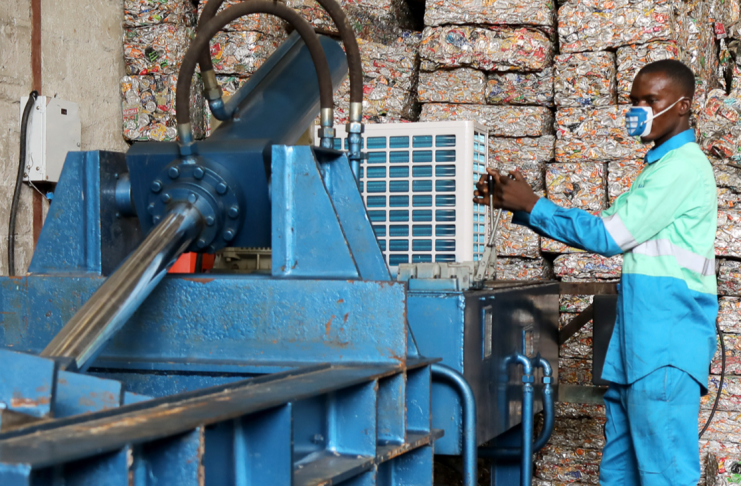
Romco is a uniquely British solution to cleaning up aluminium, taking advantage of Africa’s abundance of scrap and recycled-metal market potential. Since launching in 2017 up until 2021, Romco has cumulatively saved 352,991mt CO2 in comparison to the equivalent output from primary production. That’s a lot. The equivalent of saving 817,249 barrels of oil from being burned. But there’s potential for a lot more. When industries and companies work collaboratively, reaching the Paris Agreement’s climate goal doesn’t seem as impossible as it does, not downplaying the difficulty of the challenge. The climate situation is bleak; and, unless we just pull our socks up, bite the bullet, and make the changes necessary, ‘brighter days ahead’ will just be a euphemism for the dominoes-like-problems caused by global warming.
Learn more about truly sustainable partnerships in the commodities space by subscribing to our news at https://romcometals.com/news-insight/, or by visiting romcometals.com