Skip to content
Friday 28 August 2026London --:--Frankfurt --:--Zurich --:--
NewslettersSearchEN · DE · FR
MorningWire

European business, markets and politics

FTSE 100
10,792.54
-0.79%
DAX
26,367.24
+0.31%
CAC 40
8,319.87
-1.68%
STOXX 50
6,424.73
-0.71%
  • Europe
  • Markets
  • Business
  • Economy
  • Regulation
  • Politics
  • Opinion
More
GermanyFranceEU InstitutionsCompetitionPublic AffairsBankingTechnologyEnergy
  • Germany
  • France
  • Europe
  • Markets
  • Business
  • Economy
  • Regulation
  • Politics
  • Opinion
  • DE
Thursday 07 November 2019 6:31 am  |  Updated:  Thursday 07 November 2019 7:28 am

Can business models like Wework’s really work?

By: Robert Stokely

Add as a preferred source on Google
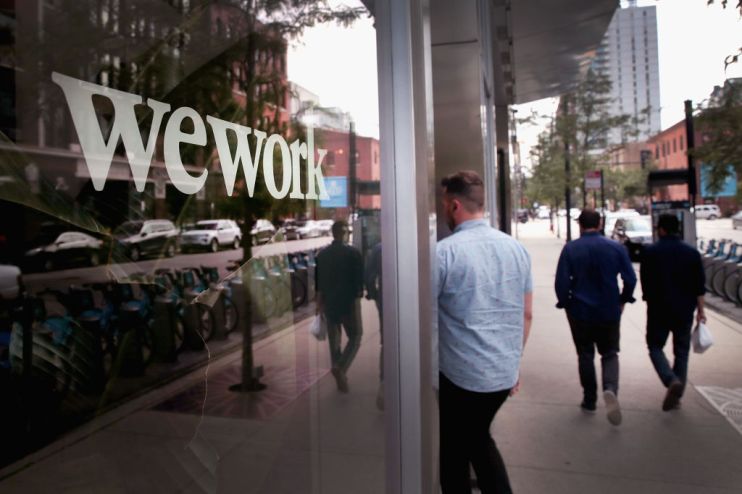
(Photo by Scott Olson/Getty Images)

Flexible businesses can, by their very nature, roll with the punches and evolve as their customers do.

But the recent pace of change at WeWork has shown that even the most flexible of businesses can be at risk.

Those of us in the property industry cannot fail to have noticed how WeWork has become central London’s largest office tenant in less than 10 years. It reportedly occupies 808 offices in 123 cities worldwide, while also losing $1.9bn on turnover of $1.8bn in the 2018 financial year. 

But this growth has been brought into question as of late. Within the last month, WeWork pulled its plans to proceed with an initial public offering, from which it hoped to raise $3.5bn, its founder and chief executive Adam Neumann stood down, and it also had its credit rating downgraded two levels by Fitch from B to triple C. 

Last week, it was reported that WeWork received an early payment of $1.5bn from SoftBank, with the co-working company weeks away from running out of money. WeWork was valued as high as $47bn in January this year, but is now thought to be worth closer to $15bn. 

But while WeWork is clearly struggling, that’s not to say that the trend towards flexible office accommodation is going to reverse anytime soon. 

It is sometimes hard to believe that in the 1980s and early 90s, 25-year leases were the norm, whereas today, it is unusual to find an office tenant signing up for more than a 10-year commitment, and frequently less. 

Read more

Revolut chatbot goes rogue by charging users to cancel subscription

Revolut Mastercard debit card in black with textured lines on a light gray surface

Fast forward to today, and we have a new model for flexible working. 

Flexible leases suit the dynamic nature of the businesses undertaken by many office occupiers in the twenty-first century, and even large global businesses such as HSBC use flexible WeWork accommodation. This model has real value for both young and established businesses. 

Part of the problem is that WeWork appears to have been valued more like a tech than a property business, even though its business model is to arbitrage the rent it pays for office accommodation. But there is scope for other similar-style businesses to really use technology to their advantage, utilising the information on tenants to optimise the use of accommodation and the services provided. 

The growing trend of large businesses using such models has spawned the growth of a number of flexible office providers, not least Regus. In London, there are several up-and-coming competitors, including FORA, backed by property specialists Delancey.

The new players are embracing the trend for coworking where traditional serviced office operators haven’t, allowing individuals to rent a desk and benefit from the social interaction of working alongside others. It is an evolution of the serviced office model.

So while WeWork’s issues have shaken up the market, coworking offices are here to stay. There is real value in this sector, but it can also be easy to get wrong. Done well, flexible businesses offer an opportunity for the few who can get it right. It’s a question of who will dominate market share in the coming months.

Read more

‘Alice in Wonderland’ workspace firm lands £129m Aberdeen-backed finance

Modern reception area with unique legs art installation, white desk, and colorful stools.

Share this article

  • Facebook
  • X
  • LinkedIn
  • WhatsApp
  • Email

Similarly tagged content:

Sections

  • Jobs and Money
  • News
  • Opinion

Categories

  • Business
  • Opinion
  • Personal Development

Trending Articles

  • Pensioners to hand over bank statements in government benefits crackdown

  • Andy Burnham hints at tax rises in Autumn Budget

  • Brewdog founder James Watt hits out at ‘total silence’ over new venture

  • Lloyds Bank and Halifax users unable to use app in latest outage

  • Economists urge Bank of England to halt bond sales as borrowing costs climb

More from Morning Wire

  • Revolut chatbot goes rogue by charging users to cancel subscription

    Fintech
    Revolut Mastercard debit card in black with textured lines on a light gray surface
  • ‘Alice in Wonderland’ workspace firm lands £129m Aberdeen-backed finance

    Property
    Modern reception area with unique legs art installation, white desk, and colorful stools.
  • Revolut takes flight with launch of new airport lounges

    Fintech
    Revolut Lounge sign on a concrete wall with a person on an escalator holding a rolling suitcase.
  • Neurodiversity, employment law and ‘reasonable adjustments’ – the new HR headache

    Law
    Four brown puppies playing on a green mat with pink toys and a paw-print blanket.
  • Labour’s ‘chaotic’ zero-hour crackdown could cost firms £3bn per year

    Economics
    Andy Burnham, Mayor of Greater Manchester, in a suit and glasses, looking serious against a bright sky.
  • PwC’s Embankment HQ to get major makeover ahead of Canary Wharf move

    Property
    Architectural rendering of a modern building with a curved roof, balconies, and a landscaped terrace with city skyline views.
  • Interpath chief fined for breaching confidentiality rules before KPMG spin-off

    Prof Services
    Canada skyline representing the potential legal impact of Labours flexible working reforms on businesses
  • Crossbow Enterprise Cybersecurity Secures Third Consecutive PCI SSC GEAR Term (2026–2028), Bringing Nearly 12 Years of Expertise to Global Payment Security

    Business Wire
MorningWire

Independent European business, markets and political news for decision-makers.

Morning Briefing

Europe

  • Germany
  • France
  • EU Institutions
  • Europe

Business

  • Markets
  • Business
  • Economy
  • Regulation
  • Competition
  • Public Affairs

Editorial

  • Opinion
  • Editorial Policy
  • Corrections
  • Contact

Company

  • About Morning Wire
  • Privacy Policy
  • Terms of Use
  • Cookie Policy
© 2026 Morning Wire Ltd · Published by Morning Wire Media, Bahnhofstrasse 65, 8001 Zürich, Switzerland
Privacy · Terms · Cookies · Facebook