Skip to content
Wednesday 12 August 2026London --:--Frankfurt --:--Zurich --:--
NewslettersSearchEN · DE
MorningWire

European business, markets and politics

FTSE 100
10,833.15
-0.10%
DAX
26,331.07
-0.23%
CAC 40
8,674.94
-0.46%
STOXX 50
6,533.99
-0.26%
  • Europe
  • Markets
  • Business
  • Economy
  • Technology
  • Politics
  • Opinion
More
GermanyFranceBankingAIEnergyFintechPropertyCapital Markets
  • Germany
  • France
  • Europe
  • Markets
  • Business
  • Economy
  • Technology
  • Politics
  • Opinion
  • DE
Monday 18 August 2014 8:44 pm  |  Updated:  Friday 07 June 2019 5:46 am

Carney must have agreed with Osborne’s interest rate policy to get governor’s post

By: Tim Wallace

Add as a preferred source on Google

Tim Wallace takes a look at the evolving relationship between the Treasury and the Bank of England.
 
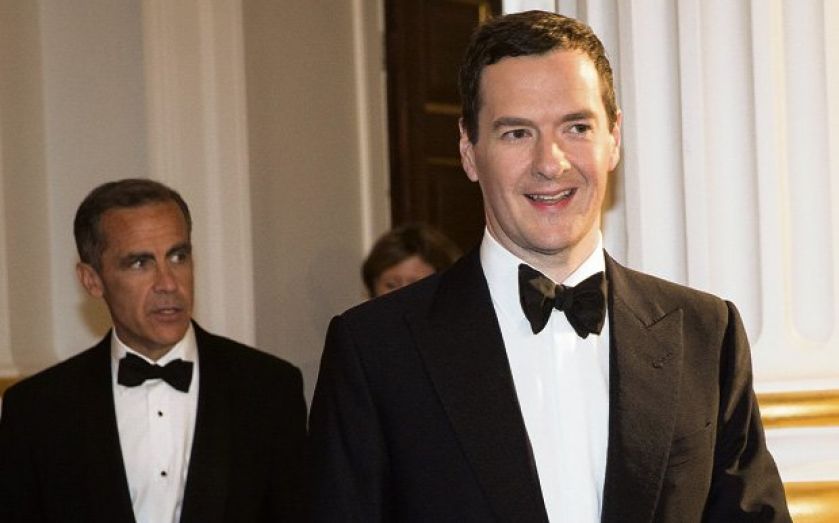
Bank of England governor Mark Carney was appointed in November 2012 by George Osborne, in a move which was at the time seen as a masterstroke by the chancellor.
 
Osborne had shown that he was extraordinarily keen to obtain the services of the Canadian – Carney had ruled himself out of the job in the summer but was persuaded to take it.
 
The job was advertised as an eight-year-long post, but Carney took it for five as it fitted his family plans better.
 
The governor’s reputation as a central banker was unimpeachable, as the ex-Goldman Sachs exec was seen as an intellectual heavy weight with serious practical experience.
 
However, it is also clear the chancellor would not have hired Carney if the governor did not subscribe roughly to a view of the economy similar to Osborne’s.
 
As a result, when Carney argues rates should be held down until the economy reaches “escape velocity”, and even then rises will only be “gradual and limited,” it can be assumed Osborne backs the policy.
 
The pair operate more closely than the previous governor, Mervyn King, did with Gordon Brown. 
 
Brown gave the Bank operational independence and largely left the MPC alone. Previously, the chancellor met the governor to set rates.
 
But the new deal changed with the financial crisis, when the Treasury and Bank collaborated on policies such as quantitative easing. Since then more schemes have been devised between both institutions – the funding for lending scheme, for in – stance, in 2012. Despite that, the MPC fiercely defends its independence and rejects claims any outsider has sway over its interest rate decisions.
 

Q&A: COULD OSBORNE INFLUENCE CARNEY?

 
Q If he wanted to, could George Osborne influence interest rates?
 
A This would be a very difficult task. Mark Carney has got a big say on the monetary policy committee, changing the way the MPC thinks about rates. But even if he was pressured by Osborne – which is very unlikely, given the governor’s very vocal support for MPC independence – he is still only one of nine votes on the committee. 
 
Q How much control does Carney have over the MPC?
 
A He is a powerful voice, and nobody has yet voted to raise rates against his wishes. Some economists think we will get more clues on any dissenters when the minutes of the latest MPC meeting are published tomorrow. Some members think the economy has less slack than Carney estimates, so some could vote for a hike soon. 
 

Share this article

  • Facebook
  • X
  • LinkedIn
  • WhatsApp
  • Email

Similarly tagged content:

Sections

  • News

Categories

  • Business

Related Topics

  • George Osborne
  • People

Trending Articles

  • Five-star Mayfair hotel hit with HMRC winding-up petition

  • Nottingham Forest owner Marinakis sues Crystal Palace for defamation

  • Back to basics: Sainsbury’s gradual retreat from the British high street

  • It’s not just Jason Arday, most of sociology is a scam

  • Hargreaves Lansdown orders staff back to office

More from Morning Wire

  • Dimon threatens to ditch JP Morgan tower in tax warning to Burnham

    Banking
    Jamie Dimon speaking at a JP Morgan event, wearing a suit and tie, addressing financial trends and market strategies.
  • Shabana Mahmood set to be named Chancellor by Burnham

    Politics
    Shabana Mahmood, potential Chancellor, in a professional setting, poised and confident, reflecting leadership qualities
  • Rachel Reeves’ sister takes top legal role in Burnham’s Cabinet overhaul

    Politics
    Close-up of a business professionals hands typing on a laptop keyboard with financial charts on screen
  • Miliband opponents pour cold water on Chancellor hopes

    Politics
    Ed Miliband outside Downing Street
  • Rachel Reeves’ legacy of tinkering with the City is not enough, says Mel Stride

    Economics
    Mel Stride addressing an audience at a business conference, standing at a podium with a presentation screen behind him
  • Sadiq Khan lobbies Burnham to appoint Miliband as Chancellor 

    Politics
    Sadiq Khan addressing media at a press conference in formal attire, discussing recent developments in London policies
  • Bank of England governor opens door to ‘simplifying’ financial rulebook

    Regulation
    Bank of England Governor Andrew Bailey said cited several indicators that the labour market was softening.
  • On this day: the birth of press freedom

    Opinion
    Black and white illustration of the Crown v. Zenger trial, featuring lawyers and observers in a courtroom.
MorningWire

Independent European business, markets and political news for decision-makers.

Morning Briefing

Europe

  • Germany
  • France
  • Europe
  • UK & Ireland

Business

  • Markets
  • Banking
  • Technology
  • Energy
  • Property
  • Fintech

Editorial

  • Opinion
  • Editorial Policy
  • Corrections
  • Contact

Company

  • About Morning Wire
  • Privacy Policy
  • Terms of Use
  • Cookie Policy
© 2026 Morning Wire Ltd · Published by Morning Wire Media, Bahnhofstrasse 65, 8001 Zürich, Switzerland
Privacy · Terms · Cookies · Facebook