The government must adopt airport testing to help rebuild the economy

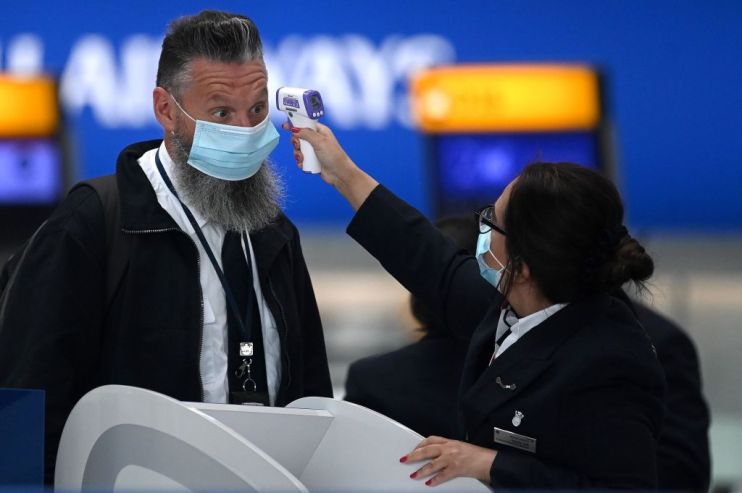
Last month, the Prime Minister announced new curbs to control the rising number of coronavirus cases for at least six months – and the prospect of tighter restrictions or a second lockdown still looms large.
The outcry was predictable: the measures are confusing, sometimes contradictory, and of course, there are concerns about the impact on our already struggling economy and industries, such as hospitality and tourism, in which these restrictions spell doom for many.
The air travel sector is clearly no stranger to being hard-hit by Covid-19. As travel restrictions were introduced in March, seat capacity fell by around 92 per cent compared to April 2019. In September, published seat capacity is around 85 per cent down on 2019 and high capacity summer months have been lost. In fact, the closed air corridor between the US and the UK is costing the UK economy £32m each and every day it remains closed.
Read more: The travel industry will not survive without a radical U-turn
Yet, despite the multiple solutions put forward, and that 30-plus other countries have already introduced it, the government still refuses to consider airport testing and continues to erode business and traveller confidence with confused, ever-changing quarantine measures and travel corridors.
This virus will be with us for a long time yet. It is critical that we learn to live with it, and avoid crashing our economy and depriving hundreds of thousands of workers their livelihood. The government must look at solutions that safely ease travel restrictions and kick-start the economy.
There are two key reasons touted for why the testing solution is being ignored. First, that testing on arrival would only uncover seven per cent of people infected. But this figure is wrong, and following Boris Johnson’s promise for “creative and imaginative” action to protect business, we in the air travel sector don’t need creativity, just a review of the facts.
Read more: Tourism slump to cost UK £22bn with London worst-hit, says WTTC
The government arrived at the seven per cent figure through computer modelling from January – just weeks after we knew the virus existed and before PCR testing for Covid-19 was even possible. This model makes a number of erroneous assumptions: that only those who develop symptoms can be detected, or if asymptomatic, a similar time has elapsed since infection before a polymerase chain reaction (PCR) test will show as positive.
Additionally, the model assumes that only those who feel well enough to fly will board an airplane. As around 50 per cent of people can become infected but will develop no symptoms, it is strange to think that this group of people will choose not to fly.
As we now know, PCR can detect infections well before symptoms start. While the Public Health England algorithm was the best we knew at the time, it is now clearly wrong and must be updated. Testing could detect the virus in these travellers upon landing. And in fact, real-world data from France, Iceland and Jersey have all shown that the PCR test has a much higher efficacy than seven per cent.
We want to convince the government to help revive air travel and our economy with a two-test model, with testing on arrival, and a second confirmatory test on day five. By initiating such a trial, we would have real-world data for analysis on which the government can accurately and scientifically judge whether testing on arrival can keep the country safe and moving forward.
The second reason is the testing capacity of the NHS. Which is why we at Collinson have offered to run the trial under government-approved conditions while using our private biotech lab network to process the tests, which are not part of the NHS labs and therefore unaffected by the current issues. Further, by introducing airport testing, we are ensuring that we are not reliant on community testing centers to process travellers.
Our model uses a centralised IT system that coordinates scheduling, testing and results, in line with successful models such as those used in Germany. With private lab capacity and a fully automated, secure IT system, we are ready to do our part to help protect jobs and keep the economy moving by ensuring that the aviation industry does not collapse during this pandemic.
With both key reasons against airport testing proven to be falsely constructed, and with six months of restrictions ahead, we ask the government: if you could make changes that could help any sector, why wouldn’t you?
Main image credit: Getty