Skip to content
Thursday 20 August 2026London --:--Frankfurt --:--Zurich --:--
NewslettersSearchEN · DE · FR
MorningWire

European business, markets and politics

FTSE 100
10,708.22
-0.33%
DAX
25,965.33
-0.48%
CAC 40
8,468.39
-0.39%
STOXX 50
6,424.68
-0.31%
  • Europe
  • Markets
  • Business
  • Economy
  • Regulation
  • Politics
  • Opinion
More
GermanyFranceEU InstitutionsCompetitionPublic AffairsBankingTechnologyEnergy
  • Germany
  • France
  • Europe
  • Markets
  • Business
  • Economy
  • Regulation
  • Politics
  • Opinion
  • DE
Wednesday 07 February 2024 11:12 am  |  Updated:  Wednesday 07 February 2024 11:15 am

Changes to UK mortgage market cushions blow to borrowers from interest rate hikes

By: Chris Dorrell

Add as a preferred source on Google
Stressing is likely to have supported the "resilience of individual borrowers and the overall market," they noted.

Changes to the mortgage market have helped protect borrowers and smooth the economic impact of higher interest rates, new research suggests.

The Bank of England’s rate hikes have increased mortgage rates by over four percentage points in the last two years, raising the cost of repayments for those re-fixing.

According to the Bank’s researchers, a three percentage point rate increase on a £300,000 mortgage would set borrowers back by roughly £500 per month

However, despite rising costs, the housing market has not seen a major upturn in arrears, defaults and forced sales. Although mortgage arrears hit a six-year high in the three months to December, this was still relatively low historically.

The figures showed that 1.14 per cent of total loans were in arrears at the end of last year, compared to 3.64 per cent in the first quarter of 2009.

New research from the Bank of England suggests part of this comes from successfully ‘stressing’ customers when the mortgage was first taken out.

Stress tests were introduced in 2014 to make sure that borrowers did not take on more debt than they could afford to repay.

Read more

House prices slump as Iran war and interest rates hit demand

The price paid for first homes has surged 7.1 per cent in a year

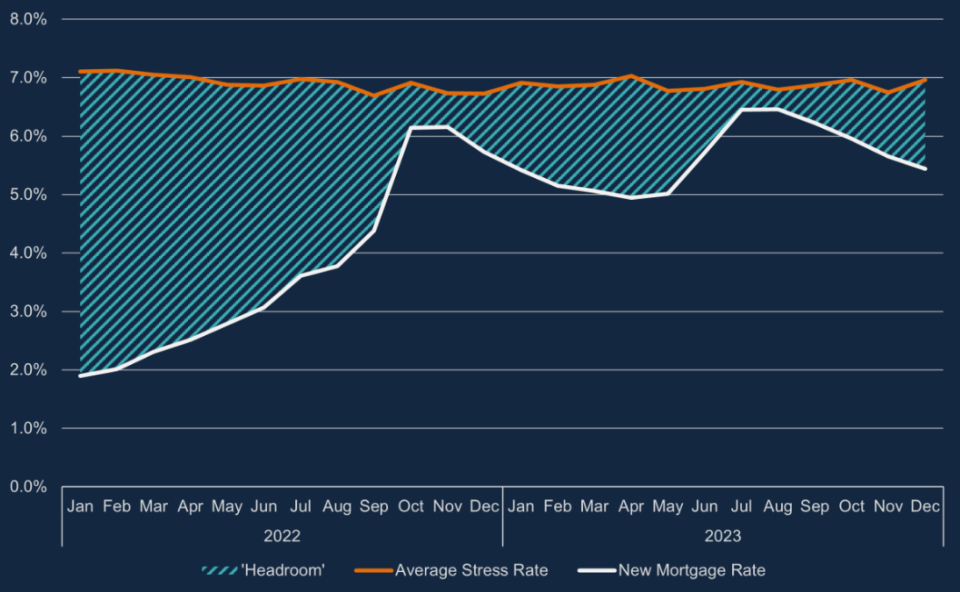
Researchers at the Bank found that the vast majority of borrowers who came to the end of a fixed term in 2023 faced new mortgage rates lower than the rate at which they were ‘stressed’.

Having no headroom against the stress rate does not imply that borrowers would default or would not be able to re-fix. However, the researchers noted there would be “less certainty about affordability”.

Stressing is likely to have supported the “resilience of individual borrowers and the overall market,” they noted.
Source: Bank of England

Research from Barclays also showed that the changing nature of the mortgage market has helped to smooth the impact on the economy.

Around 85 per cent of mortgage debt is on fixed deals, mainly two years or five years. Back in 2012, as much as 70 per cent of mortgage debt was on variable rates, Barclays said.

If there were as many variable rate deals now as there were in 2012, the current hiking cycle would have led to a 3.5 per cent cumulative fall in disposable income over 2022 and 2023. This is more than four times the estimated impact on the current mortgage market, Barclays’ Abbas Khan said.

“The structure of the mortgage market has smoothed the impact on consumption from the rate cycle,” he concluded.

Read more

Mortgage approvals inch up yet gains to be ‘retracted’

Bank of England headquarters in 2025, showcasing modern architecture and iconic London skyline in the background.

Share this article

  • Facebook
  • X
  • LinkedIn
  • WhatsApp
  • Email

Similarly tagged content:

Sections

  • Markets & Economics

Categories

  • Economics
  • Property

Related Topics

  • Bank of England
  • mortgage
  • mortgage rates
  • UK interest rates

Trending Articles

  • Jobless Banquet: Youth unemployment surge ‘sends Neets to KFC’

  • City law firm sues prominent Emirati business family

  • Amanda Blanc has worked her magic at Aviva

  • As it happened: Miners fuel FTSE 100 recovery; oil jumps as Trump claims Strait of Hormuz

  • House prices in wealthy London boroughs fall by up to £300,000

More from Morning Wire

  • House prices slump as Iran war and interest rates hit demand

    Property
    The price paid for first homes has surged 7.1 per cent in a year
  • Mortgage approvals inch up yet gains to be ‘retracted’

    Property
    Bank of England headquarters in 2025, showcasing modern architecture and iconic London skyline in the background.
  • House prices rise as mortgage rates ease from Iran war highs

    Property
    Starmer plans to build up to 12 new towns.
  • House prices suffer biggest August slump in eight years 

    Property
    Aerial view of colorful residential houses built on a hillside, nestled among green trees, representing housing markets
  • KBRA Assigns Preliminary Ratings to Lugo Funding 2026-1 DAC

    Business Wire
  • House prices in wealthy London boroughs fall by up to £300,000

    Property
    Waverton Investment Management and London & Capital combined into W1M.
  • London house prices fall again as property slowdown drags on

    Property
    Two people looking at real estate listings in an estate agents window, showcasing properties for sale.
  • KBRA Releases Research – KBRA-Rated European CMBS Exposure to Wildfires in Spain and France

    Business Wire
MorningWire

Independent European business, markets and political news for decision-makers.

Morning Briefing

Europe

  • Germany
  • France
  • EU Institutions
  • Europe

Business

  • Markets
  • Business
  • Economy
  • Regulation
  • Competition
  • Public Affairs

Editorial

  • Opinion
  • Editorial Policy
  • Corrections
  • Contact

Company

  • About Morning Wire
  • Privacy Policy
  • Terms of Use
  • Cookie Policy
© 2026 Morning Wire Ltd · Published by Morning Wire Media, Bahnhofstrasse 65, 8001 Zürich, Switzerland
Privacy · Terms · Cookies · Facebook