Chris Whitty: Second wave of coronavirus is a ‘really serious concern’

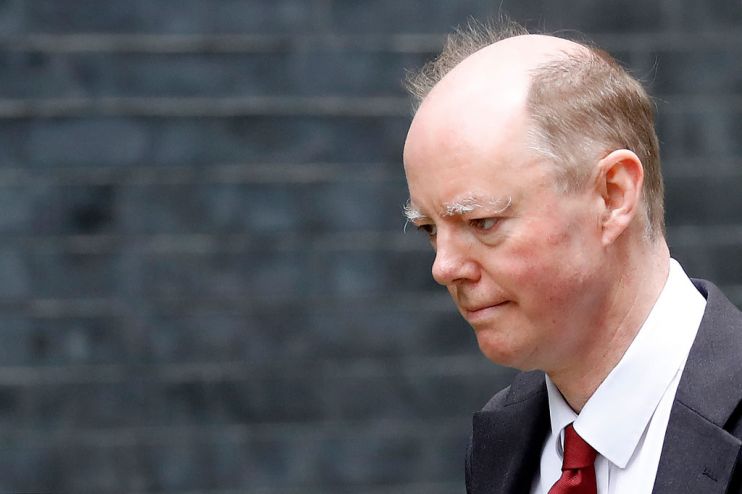
Professor Chris Whitty has said a second wave of coronavirus in Britain this winter is a “really serious concern”, as the chief medical officer today faced a grilling over the UK’s response to Covid-19.
Facing questions from former health secretary Jeremy Hunt in a virtual meeting of the Health and Social Care Committee, Whitty said: “A surge in winter is a really serious concern looking forward [and] where I spend most of my thinking time.”
“We are now much more secure than we were a couple of months ago. But if we have a major surge in the winter that is simultaneous with a major surge in the winter in many other countries, I think it would be foolish to say that the risk of this has completely gone away.”
The chief medical officer said the UK needs asymptomatic testing capabilities to defeat a potential second wave, adding: “If there was a big surge, I would absolutely be in favour of going for regular testing, even in advance of knowing the optimum frequency.”
In a tense stand-off between Hunt and Whitty, the chief medical officer admitted that the UK death toll was exacerbated because Britain did not have sufficient testing capacity to contain the virus before the lockdown was introduced.
There have now been more than 295,000 registered cases of the virus in the UK, and 45,312 fatalities.
Prime Minister Boris Johnson announced a national lockdown on 23 March, two weeks after Italy and nine days after Spain, despite the fact that 6,650 people had tested positive and 335 people had died in the UK by that point.
But Hunt suggested that the true scale of the crisis was veiled by the lack of testing in the UK before the lockdown was introduced.
Whitty said: “We had no capacity to [test] on the scale that was needed for the kind of epidemic that we had.”
“I think it’s well known at that stage we had incredibly limited testing capacity, and we were at the tail end of the winter respiratory illness system. We therefore had no capacity to find all the cases and do the kind of isolation that you would need to do if you think about the scale of what we’ve got.”
The UK’s testing capacity has been plagued with accusations of inadequacy. In February, the government’s Scientific Advisory Group for Emergencies (Sage), concluded that the UK’s strained public health system was incapable of widespread Covid-19 testing, even by the end of the year.
In April, the UK met its target to rollout 100,000 coronavirus tests a day, doubling that capacity the next month. However, the pledge has since been watered down, with Downing Street later stressing that the 200,000 target set by the Prime Minister related only to testing capacity and not to the number of tests actually carried out.
However, Whitty dug his heels in over claims that the UK failed to appropriately respond to increasing infection rates around the country, adding: “Given that capacity, that was in my view the correct advice.”
Asked whether MPs had “followed the science”, as Johnson repeatedly stated was at the core of the government’s response, Whitty said: “I am confident that the ministers at the time, who were put in an incredibly difficult position, in my view, followed the advice given by Sage.”
But Professor John Bell, Regius Professor at University of Oxford, told the Commons committee that the UK’s failure to test health care workers for coronavirus was a “major oversight”.
Bell said: “The failure to aggressively approach health care testing was a major oversight and one where I am not entirely sure what the motives were”.
“It was well documented in Italy that the problem was hospital testing. So it wasn’t a novelty to think: ‘oh gosh, we should test health care workers’. It was a fact that we knew about from other places,” he said.
Professor Devi Sridhar, Professor of global public health at University of Edinburgh told the committee that another national lockdown was still on the horizon.
“If you have existing community transmission, where England is at now, you’re going to see spikes. It is inevitable. As we’ve seen with Australia in Melbourne, you’re going to have to tip into a local lockdown,” she said.
“Then if the local lockdown gets too stretched then you’re going to have to go into a national lockdown and that’s what’s happened in other places.”