Skip to content
Friday 7 August 2026London --:--Frankfurt --:--Zurich --:--
NewslettersSearchEN · DE
MorningWire

European business, markets and politics

FTSE 100
10,901.09
+0.31%
DAX
26,319.45
+0.69%
CAC 40
8,714.93
+0.17%
STOXX 50
6,523.86
+0.33%
  • Europe
  • Markets
  • Business
  • Economy
  • Technology
  • Politics
  • Opinion
More
GermanyFranceBankingAIEnergyFintechPropertyCapital Markets
  • Germany
  • France
  • Europe
  • Markets
  • Business
  • Economy
  • Technology
  • Politics
  • Opinion
  • DE
Saturday 26 July 2014 12:20 pm  |  Updated:  Friday 07 June 2019 1:41 am

Climate change increases risk of global food demand outstripping supply, study finds

By: Sarah Spickernell

Add as a preferred source on Google

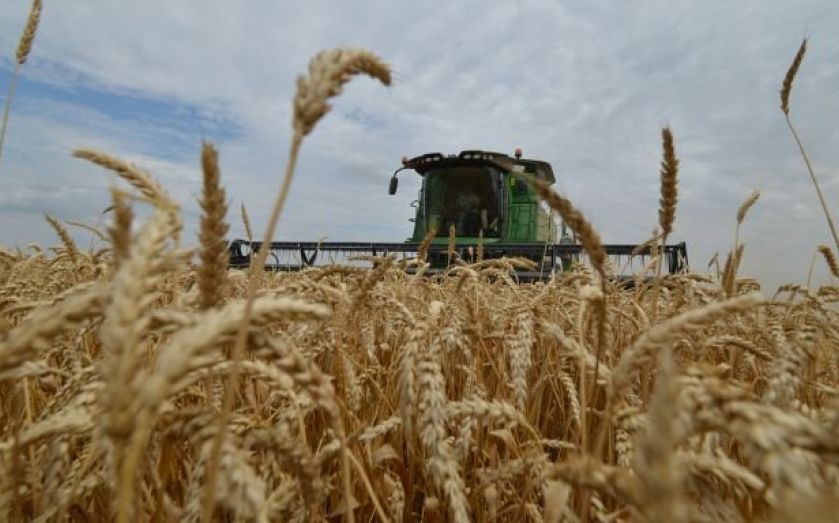
Researchers at Stanford University have found that global warming will significantly increase the risk of a major slowdown in the production of wheat and corn over the next two decades. 
 
By putting data about crops and weather into computerised climate models, they set out to estimate the chance that climate change would interfere with the ability of crop producers to keep up with demand. 
 
They used simulations to compare what would happen to the world's crop-intensive regions as a result of varying levels of carbon dioxide emissions. They also looked at what would happen in a natural environment without human-induced global warming.
 
The results of the study, published in Environmental Research letters, show that the likelihood of natural climate shifts causing a significant slowdown over the next 20 years is only 1 in 200. But when human-induced global warming is taken into account, the odds go up to 1 in 10 for corn and 1 in 20 for wheat.
 
"Climate change has substantially increased the prospect that crop production will fail to keep up with rising demand in the next 20 years," said Claudia Tebaldi, co-author of the study.
 
Global yields of crops such as corn and wheat have typically increased by about one to two per cent per year in recent decades, and the UN Food and Agriculture Organization projects that global production of major crops will increase by 13 per cent per decade from now to 2030. 
 
However, global demand for crops is also expected to rise rapidly during the next two decades because of population growth, greater per-capita food consumption, and increasing use of biofuels.
 
"We can't predict whether a major slowdown in crop growth will actually happen, and the odds are still fairly low," said Tebaldi. "But climate change has increased the odds to the point that organisations concerned with food security or global stability need to be aware of this risk."
 
The report suggests that such organisations should make plans in case a significant slowdown in crop production does occur. 
 
It also warns that although the risk could be offset by planting wheat and corn in cooler regions, such planting shifts to date have not occurred quickly enough to offset warmer temperatures. The authors also found little evidence that other adaptation strategies, such as changes in crop varieties or growing practices, would totally offset the impact of warming temperatures.Based on the findings, the study suggests that organsations affected by international food availability and price should make plans in case a significant slowdown in crop production does occur. 

Share this article

  • Facebook
  • X
  • LinkedIn
  • WhatsApp
  • Email

Similarly tagged content:

Sections

  • News

Categories

  • Business

Related Topics

  • Climate change

Trending Articles

  • Revolut founder’s wealth set to balloon amid talks of share award at $500bn valuation

  • Rupert Lowe axes pensions triple lock and pledges tax cuts in economic plan

  • WPP slashes jobs as revenue continues to fall

  • Liverpool owners tipped to sell – but not to Amazon boss Bezos – by former CEO

  • As it happened: Stocks rise as oil fluctuates after Red Sea attack; US-Iran deal ‘being circulated’

More from Morning Wire

  • Arch Construction Risk Report Reveals Top Challenges Facing Sector Amid Rising Volatility

    Business Wire
  • From Mongolian camels to Tibetan verbs: the absurdity Ed Miliband’s aid spending plans

    Opinion
    Ed Miliband speaking at a podium during a press conference, addressing energy policy reforms and climate change initiatives.
  • Heatwave slows retail sales but World Cup boosts online shopping

    Retail
    Scorching sun over urban skyline during intense heatwave, highlighting climate change impact on city infrastructure.
  • El Nino heatwaves to ‘fuel inflation next year’

    Economics
    Firefighter in helmet and uniform watching a blazing forest fire at night, red glow in the sky
  • Keep your politics out of your investments

    Analysis
    Donald Trump dancing at a campaign rally in Pennsylvania, engaging supporters with enthusiastic gestures and lively expres...
  • Meet the new energy minister who believes lower growth is “good news”

    Opinion
    Katie White, a woman with curly blonde hair, smiling in a navy blazer and white collared shirt against a dark background.
  • Scottish Government Selects Planet for AI-Enabled Monitoring to Support Sustainable Agricultural Reform

    Business Wire
  • London house prices fall again as property slowdown drags on

    Property
    Two people looking at real estate listings in an estate agents window, showcasing properties for sale.
MorningWire

Independent European business, markets and political news for decision-makers.

Morning Briefing

Europe

  • Germany
  • France
  • Europe
  • UK & Ireland

Business

  • Markets
  • Banking
  • Technology
  • Energy
  • Property
  • Fintech

Editorial

  • Opinion
  • Editorial Policy
  • Corrections
  • Contact

Company

  • About Morning Wire
  • Privacy Policy
  • Terms of Use
  • Cookie Policy
© 2026 Morning Wire Ltd · Published by Morning Wire Media, Bahnhofstrasse 65, 8001 Zürich, Switzerland
Privacy · Terms · Cookies · Facebook