Clowns vs the council: Inside the regulation spat threatening Covent Garden’s street performers

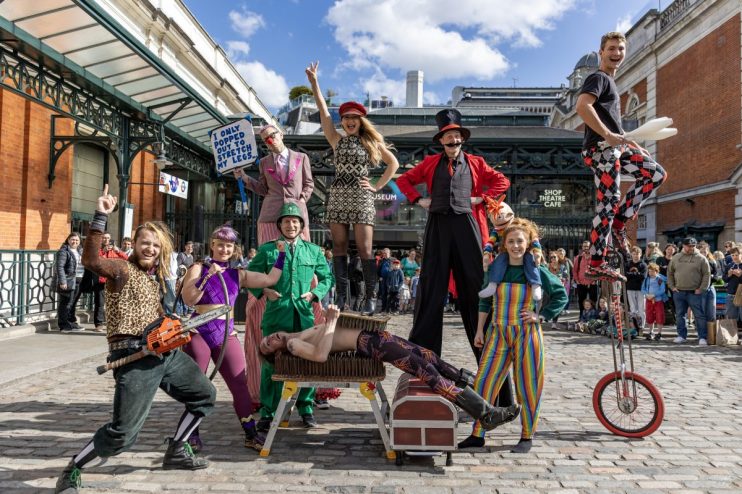
As Covent Garden’s street performers celebrate 50 years of clowning on the cobbles, Anna Moloney asks why they’re worried about their future
Every morning in Covent Garden at 9:30am, street performers from far and wide draw lots in a bid to perform at the famous cobbled piazza. Slots are allocated randomly and you need meet only three conditions to apply: have a show, have insurance and, for god’s sake, no fire. The latter causes far more trouble than it’s worth, former clown Melvyn Altwarg, now a rep for the Covent Garden Street Performers Association (CGSPA), tells me.
Arguably, however, such performers now operate upon the cobbles illegally.
In 2021, Westminster Council introduced new rules mandating formal licenses for all street performance in the borough. The CGSPA, however, have been boycotting these for the past four years. Instead, performers in the area have continued to operate under their own system, with performers allowed to disappear their rabbits and swallow their swords without formal permits or external regulation and programming managed by the group itself. “‘Politely refusing’ – that’s the way we’re terming it,” CGSPA spokesperson and stuntman Peter Kofolsky tells me, nodding to his PR rep sat nearby. While the council, he says, have largely left them to it, the group wants a formal exception in writing.
Kofolsky, or Heavy Metal Pete as he’s more commonly known, took to street performing when he found he could make more in an hour from juggling than working on building sites. Now, he regularly dazzles crowds at the piazza with a spine-prickling stunt, in which he lies sandwiched between two beds of nails with an audience member perched on top. “There’s actually no trick to it,” he admits. It just hurts. But Kofolsky doesn’t mind suffering for his art.
I’ve come to meet him and Altwarg under the more pedestrian setting of a coffee at the Seven Dials Playhouse Cafe ahead of festivities over the weekend celebrating 50 years of street performance at Covent Garden. The event was not designed as a protest party, but has increasingly started to look like one amid the growing licensing spat.
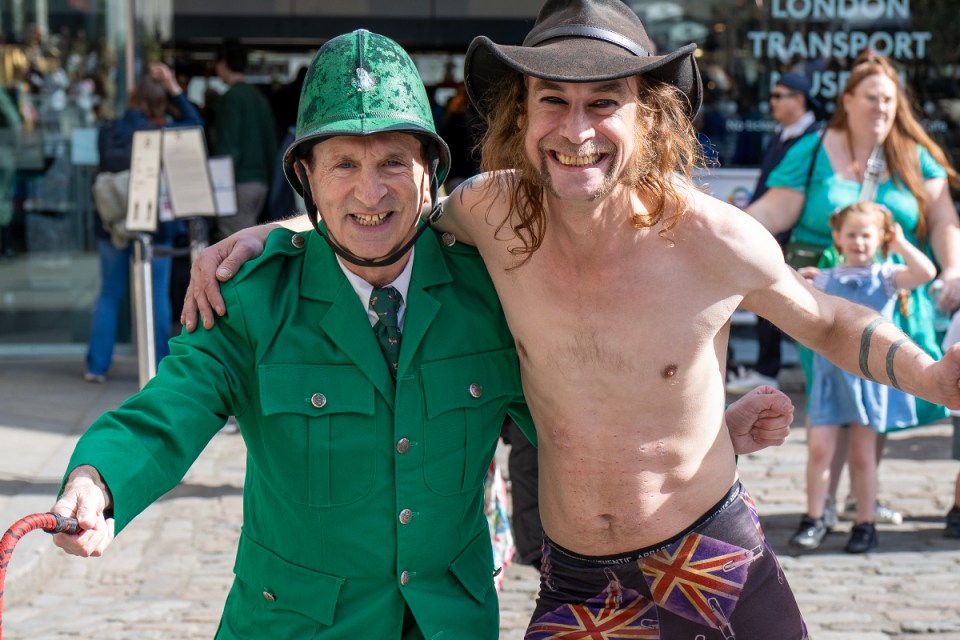
Kofolsky tells me the group has been operating under an “informal truce” with the council for the last 18 months allowing them to continue self-governing (following previous “tussles”) but is keen to reach a formal written agreement. “They’ve taken a hands-off approach with enforcement at Covent Garden which we welcome, but we could do with some actual concrete statutory commitments from them that they’re going to take us out of the scheme,” Kofolsky says.
Leicester Square busking shutdown has Covent Garden worried
In particular, recent developments at Leicester Square have worried the CGSPA, with a ruling last month in favour of Global Radio resulting in the closing of two popular busking pitches due to noise complaints. In the case, the judge sided with a claim brought by the media company, whose offices are located nearby, that the performances counted as a public nuisance and were akin to “psychological torture”.
The council says the closing of the Leicester Square pitches is “categorically not a ban on street performers in Westminster”, but buskers from the Westminster Street Performers Association (WSPA) argue it may as well be, with very few amplified spots – crucial for singers – now available to perform at. WSPA representative Serena Kaos said the ruling was “incredibly damaging” and warned it would come at a cost not only to street performers but the whole area, which was “pretty devoid of anything” without the buskers.
She also disputes Global Radio’s claim Sweet Caroline was being played over and over in the area, but that’s by the by. To be fair, quality of performance is not vetted under the licensing scheme, nor indeed under the CGSPA’s system, but the reason why is self-explanatory: by its very nature, street performance self-regulates – if you’re not very good, you probably won’t be earning a living.
That being said, Kaos admitted performances had grown louder in the area over the past few years, but argued that the licensing system itself was to blame. Whereas before buskers could pitch up pretty much anywhere that wouldn’t cause a nuisance, the 2021 rules mean there are now a diminishing number of spots available to perform at. As a result, it has become more and more competitive to perform in London. “There’s been this increasing suffocation of performers, who then increased our necessity to try and make the most out of our 45 minutes per day,” Kaos said.
The case for street performance licenses
For Kofolsky and the CGSPA, the developments at Leicester Square are worrying but also vindicating. The CGSPA have continuously argued for the superiority of their own system of self-governance in regulating noise and maintaining good relations with local businesses, many of whom are grateful for the performers’ contribution to the area’s footfall. The CGSPA has even said it would welcome taking over organisation for street performers at Leicester Square.
That appears to have little chance of happening, however. For the council’s part, they deny there is any informal agreement in place with the Covent Garden street performers regarding their self-governance, adding that they are “very supportive of Westminster’s immensely talented street performers”.
“There are no informal agreements with any performer associations, and our licensing scheme aims to set a level playing field,” deputy council leader Aicha Less told Morning Wire. “We have worked closely with all stakeholders and hope to work with the Covent Garden Street Performers Association to develop guidance on licensing in the future,” she added.
Away from local government, a wholescale rejection of the licensing system is also not universally endorsed by the street performers themselves. Kaos told me there was a feeling the CGSPA were sometimes “a little bit closed off to new performers” and that the licensing scheme had the potential to make things fairer for all performers, if implemented in a better way.
The CGSPA agreed there was nuance. “It’s not as black as white as we could paint it out if we wanted,” Altwarg says to me, adding that he hoped yesterday’s celebration would be a good opportunity to bring forward relations.
Ultimately, Altwarg and Kolofsky explain, it’s simply not in their interest, nor that of any of the performers, to have bad relations with the council or locals. “We’ve all got an interest in making it work. It’s where we all make our living,” Altwarg says. He says their relationships with local businesses, who they’ve surveyed in the past, have been overwhelmingly positive, with local shops like Charlotte Tilbury even reaching out to the performers to help with brand events.
He adds that the performers are aware of their responsibility to the local area, especially in regard to noise, with their local approach meaning any complaints can be dealt with swiftly and amicably. In contrast, those with the council under the licensing scheme might take days – or, as recently seen, even a court case – to deal with. “It’s the nature of street performance itself – it’s a very spontaneous art form. It’s just not suited to that kind of top down control,” Altwarg says.
And after our coffee, when I wander over to the piazza, it’s not long before I can see why. When a couple of stray tweens from a school group start running perilously close to a knife juggler, it’s only a minute before another performer on standby in the back is over to get them back sitting down with a gentle scolding. It’s self-regulation in action.
Street performance and the democratisation of the arts
But why, anyway, does it even all matter? More than anything when chatting to Kofolsky and Artwarg, I was struck by their case for just how important street performance is. As doing just about anything, not least the theatre, becomes more and more expensive in London, street performance has remained a rare form of democratised entertainment – available for audience members and performers alike for close to free. And that matters.
“There was one time I was collecting money at the end of a show and I went up to the balcony when a guy stopped me,” Altwarg recounts. “He said: ‘I have been depressed for a year and that’s the first time I’ve laughed.’ He gave me a lot of money – I mean a serious big chunk of money because he was so pleased. But I’ve heard that story again and again. Pretty much almost every performer on the pitch could tell you something along those lines.” It’s a good example of the often hard-to-quantify benefits of the arts.
As the performers mark 50 years of self-regulation, it’s timely to also note why the CGSPA formed in the first place: resistance in the 1970s to plans to flatten Covent Garden to make way for a concrete flyover. In the cobbled piazza today, now one of the capital’s most bustling areas for Londoners and tourists alike, it’s incredible to imagine its alternate reality as a concrete motorway. Then, just as now, it’s a reminder of why it’s essential not to take the status quo for granted.
Now, in preserving the future of the area and that of street performance itself, the council is left with the interests of multiple parties to juggle. Lucky, then, that there may just be a person or two in the vicinity able to teach them the delicate art of the balancing act.