Congratulations, students – welcome to a broken system

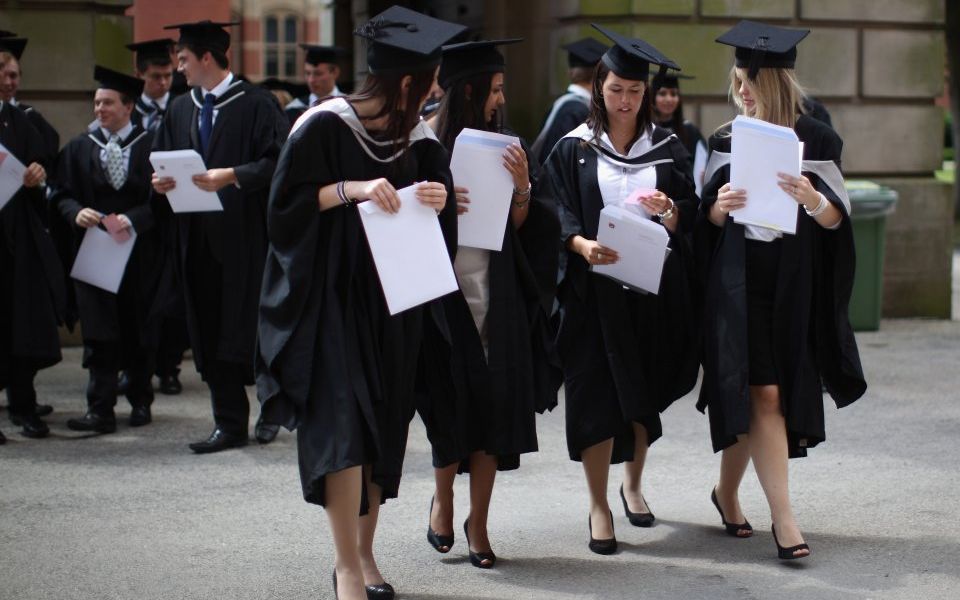
It is hard to think of a more eccentrically British fixation than the national obsession with A-level results day.
And there’s something for everyone in the results announced yesterday
A rise in the proportion of students achieving As and A*s (“exams have become too easy”), a fall in the numbers achieving above a C grade (“exams have become too hard”), a slight increase in boys outperforming girls (“we need to fix the gender bias in A-levels”), more girls studying stem subjects (“…good”), all accompanied by endless pictures of squealing girls celebrating their results (“reverse sexism!”).
For the students, this is a momentous occasion. For everyone else, the national attention paid to it is probably overkill. But the lists of anodyne advice and Ucas helpline numbers printed in large friendly letters mask a serious point, and one that no one – not students, parents, teachers, or politicians – wants to admit: the current higher education system is a mess.
Tony Blair promised in 2001 that half of all young people would go to university. That’s almost been achieved. Last year, a record 32.6 per cent of 18-year-olds gained a university or college place, and figures indicate that 49 per cent of people aged under 30 are expected to participate in higher education.
That is obviously a positive thing in many ways. A degree has become accessible to many who two decades ago could never have dreamt of it. But in order to achieve that, we’ve ended up with a system that is aparadoxical blend of markets, state-sponsorship, debt, and long-term gambling – and it is probably unsustainable.
For a start, universities have competing aims: offer the best teaching, or attract the most students. These are not always compatible. Glitzy facilities, shiny technology, and modern accommodation have less of an impact on the knowledge it’s possible to accumulate than investing in the best staff or small class sizes, but they look more appealing on a brochure for prospective customers. Sorry, I mean students.
Then there’s price. It costs significantly more to teach chemistry each morning in a world-class lab than it does English with one supervision a week and vague instructions to go read something in the library.
That’s not a judgement on the value of the degrees, simply a practical point about resource allocation. But with all degrees capped at £9,250 per year, arts students end up subsidising their science-loving peers – even though stem graduates will probably go on to earn more.
There’s also a delicate balance inherent in the courses themselves.
Too rigorous, and the number of graduates achieving top degrees falls – bad for league tables, for recruitment, and for reputation when disgruntled students complain. (Remember the man who tried to sue Oxford University for £1m when he failed to get a first?)
Make the courses easier, and students are happier… until employers cotton on and the value of degrees from that institution falls.
It’s game theory, but played out over decades with people’s lives.
The consumer, in this market that isn’t really a market, is the 18-year-old school leaver. Except no one wants people to be put off applying for university or have their choices limited by finances – hence the blanket cap on tuition fees and the student loan system. Which brings the government into the heart of it all.
Student loans are theoretically a great idea: no upfront cost, repayment that only starts when a graduate is earning a certain amount, and any remaining debt written off after 30 years. Don’t end up in a high-powered career that makes the cost of your degree worth it? You will be subsidised by the graduates who did.
The trouble is that whoever designed the system got their numbers wrong – so wrong that 77 per cent of students who took out these loans after 2012 will not earn enough over their lifetimes to pay back the full amount.
The extortionate interest charged (currently 6.1 per cent – 12 times the recently raised Bank of England base rate) is understandably quite off-putting. Politicians may promise that the terms won’t change (you currently only start repaying when earning more than £25,000), but with budget black holes to fill and attempts from the government to sell this debt to the private sector, that isn’t as comforting a guarantee as it might seem.
And, indeed, there are some who argue the government – or rather, taxpayers – shouldn’t be subsidising university at all. If you want to improve your future prospects with an engineering degree or spend three years delving into obscure medieval poetry, that’s your choice, and you should pay for it.
This would be a sensible argument, if the normal economic incentives were at play in the university market. As we have already seen, they are not.
The fact is that successive governments have tried to make higher education too many things: accessible but elite, affordable but world-class, egalitarian for students but turning out the kind of graduates that businesses will rush to employ.
A poll released on results day shows that fewer young people think it’s important to go to university. The proportion of applications may be up, but enthusiasm is falling – today’s school leavers are growing sceptical.
And while we should offer nothing but congratulations and good wishes to all those who achieved top A-level results this week, maybe that’s a scepticism we should take seriously.