Contemporary dance is aging well but it’s ready for new ideas

Choreographers in both London and New York seem to be going through an introspective phase. Western contemporary dance has lost many of its leading creatives: Alvin Ailey, Martha Graham, Pina Bausch, Merce Cunningham, all left the stage for good. Those who still create are looking inwards, testing one by one the ideas contemporary dance stands for. Sehnsucht has set in.
We know what to find in this style. Since the Seventies we have been enjoying ensembles without the military synchronicity of precision movement: we relish the individual personality within the formation and the creative variation between one performance and the next. We expect dancers to shape their bodies along a continuum of positions rather than execute a sequence of figures: uninterrupted flow over repetition, supple limbs over joints locked in extreme tension.
In sharp contrast to classical ballet, we cherish the non-artificial nature of moves: there is technique and athleticism, of course, but also mundane, recognisable crouching, slouching, tugging, leaping falling, and just-in-time catching. It’s a mirror of our own daily moves preserving, nonetheless, some of the notions we most closely expect of dance: soaring elevations, perfectly built bodies, absolute control of dancers’ movement and balance.
Two recent performances at Sadler’s Wells test many of these expectations to the limit.
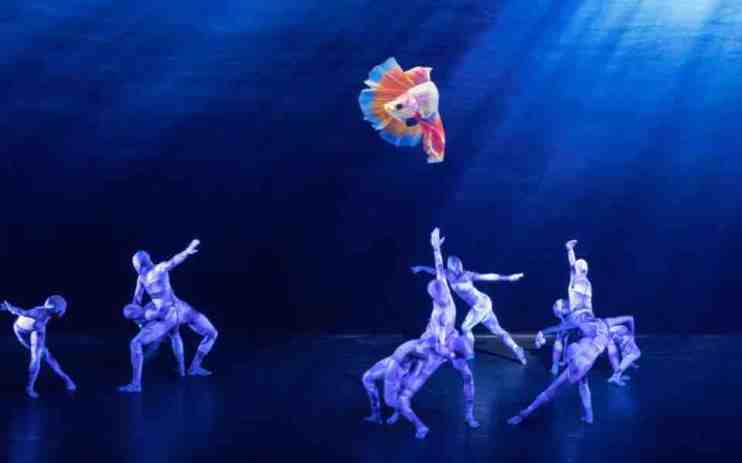
Sadler’s Wells associate artist Wayne McGregor’s choreography for UniVerse, inspired by a 42-year old film that few recognise, The Dark Crystal, reads as an indictment of oil’s destructive effects on the planet. It achieves this by subverting some dancing’s key tacit assumptions. The opening scene is delightfully serene, yet otherworldly: dancers, in groups of threes, move like sea anemones attached to a coral reef, limbs floating and spreading, then closing again, rhythmically and slowly.
The drag and resistance offered by an imaginary ocean to the their bodies’ movement is palpable: this is underwater dancing in all its energy and beauty. A burning Polaroid of a burning oil rig marks the end of that life form and introduces new ones: dancers’ bodies, deformed by costumes with protruding backs and hips, all sit in tight formation, moving hands and legs in waves, recreating the frantic motions of an enormous, upturned centipede.
Oil features again in the most memorable closing scene: one where all the dancers seem trapped in an invisible oil slick as vast as the set, unable to stand for longer than a few seconds. We see them slide, stagger and crash onto the black stage, again and again, unable to support each other or themselves in getting upright and finding their balance again.
In Rotunda, choreographed by Justin Peck and performed as part of New York City Ballet’s Mixed Bill, the notion stretched to its limit is that of ensemble dancing. What does it mean to be a corp de ballet? How many intermediate degrees of togetherness are there between dancing in perfect uniformity and complete dissonance?
Turns out they are many and surprising: a dancer summons a group to gather round, as if to share gossip during a break; pairs dancing together but practicing their dance sequence on their own time, each gliding past the others; formations where individuals break off and then rejoin, as if to underscore that strong dance companies will not splinter, absorb losses well and will keep a place for returners. Dancers in Rotunda revert to a circle when pausing in between movements, alluding at unison reached thanks to community, rather than drills and precision training, as the mechanical unit that is the kickline or chorus line might do.
Not one but two of our expectations are subverted in Gustave Le Gray No.1, choreographed by Pam Tanowitz, to music by Caroline Shaw, also part of NYCB’s Mixed Bill.
A quartet dance not to piano music but, rather, with a piano while it is being played. Dancers first surround the pianist to listen intently, then respond to the notes by composing symmetrical moves and, finally, take it upon themselves to push both piano and piano player, still playing, from the left to the right of the stage, to knowing smiles in the audience. Most delightfully of all, however, the four dance not in costumes but with their costumes’ own, slightly delayed movements.
The effect of Reid Bartelme and Harriet Jung’s red, luminous, flowing outfits on the dancers’ moves is unlike anything that can be achieved in practice gear. The impetus dancers impart on the fabric is mesmerising and, undoubtedly, what gives this choreography its identity and what gives these costumes a place in dance history. The romantic tutu, with its hemline below the knee, was to showcase the skill in the footwork. The short tutu, covering absolutely nothing, but creating a visual split line between the movements of the upper and the lower body, was meant to highlight the harmony in how both moved. The leotard made us focus on the naked power of dancers’ bodies. Bartelme and Jung’s dancing fabric acts as a visual multiplier of the quartet’s response to each other and to the music: it makes us focus so intently on light, rhythms, flow and hues that we hardly notice whether dancers’ bodies are male or female, Black or white Caucasian or Asian. We only see bright, flowing waves of scarlet and we don’t want them to stop.
Limits tested, tacit assumptions smashed, where will contemporary dance go next?
New associate artists announced by Sadler’s Wells mean there is a lot to be excited about. We can expect Jules Cunningham, Dan Daw, Oona Doherty, Michelle Dorrance, Seeta Patel, Alesandra Seutin and Botis Seva will bring to Western dance an entirely new dance vocabulary, will make dancers find new centres of gravity, and will blend into contemporary moves other non-western dance traditions. Trust Sadler’s Well upcoming Breakin’ Convention to throw into the mix also street and hip hop dance and inject fresh energy and new semantics into the canon.