Coronavirus and football: What happens if the Premier League is cancelled?

As Liverpool’s footballers emerged from the dugout at Anfield on Wednesday evening, fans stretched their hands down towards them from the flanking stands in search of a high five.
Most players ignored them. Sadio Mane, Liverpool’s second highest goalscorer of the season and African player of the year, reached up to grant one supporter his wish. Manager Jurgen Klopp was not so obliging. “Put your hands away, you f***ing idiots,” he snapped.
The German’s reaction to his own fans clearly came from a fear of spreading coronavirus to his players. It reflected an increasingly febrile atmosphere in English football — and the multi-billion-pound industry it supports — in the run-up to authorities eventually suspending the season on Friday. After Arsenal manager Mikel Arteta and Chelsea striker Callum Hudson-Odoi contracted the virus, this was perhaps the only sensible option. The worst-case scenario — cancelling the football season — is not unrealistic.
From a business perspective, everything is now up in the air. If the season restarts on 3 April, the earliest date possible, it will almost certainly be behind closed doors, to slow the potential spread of the virus through tens of thousands of spectators. Before Arteta and Hudson-Odoi, several games had already been played in those conditions across Europe, and the Premier League was coming under huge pressure to enforce the rule across all of its matches.
Closed-door matches
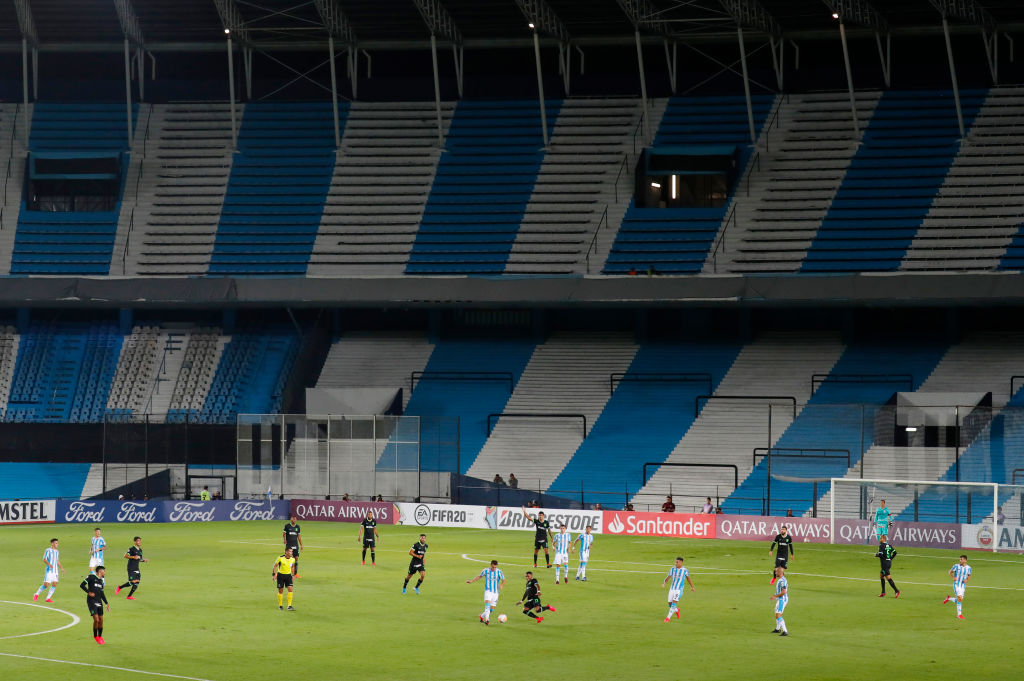
A two-and-a-half week delay to the season would unlikely have a significant impact on the top flight, because their main source of income — broadcast money — has already been paid. But what about playing to empty stadiums?
The main difference between a closed-door match and a normal game of football is gate receipts. Across the 20 teams in the Premier League, a little under £1 in every £7 of revenue comes from matchday. For the well-insulated clubs in the top division, this is unlikely to be too damaging, but it would still be enough to make a dent in their balance sheets. “It is a significant financial impact whichever way you cut it,” says Dr Dan Plumbey, a senior lecturer in sports finance at Sheffield Hallam University. “But in the Premier League the majority of revenue comes from broadcasting. In the short term at least, they’re okay.”
The real pain from closed-door matches will be felt in the lower leagues, where gate receipts are more integral to clubs’ income. In Leagues One and Two, the average amount of annual revenue from matchdays is more like a third, rising to as much as three quarters for some when season ticket sales and walk-in trade are factored in.
Moreover, cash is tighter in the lower leagues. Already, many clubs operate on an annual loss, betting that their outlay will eventually be dwarfed by the massive cash injection that comes with getting promoted at the end of the season. In February, Southend and Macclesfield’s financial difficulties meant they were unable to pay their players’ wages on time. “It is difficult to see how those issues can be turned round,” says Kieran Maguire, author of The Price of Football and lecturer at the University of Liverpool. “My concern would be for those clubs.”
Delaying the restart
Looking further into the future, any delay to matches beyond the planned restart in April will cause serious complications for English football’s richest as well as its poorest. Players’ contracts usually run until 30 June, meaning that pushing matches back until the summer could leave clubs in the lurch. Maguire asks: “Will they be offered short-term contracts? Or will the football authorities come up with some sort of compromise where all EFL clubs agree to extend the period of contract to the 31 July? Whatever they do, they will have to be innovative.”
Plus, the footballing calendar is crowded. Euro 2020, the international tournament, is scheduled to run from 12 June to 12 July, effectively giving clubs a deadline by when the domestic season must be completed. But with that tournament spread over some of the continent’s worst-affected cities, that is also in doubt. European managing body Uefa meets tomorrow to decide whether to push that back by a year.
Getting lawyered up
All of this throws up an unprecedented number of legal issues. Jake Calvert, an associate at law firm Cooke, Young and Keidan, who acts on high-profile sports litigation cases, tells me that most clubs would not be able to sue managing bodies for their losses because a pandemic would likely be covered under a force majeure clause in their contracts — a rule which provides for an exception to contractual obligations in unforeseen circumstances.
“But I would imagine given the hefty sums involved, everyone is going to have a go [legally],” he says. “The sponsors will have a go at the clubs, and it will be for the clubs to raise these arguments in their defence.”
Maguire disagrees. He tells me: “Many sponsors are looking at long-term relationships with clubs. To have your product across the front of Liverpool’s shirt, for example, is quite coveted. I don’t think it would be in the sponsor’s interest to take a confrontational approach, because next time the contract comes up for renegotiation the club is going to take a pretty dim view in itself.”
Bailouts from the top
Nevertheless, with matchday income on hold, belated transfer fees to pay, and footballers’ famously high wages to account for, leniency from sponsors may not be enough for some clubs.
“You can theoretically be right but still run out of money,” says Fausto Zanetton, chief executive of sports advisory firm, Tifosy. “At the end of the day you need to have cash in the bank. These clubs all have bills to pay to other clubs. It’s a house of cards that can fall apart very quickly.”
If the situation becomes worse, “it would be necessary to have a more centralised approach to how you deal with the risk of some of these clubs going into financial distress,” he continues, citing Germany as an example. “The Bundesliga has made noises that they might use some of the broadcasting money as a bridge for this year for the potential loss of revenues.”
Maguire adds that if the Premier League were to support cash-strapped clubs through the period, “it would show that football has a conscience”.
As for the worst-case scenario, cancelling the season altogether would mean heartbreak for Klopp and his team. Until the virus reached Britain, they were almost certain to win their first league title in 30 years, and the £150m prize that comes with it. However, fans must keep things in perspective. Liverpool’s legendary manager from the 1970s, Bill Shankly, once said: “Some people think football is a matter of life and death. I don’t like that attitude. I can assure them it is much more serious than that.” In this case, he is mistaken.