Skip to content
Thursday 20 August 2026London --:--Frankfurt --:--Zurich --:--
NewslettersSearchEN · DE · FR
MorningWire

European business, markets and politics

FTSE 100
10,743.35
+0.14%
DAX
26,091.33
0.00%
CAC 40
8,501.91
0.00%
STOXX 50
6,444.46
0.00%
  • Europe
  • Markets
  • Business
  • Economy
  • Regulation
  • Politics
  • Opinion
More
GermanyFranceEU InstitutionsCompetitionPublic AffairsBankingTechnologyEnergy
  • Germany
  • France
  • Europe
  • Markets
  • Business
  • Economy
  • Regulation
  • Politics
  • Opinion
  • DE
Wednesday 04 October 2023 6:00 am  |  Updated:  Tuesday 03 October 2023 7:26 pm

Cost of rail strikes mounts to £716m as taxpayers forced to support struggling industry

By: Guy Taylor

Transport Reporter

Add as a preferred source on Google
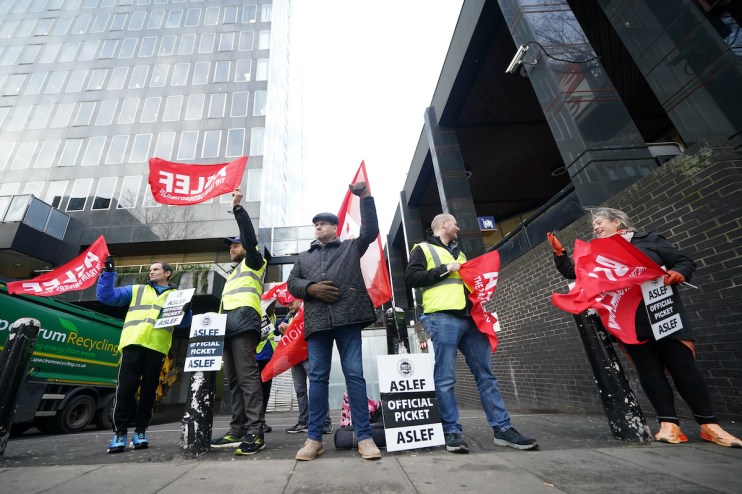
Aslef train workers on the picket line at Euston station in London.

Industrial action has cost the rail industry £716m since the feud between unions and operators began, new figures have revealed.

According to industry analysis shared with Morning Wire, rail strike days have wiped £716m off the sector’s already struggling finances since June last year, with taxpayers now footing a bill of £175m per month to keep the industry alive.

Commuters are currently facing fresh strikes from the train drivers’ union ASLEF today, which are intended to hit the Conservative Party’s annual conference in Manchester.

A slew of operators including Avanti West Coast, Northern, Southestern and Transpennine Express are running no services whatsoever.

Further strikes on the London Underground were also scheduled until a last minute pay deal was reached between Transport for London (TfL) and the Rail, Maritime and Transport Union (RMT) early on Tuesday afternoon.

Ahead of the action, the Rail Delivery Group (RDG), which represents train operators and provided the figures, urged ASLEF leaders to accept the currently tabled offer to avoid taxpayers and businesses facing further costs.

“There is a deal on the table for ASLEF that would take average driver salaries to £65,000 for a four-day week – that’s more than double the average UK salary.”

The Department for Transport (DfT) meanwhile argued that an offer was already on the table and accused the union of failing to put it to their members, “damaging their own industry in the process”.

The government has repeatedly claimed that the dispute is for operators and unions to resolve, while ASLEF has accused senior transport ministers of avoiding their responsibilites by failing to come to the negotiating table.

But experts told Morning Wire that it is the government which actually holds the cards, and that their close oversight of rail groups under the current contracting system is a major reason behind negotiations floundering.

Read more

Virgin Trains gets green light for channel tunnel route

Red Virgin high-speed train on tracks at a station platform, under an arched glass roof, with blurred people.

One source with close knowledge of the sector’s finances told Morning Wire that rail operators are quietly but deeply frustrated with the degree of government oversight, particularly on fiscal matters.

“The way that the National Rail contracts are designed are to try and make sure all the train operators report back to the government on every element of the cost that’s incurred,” the source said.

“The train operators can’t do anything without getting government consent… So all of this kind of rhetoric around, you know, when negotiating with the train operators essentially is all nonsense, because the train operators can’t do anything without going back to the government, there’s that much control.”

The government is currently responsible for rail operators’ cost and revenue risk, after changes to the contracting system during the Covid era.

The source argued this was a “big barrier” to resolving the dispute, as train operators had far greater flexibility prior to the pandemic to pursue agreements in line with their commercial goals.

Before new contracts were introduced, “they could look at it and say, well, we don’t want to have strikes, because we’re losing X, Y, and Z of revenue and we’ve still got all the costs to pay…. So we’ll be more pragmatic”, the source said.

The IEA’s Labour market expert Len Shackleton argued that unions were to blame in part for requesting “inflation-busting pay increases for already well-paid ASLEF drivers”, while taxpayers dish out for the network’s “stonking losses”.

But he added that under the fixed contract system with the DfT, they are “unable to negotiate properly” as train operators “no longer get revenue directly from travellers”.

“The strikes will continue until one side cracks – and I don’t think it will be railway-sceptic Downing Street.”

Read more

Strait of Hormuz ‘closed’ as Iran and US exchange strikes

Bustling shipping activity in the Strait of Hormuz with tankers and cargo ships navigating Iranian waters.

Share this article

  • Facebook
  • X
  • LinkedIn
  • WhatsApp
  • Email

Similarly tagged content:

Sections

  • News

Categories

  • Morning Wire Content
  • Transport & Infrastructure

Trending Articles

  • Jobless Banquet: Youth unemployment surge ‘sends Neets to KFC’

  • Amanda Blanc has worked her magic at Aviva

  • City law firm sues prominent Emirati business family

  • As it happened: Miners fuel FTSE 100 recovery; oil jumps as Trump claims Strait of Hormuz

  • As it happened: FTSE 100 mixed; oil breaks $91 as Trump rules out new US-Iran ceasefire

More from Morning Wire

  • Virgin Trains gets green light for channel tunnel route

    Transport & Infrastructure
    Red Virgin high-speed train on tracks at a station platform, under an arched glass roof, with blurred people.
  • Strait of Hormuz ‘closed’ as Iran and US exchange strikes

    Economics
    Bustling shipping activity in the Strait of Hormuz with tankers and cargo ships navigating Iranian waters.
  • Britain can’t afford a self-harming tourist tax

    Opinion
    Business professionals in formal attire engaged in a lively discussion at a corporate meeting in a modern office setting.
  • As it happened: Stocks reverse losses after Trump threatens harder strikes on Iran; Oil at four-week high

    Markets
    Donald Trump has threatened to sue the BBC for $1bn
  • Trump suspends strikes amid new peace hopes

    Politics
    Donald Trump speaking at press conference podium, addressing media with serious expression, American flags in background
  • Trump warns Iran: ‘We’re going to beat the f***ing s*** out of them’

    Politics
    Donald Trump speaking at press conference podium, addressing media with serious expression, American flags in background
  • As it happened: Stocks jump as oil drops below $100; Trump in tariff blitz

    Markets
    Donald Trump speaking at a press conference with microphones, blue sky background
  • Burnham promises to ‘build new economy’

    Politics
    Andy Burnham, Mayor of Greater Manchester, speaking at an event
MorningWire

Independent European business, markets and political news for decision-makers.

Morning Briefing

Europe

  • Germany
  • France
  • EU Institutions
  • Europe

Business

  • Markets
  • Business
  • Economy
  • Regulation
  • Competition
  • Public Affairs

Editorial

  • Opinion
  • Editorial Policy
  • Corrections
  • Contact

Company

  • About Morning Wire
  • Privacy Policy
  • Terms of Use
  • Cookie Policy
© 2026 Morning Wire Ltd · Published by Morning Wire Media, Bahnhofstrasse 65, 8001 Zürich, Switzerland
Privacy · Terms · Cookies · Facebook