
Curing a village of needless blindness

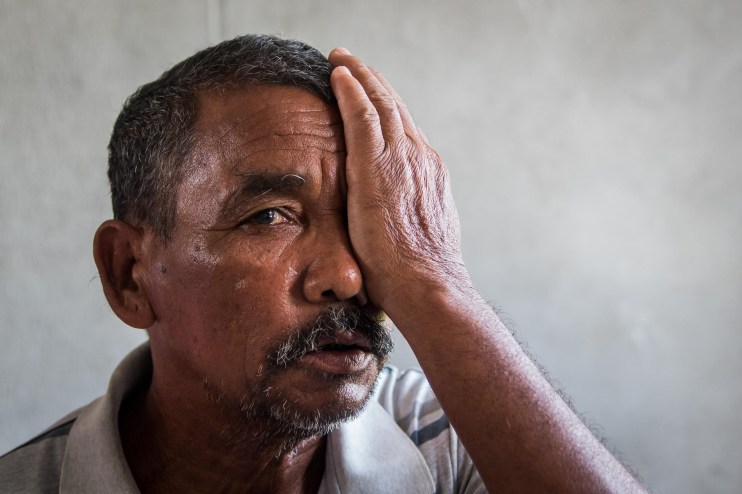
In a rural fishing and farming village in Morang District of Nepal, a team from the Tej Kohli & Ruit Foundation set up a screening camp on 15th August 2022.
From the village, over 150 people were screened and 23 of those were found to be living with cataracts. This is an extremely common form of needless blindness which affects a lot of the developing world. The prevalence rate of cataract blindness in the village was 14.83%, confirming the ideas of several research reports that state that the prevalence of cataract blindness is much higher in the developing world compared to developed nations.
According to a report by the International Agency of Preventable Blindness (IAPB), “The major challenge in eye health remains reducing the inequality in coverage. Currently, 1 billion people are being left behind in eye health. Sadly, blindness and vision impairment tends to be concentrated among the poorest and most socially disadvantaged members of society.”
Needless blindness is both a cause and consequence of extreme poverty. To assist in achieving the first of the United Nations Sustainable Development goals of eliminating extreme poverty everywhere, significant investment in curing blindness in the developing world must be made.

Inspired by the vision to eradicate extreme poverty across the world, the Tej Kohli & Ruit Foundation has pledged to screen one million people in the developing world. In the Kalahari village in the Morang District of Nepal, 23 people were found to be living with cataract blindness. Such a high rate of blindness not only affects individuals and families but at many times pushes entire communities further into the vicious cycle of poverty.
Of the 23 people suffering from cataracts was Bindeshwar Sardar. Bindeshwar is a 63-year-old man who lives with his family in Katahari of Morang, Nepal. Complaining of visual impairment for 2 years, he was referred to a specialist hospital in Biratnagar for further check-ups. However, he lacked the financial means to afford surgery at the hospital. Therefore, he continued to live a life of needless blindness.

Unable to perform most of his work, he limited himself to taking care of the buffalo that was owned by his family. “I can’t even milk the buffalo anymore”, he says. “My daughter-in-law milks the buffalo these days. She has so much household work to look after, and now she has one more responsibility”, he adds.
When the Tej Kohli and Ruit Foundation screening camp arrived at his village on the 15th of August, he made his way to the camp to have his sight restored. At the camp, he was invited for free cataract surgery by the Tej Kohli and Ruit Foundation.
Bindeshwar’s surgery was performed on the 16th of August 2022 by Dr Subash Pokhrel from the Ramlal Golchha Eye Hospital in Biratnagar – a partner hospital of the Tej Kohli and Ruit Foundation that works towards identifying and eradicating needless blindness in the region.
The next day, Bindeshwar was happy to return home with restored sight and looked forward to resuming his daily activities and assisting his family.
Another patient, 59-year-old Ravilal was already leading a difficult life owing to a disability in his hand. Life had become a lot more difficult after cataract blindness set in. He had always tried to do his best to not become an inconvenience to his family, as his vision deteriorated, he worried he was going to become completely dependent on them.

When a Tej Kohli & Ruit Foundation team set up camp near his village, he quickly made his way there. At the camp, eye health personnel told him he was suffering from cataract blindness and that he could be cured. He breathed a sigh of relief when the team told him his surgery would be done for free. Ravilal’s surgery was performed the next day, along with twenty-two others from his village who were identified as living with needless blindness.

One of the other patients to be cured was construction worker Semilal Sardar. He had spent his life roofing houses and erecting pillars to earn a steady income. Having worked from a young age, his work was his passion. However, for the past year, he has been experiencing difficulty performing his work.
Knowing that there was an issue but being unsure what to do Semilal began to deteriorate quickly. He then found out that he was suffering from cataracts. When asked the reasons for not showing himself to a doctor when his vision began to deteriorate, he stated that he did not have enough money to seek treatment.
“It is difficult for me to see. I cannot recognize a person from this short distance as well”, he tells us. However, despite his blindness, he has had to continue working. He went on to say:
“When I look at the roof I am working on, it looks aligned from the centre. However, when I look at it from the right, I realize I am off by at least 4 inches. It is becoming really difficult”.

Semilal’s surgery was performed the next day alongside the other members of his community. The cure they all received will now allow them to have a second chance to pursue their economic activities, and
The Tej Kohli & Ruit Foundation believes large-scale investments in sight restoration programs have the ability to transform communities – communities such as Katahari of Morang, where those living with needless blindness are able to have a second chance to become active members of society – to be able to pursue their economic activities, and therefore lifting entire communities out of extreme poverty.
With such interventions, the Tej Kohli & Ruit Foundation hopes by 2030 – it would have made a significant impact on the number one United Nations Sustainable Development Goal of ending extreme poverty everywhere.
The Tej Kohli & Ruit Foundation is a restricted fund operating under the auspices of Prism The Gift Fund, registered UK charity number 1099682.