Death Note: The Musical review – a high-shine, high school take on the trolley problem

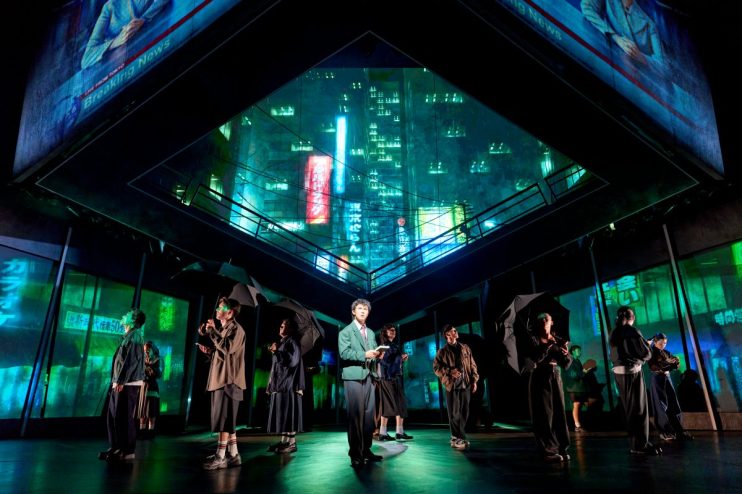
Death Note: The Musical | Barbican Theatre | ★★★☆☆
After 10 years of cult success in Japan and Korea, Death Note: The Musical, a pop-rock production adapted from an early noughties manga series, has arrived in London for its English language world premiere. Staged at the Barbican for a 50-show run, scores of costumed fans have already flocked to the theatre for a taste of this high-shine production, in testament to its cult status.
The show has a neat premise: Tokyo high school student Light Yagami comes across a notebook with which he can murder anyone simply by writing down their name. If he wants, he can specify the means of death; otherwise, they are simply given a heart attack after 40 seconds. It’s the setup for a series of trolley problems, the exploration of which unfortunately goes little beyond the discussion you may have had in your high school philosophy classes.
Light’s black and white perspective on justice is made clear from the opening song ‘Where is the Justice?’, in which Light leads his classmates in a number about the inadequacy of the Japanese justice system, under which he feels too many go unpunished. “Where is the justice when the guilty all go free? Why don’t we lock them up and throw away the key?” He is lightly chastised by his teacher, who suggests the world is not so simple. This exchange – we should kill murderers, no it’s more complicated than that – quickly becomes the show’s philosophical refrain.
Light’s first use of his power – to kill a gunman holding a group of children hostage – is trolley problem number one, and it’s a pretty easy one. However, when Light attracts the attention of the police and swiftly starts to eliminate those who threaten to expose him too, any sense of his ethical framework being morally interesting quickly dissipates.
A half-baked interrogation of capital punishment
For important context, Japan still employs capital punishment with overwhelming public support (a 2025 survey found 83.1 per cent of the Japanese public supports the death penalty). The country also has an incredibly high conviction rate (over 99 per cent), but only because of its low prosecution rate (essentially, only cases with clear evidence are brought to trial). Both of these things go a long way to explaining Light’s absolutist approach to justice, only his stubbornness in holding such a position and complete lack of remorse quickly makes a panto villain of him.
When he is called a “childish serial killer” by a previously friendly shinigami at the show’s climax, it feels like more of a “duh” than an epiphany. Additionally, a hostage scene featuring pop star character Misa Misa, who belts a song blindfolded while tugging at chains she is being bound down by becoming entangled in Light’s murders, felt more like a male BDSM fantasy than an emotional highpoint.
What the musical lacks in philosophical rigour though it makes up for in production value. No doubt, this is an impressive staging with a talented, energetic cast to carry it too.
With set design by Jon Bausor, Death Note’s visuals are magnificent. The stage itself is set beneath a concrete balcony on which the shinigami play, itself beneath mammoth projections of a Tokyo metropolis. The balcony creates a striking diamond structure above the action, reminiscent of that kind of comic-strip 3D look (fitting for the source material). There is also a bit of echoing of the Barbican itself in the brutalist landscape. Lighting also plays a key part; scenes are often bathed in neon, while blackouts and white flashes punctuate the dramatic high points.
Arguably, the visuals make for the perfect companion for the show’s moral framework too: stark, sharp and full of harsh lines.
Death Note: The Musical is running at the Barbican Theatre until 12 September