
Decarbonisation – Scope 1, 2 and 3: The ‘what’, ‘how’ and ‘why’
Blog summary
- Scope 1, 2 and 3 emissions concern the different types of greenhouse gas (GHG) emissions (direct and indirect) that a company produces.
- Organisations must measure and report on GHG emissions for legal requirements and to maximise the potential benefits.
- The emissions data collection process can be facilitated by fostering strong governance, seeking expert advice, and setting targets aligned to science.
The ‘what’: Understanding scope 1, 2 and 3
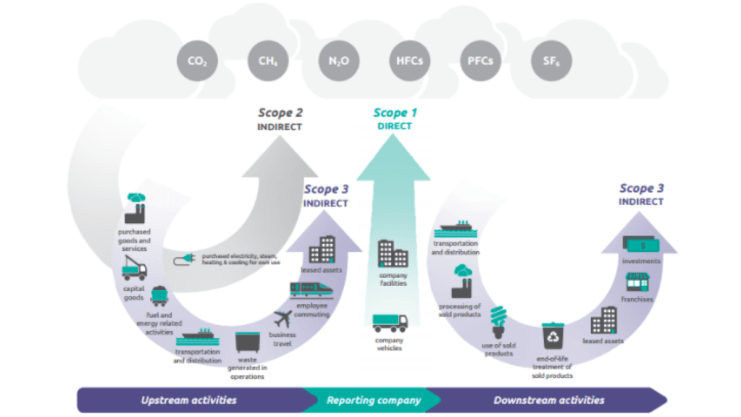
The terms scope 1, 2 and 3 were born out of theGHG Protocol (2001) and represent distinct categories of GHG emissions that arise from different sources within and beyond an organisation. This methodology now acts as the backbone for GHG emissions reporting in the UK and will become employed internationally too.
Breaking the scopes down:
Scope 1 Emissions: These emissions occur from direct sources that your organisation owns or controls. Examples include emissions from company-owned vehicles or manufacturing processes. Effectively managing scope 1 emissions can enhance efficiency and facilitate in meeting net-zero targets.
Scope 2 Emissions: These are indirect emissions associated with purchased electricity, heating, or cooling services. Although these are indirect sources of emissions, they can be reduced and influenced by, for example, opting for sustainable procurement strategies (e.g., Renewable Energy Guarantees of Origins – REGOs).
Scope 3 Emissions: Often considered ‘hidden’ emissions, scope 3 emissions constitute a wide range of indirect emissions generated throughout your value chain and can amount to approximately 80% of total emissions (Edie, 2020). There are 15 categories within scope 3 and examples include includes emissions from transportation and waste of goods from your supply chain. Addressing scope 3 emissions is key to decarbonisation and paves the way to improved resilience, however, it requires collaboration with your whole value chain.

The ’why’: Prioritising the measurement and reporting of scope 1, 2, and 3 emissions
01 Legal Requirements: In line with evolving ESG regulations (e.g., ISSB and CSRD), organisations are increasingly mandated to measure and report their emissions. Adherence to these requirements is crucial in ensuring an organisations success in the long term. Moreover, reporting on scope 1 and 2 emissions is already a legal requirement for many companies. In line with the recommendations of the Intergovernmental Panel on Climate Change (IPCC), businesses must cut GHG emissions 45% by 2030 and meet net-zero by 2050 (as enshrined in UK law in 2019).
02 Business Benefits: Taking proactive measures to reduce emissions delivers multiple benefits. It enhances brand reputation and facilitates securing ESG approved investment. Additionally, by identifying the emission hotspots in your organisation, cost saving strategies and more efficient operations can be realised. Notably, firms who focus on ESG have more satisfied employees, which in turn correlates to having a three-year revenue growth up to 6% above those in the same sector but with less satisfied employees (Edie, 2022).
The ‘how’: Implementing a Robust Approach
To effectively measure and report scope 1, 2, and 3 emissions, the following key tips should be considered:
- Seek Expert Advice: Seek guidance from professionals with expertise in GHG emissions and climate science. This will streamline your data collection process and ensure best practise is adopted.
- Set Ambitious Targets: Align your emission reduction targets with the Science Based Targets Initiative (SBTi). This demonstrates your commitments and adds competitive edge.
- Foster Strong Governance: Establish robust governance structures by establishing a net-zero working group within your organisation. This ensures that emissions data collection and reporting processes are streamlined and reliable.
Moving towards a net-zero future
As aptly articulated by Mark Carney, former Governor of the Bank of England: “Firms that adjust their business models to the transition to the net zero world will be rewarded handsomely. Those that fail to adapt will cease to exist.” Therefore, measuring and reporting scope 1, 2, and 3 emissions is essential for long-term success, allowing organisations to not only meet regulatory requirements but to reap business benefits.
To further your understanding, follow our series of scope 3 category deep-dives, where we unpack each of the 15 categories and the necessary business actions for each, which will be posted on our blog monthly.