Denmark has the ‘happiest city in the world’. I spent a week there in search of their secret

Can a city cure sadness? Adam Bloodworth visits Denmark’s other capital, Aarhus, to speak to some of the happiest people in the world
You probably haven’t heard of Aarhus, but Denmark’s second biggest city – which has serious beef with Copenhagen – claims to be the ‘happiest city in the world’. The British Institute for Quality of Life this summer draped the medal over the shoulders of the low-key place, home to 300,000 Danes. “I would think a lot of people who live here would imagine the happiest place must be somewhere in California,” local record store owner Bjørn tells me. “Somewhere where it’s sunny. Happiest place? Really?”
Amid the cost of living crisis, the loneliness epidemic, and the world burning, it’s a tempting prospect. So what’s their secret, and should we throw everything we own in a bag and relocate? Could the grass actually be greener? What does it take to be hailed as the happiest city in the world, and can a concept so subjective really be attributed to a geographical location?
Surely cities don’t have feelings. But I was interested to walk among the people who, at least statistically, have the odds stacked in their favour
First things first, Aarhus really is a cool place. I visited over the summer because I was fascinated with the idea of bottling utopia. Some reasons it is cool: it is by the sea; it is small enough to be walkable but cosmopolitan enough to have things to do; there is a jazz festival; bikes seem to be the main mode of transport; nature is everywhere and streets suddenly get engulfed by forests. The city beat off competition from London (voted 33rd happiest city), and front-runners Zurich, Berlin and Gothenburg to take the gong.
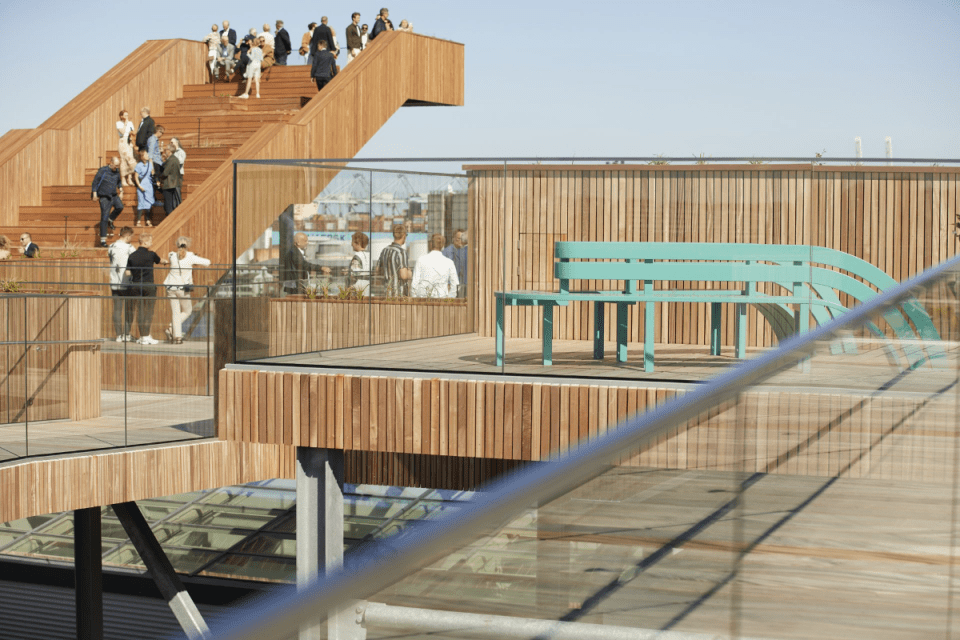
Everyone looks well. Great hulking Vikings with impeccable dentistry, well-curated garms and, seemingly, not a worry in the world (this may be reserved for heteronormative white Aarhusians, but more on that later).
The Latin Quarter, a few minutes’ walk from the commercial centre, is a comedically perfect-looking hipster utopia. The city is populated by 38,000 students, and impossibly handsome young people stroll at a pace that suggests they have absolutely nowhere to go. Shops and cafes display a distinguishably Danish type of cool; al fresco dining from steel tables that glint in the sun; people sitting on azure-blue milk crates turned on their side. No one seems to be at work.
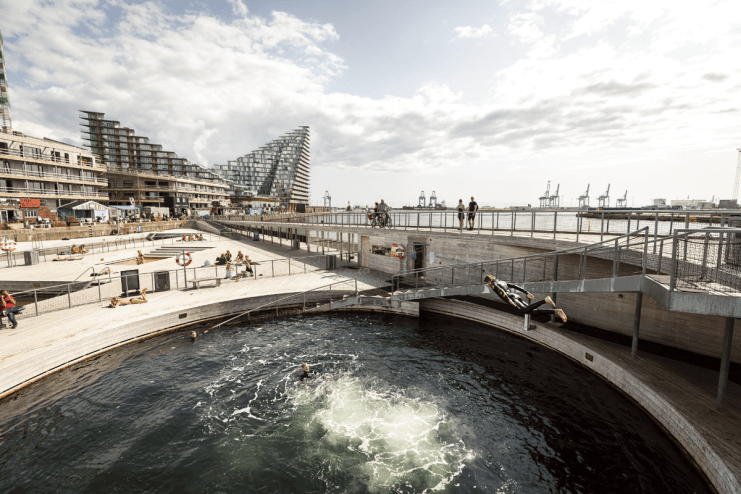
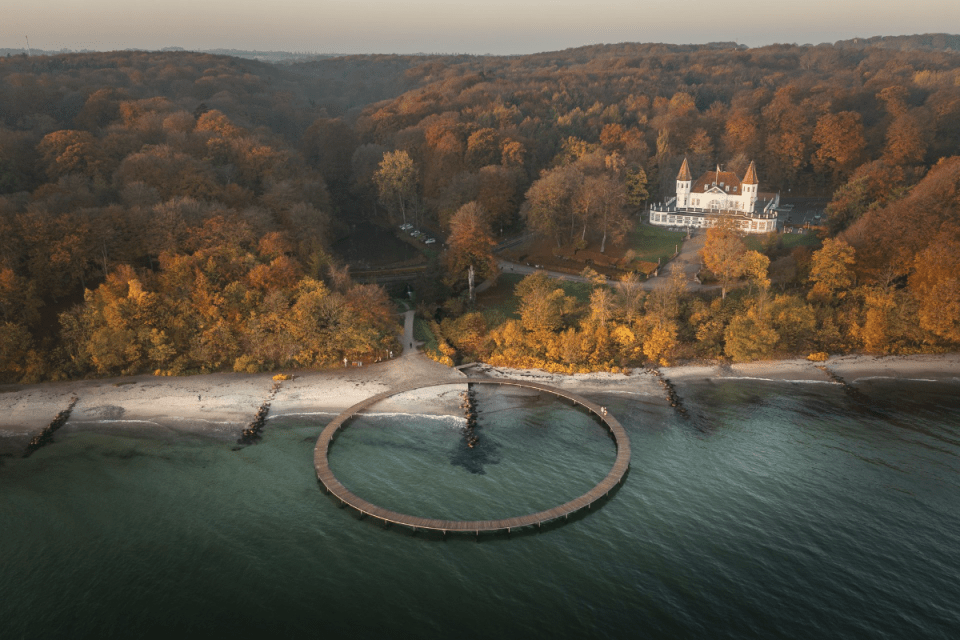
A ten minute cycle away, The Infinite Bridge forms a boardwalk ring over the bay, like a metaphor of how, in Aarhus, beauty is cyclical and never ending. It almost certainly helps that salaries are high and rents lower than in Copenhagen, but there’s also a focus on high quality municipal projects: the world’s largest harbour baths, a world-leading design triumph, are free-to-enter; locals swig from shop-bought bottles of wine in-between plunges. A gender museum highlights over a dozen ways to self-define and feels strides more progressive than any comparator in London (our Queer Museum is much smaller and only opened in 2021).
“People are maybe a little bit more relaxed and there’s a lot of trust as well,” muses Bjørn. “That’s an important thing, to establish personal connection with customers. That’s something that contributes to a happy city.”
But there’s another facet to this conundrum. One black local pulls me away from her group to share her experiences of racism. “Beware of the blonde hair and blue eyes,” she says. A fairly staggering 86 per cent of the country’s population is ethnically Danish and new reports highlight the discrimination faced by people from minority ethnic backgrounds. Suicide rates are higher than in the UK, and there’s an epidemic of lonelinesss.
The happiest place in the world? Clearly it’s not as simple as that. Aarhus is a bellwether for a far more interesting conversation: how we define happiness, and where we look for it. Anna Overgaard, a ceramicist in the city, illustrates the issue that lies beneath the locals’ perfectly smooth skin: “What are you looking for? Is it whether you feel safe? Content? Do you go to bed with a full belly and a roof over your head? Or is it that you’re happy? Content with yourself?”
Philosophers broadly describe happiness in two ways: hedonism, and life satisfaction, the first relating to a temporary state of mind and the second to a broader style of living. But it doesn’t take an Oxbridge grad to work out that a city – a nebulous, ever-changing thing – cannot be either of those. Even the Happy City Index admits this, opening its list with a 300-word blurb explaining why the idea of a happy city is essentially nonsense. “We believe it is not possible to fairly identify a single city as the best in terms of ensuring the happiness of its inhabitants.”
Read more: No more Noma: What’s next for Copenhagen’s food scene
“A city does not have feelings,” confirms psychologist Clare Patterson, a member of the Counselling Directory. “It is not the city that is happy, and our happiness is not dependent on it. We can be just as satisfied anywhere else in the world. Happiness is within, not without.”
The risk many of us face in day-to-day life is confusing happiness with peace of mind, says Patterson. “Our happiness can go up and down depending on our life circumstances. Our peace cannot. It is always within us and cannot be affected by our environment.”
Perhaps the best Aarhus can do is to help us acknowledge that if we’re chasing happiness in physical form, it can point to a deeper problem. And that has very little to do with where we live. “Happiness is seriously misunderstood. It really isn’t as ‘far away’ as we think it is,” adds Patterson. “Ironically, when we discover the peace inside ourselves, our happiness increases naturally and we become far less dependent on our material circumstances. It really does take very little to be happy, but sadly in today’s materialistic society, this is not the message we receive.”
That’s not to say nature cannot impact happiness. More that it’s a small factor inextricably tied to other things, like our own view of ourselves and our inherent sense of inner peace. Patterson acknowledges that most of us “‘feel better’ when out in nature,” because it “removes some of the obstacles we may have to realising peace and joy within ourselves.” In other words, it papers over our issues; offers a temporary reprieve.
Clearly Aarhus is a great place to live. Bjørn moved there in 1998 to study and has never looked back; his student job at the record store ending up with him running the place. “You never really know where life takes you,” he says. Anna fled Aarhus for the Danish capital in her twenties but has returned to open her first ceramics studio. “In Copenhagen it is difficult to do this full time.”
Before I touched down in Aarhus I was, of course, aware that cities can’t cure sadness. But I had been interested to walk among the people who, at least statistically, had the odds stacked in their favour. The city did not make me happy, however; if anything, the Danish reputation for reserve can feel cold and standoffish, and Aarhus didn’t feel like an easy place to travel alone. I experienced my own dose of the loneliness epidemic while I was on happy soil.
Still, the reasons for its happiness credentials were plain to see: it was lovely to visit the beach and go to the forest straight after, via a decent supermarket. As a Londoner, I’m used to a 40 minute schlep to reach my friends on the other side of the city, and I certainly felt less stressed being able to reach Aarhus’ extremities via a five minute bike ride.
I am certain that the city is geographically utopic, and it felt inspiring to watch the Danes go about their lives, jumping in and out of the saltwater pool with their perfect skin and perfect smiles. But who knows what’s going on inside.