Skip to content
Sunday 6 September 2026London --:--Frankfurt --:--Zurich --:--
NewslettersSearchEN · DE · FR
MorningWire

European business, markets and politics

FTSE 100
10,831.09
0.00%
DAX
26,046.40
+0.17%
CAC 40
8,278.77
-0.09%
STOXX 50
6,392.93
+0.16%
  • Europe
  • Markets
  • Business
  • Economy
  • Regulation
  • Politics
  • Opinion
More
GermanyFranceEU InstitutionsCompetitionPublic AffairsBankingTechnologyEnergy
  • Germany
  • France
  • Europe
  • Markets
  • Business
  • Economy
  • Regulation
  • Politics
  • Opinion
  • DE
Wednesday 09 July 2014 10:18 am  |  Updated:  Friday 07 June 2019 12:56 am

Do we need stronger restrictions on public sector strikes?

By: Mark Wallace

Add as a preferred source on Google

Mark Wallace, executive editor of ConservativeHome, says Yes.

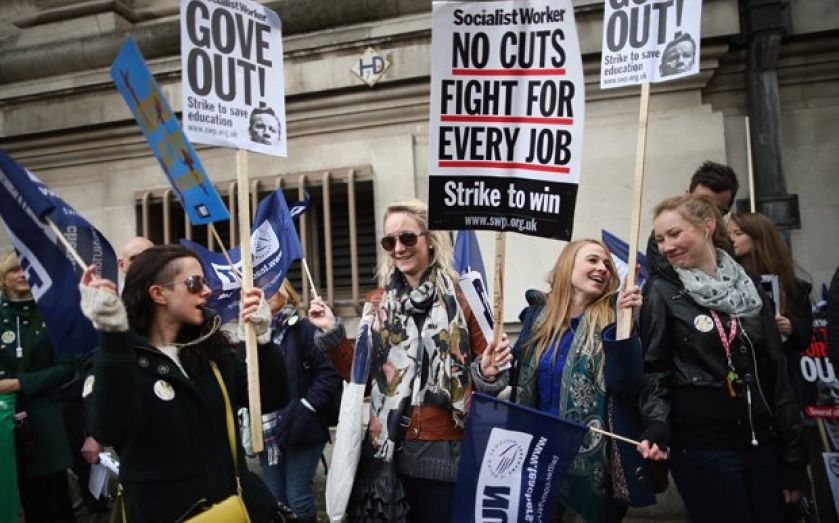
Today’s strike is a farce. The National Union of Teachers walk-out, which is at the heart of the action, is based on a ballot which took place two years ago and secured only the majority support of a tiny turnout.

That flimsy, moth-eaten mandate will be used to bring disruption and misery to millions. It’s hard to think of a better example of why the laws on public sector strikes require reform. Rolling mandates, where one strike ballot can be used to justify strikes for years afterwards, must be abolished.

Furthermore, a public sector strike should only be valid if a real majority of union members vote for it – not a tiny, militant minority winning a ballot in which few people took part. Most trade union members don’t join up to strike.

They join for productive representation, training and, particularly in the case of teachers, legal insurance. Those pragmatic voices far outnumber the striking radicals – we need reform to ensure they are heard.

Ralph Scott, head of editorial at Demos, says No.

Strikes, especially when they lead to closures of schools, are frustrating and inconvenient for everyone. But action by unions is one of the ways employees can make their voice heard in the workplace, and shouldn’t be restricted.

The Conservative Party has said it is considering a ballot threshold as a manifesto commitment, with a figure of 50 per cent having previously been floated by the mayor of London.

But if you think about this for a second, it’s clear this could lead to the perverse situation of an abstention carrying more power than a vote against action. Say a workplace of 200 people is balloted and only 99 people vote in favour – the vote would be ineligible. But if 51 vote for and 50 against, the strike has more legitimacy in Boris’s view.

Strikes are frustrating, but the answer is for both sides to negotiate a way forward and encourage voting reform in union elections, not to legislate them out of existence.

Share this article

  • Facebook
  • X
  • LinkedIn
  • WhatsApp
  • Email

Similarly tagged content:

Sections

  • Opinion

Categories

  • Opinion

Trending Articles

  • Victoria Beckham owed £350,000 by Harvey Nichols

  • Iceland boss Richard Walker vows to set up shop on Falkland Islands

  • Don’t underestimate the free trade agreement Britain just joined

  • £74m for branded condoms? UK must stop spaffing cash on foreign aid

  • Britain ‘taxing itself to death,’ Burnham warned

More from Morning Wire

  • Doctors union tops up £1m reserve pot for strikes

    Healthcare
    GettyImages 2246649047: Business professionals discussing strategy at a conference table, highlighting teamwork and collab...
  • As it happened: FTSE 100 slides as bound rout deepens; Oil jumps as Trump vows more strikes on Iran

    FTSE 100 Live
    Large oil tanker navigating a strait under a cloudy sky, impacting oil prices and global trade.
  • Burnham pledges to tackle ‘cost of business’ as firms fear Budget tax raid

    Politics
    Andy Burnham, Mayor of Greater Manchester, drinks a pint of ale in a pub with people blurred in the background
  • Trump suspends strikes amid new peace hopes

    Politics
    Donald Trump speaking at press conference podium, addressing media with serious expression, American flags in background
  • Britain’s problem isn’t too much Thatcherism, but too little

    Opinion
    Margaret Thatcher smiling outside 10 Downing Street during her tenure as UKs longest-serving Prime Minister in the 20th ce...
  • Keir today, gone tomorrow: A London by-election may spell danger for Labour

    Opinion
    Keir Starmer shaking hands with a man in a tall hat and red furry costume at a Holborn and St Pancras election event.
  • Lord O’Neill declines job in Burnham government

    Economics
    Jim ONeill, economist and former Goldman Sachs chairman, sitting on a yellow sofa in front of large windows.
  • Treasury ‘tells Healey’ to consider tax on banks and oil

    Politics
    Chancellor John Healey smiling, wearing a navy suit, white shirt, and red tie.
MorningWire

Independent European business, markets and political news for decision-makers.

Morning Briefing

Europe

  • Germany
  • France
  • EU Institutions
  • Europe

Business

  • Markets
  • Business
  • Economy
  • Regulation
  • Competition
  • Public Affairs

Editorial

  • Opinion
  • Editorial Policy
  • Corrections
  • Contact

Company

  • About Morning Wire
  • Privacy Policy
  • Terms of Use
  • Cookie Policy
© 2026 Morning Wire Ltd · Published by Morning Wire Media, Bahnhofstrasse 65, 8001 Zürich, Switzerland
Privacy · Terms · Cookies · Facebook