Skip to content
Tuesday 25 August 2026London --:--Frankfurt --:--Zurich --:--
NewslettersSearchEN · DE · FR
MorningWire

European business, markets and politics

FTSE 100
10,854.32
+0.35%
DAX
26,106.60
-0.11%
CAC 40
8,453.01
0.00%
STOXX 50
6,447.98
-0.22%
  • Europe
  • Markets
  • Business
  • Economy
  • Regulation
  • Politics
  • Opinion
More
GermanyFranceEU InstitutionsCompetitionPublic AffairsBankingTechnologyEnergy
  • Germany
  • France
  • Europe
  • Markets
  • Business
  • Economy
  • Regulation
  • Politics
  • Opinion
  • DE
Wednesday 20 March 2024 1:31 pm

Will the US government’s ballooning fiscal deficit put the Federal Reserve’s independence at risk?

By: Chris Dorrell

Add as a preferred source on Google
Fiscal dominance is when the decisions of an independent central bank are driven by how it might impact governments rather than inflation.

The independence of the US Federal Reserve may come under threat from ballooning government deficits, according to a leading analyst.

Liberum’s Joachim Klement argued the Federal Reserve may have to increasingly consider the impact of interest rate hikes on government debt, raising the risk that its independence could be undermined by fiscal dominance.

Fiscal dominance is when the decisions of an independent central bank are driven by how they might impact fiscal policy rather than narrowly monetary issues.

For example, big budget deficits could prevent aggressive rate hikes if a central bank is concerned about the sustainability of government debt.

Klement argued this was likely to be a necessary state of affairs in an emergency, such as during the financial crisis or the pandemic, but warned the Federal Reserve’s independence could be threatened.

“I think we are on our way to another major shift in the relationship between governments and central banks,” he said.

“For decades, we lived in an era of monetary dominance where central banks were actively trying to manage inflation while governments passively set fiscal policy, accepting interest rates and the cost of debt as a given.

“But the chart below shows that fiscal policy and monetary policy are more and more often in conflict, with one of them being expansionary while the other is restrictive. If such conflicts appear, either the central bank or the government must give in and change course or inflation will get out of control,” he said.
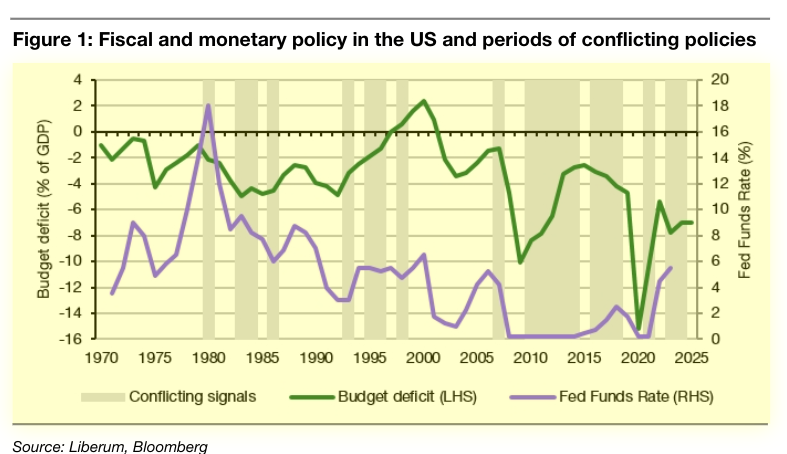
Klement pointed out the government debt is extremely high in the US with little sign that it will come back down any time soon. This will mean the Federal Reserve will have to consider debt sustainability when it is setting interest rates in the years to come.

“If the Fed wants to prevent a slow-motion version of the debt crash under Liz Truss and Kwasi Kwarteng in the UK, it will increasingly have to limit interest rate hikes to levels that do not endanger bond market stability. Which in turn means that the fight against inflation will become more difficult,” he said.

“Consciously or unconsciously, fiscal policies will become more and more dominant over time, reducing the independence of monetary policy and making inflation harder to control. And where inflation becomes harder to control, you can rest assured that it will at least become more volatile,” Klement concluded.

Read more

Investors ‘may be less than impressed’ by John Healey’s £9bn borrowing plans 

Man in suit and red tie speaking at a podium to an audience in a modern building.

Share this article

  • Facebook
  • X
  • LinkedIn
  • WhatsApp
  • Email

Similarly tagged content:

Sections

  • Markets & Economics

Categories

  • Economics

People & Organisations

  • The Federal Reserve

Related Topics

  • Federal Reserve
  • US interest rates

Trending Articles

  • Can debt-ridden Morrisons become a Big Four supermarket again?

  • Ratcliffe’s Ineos saves Runcorn plant

  • As it happened: Stocks rally; US to unveil ‘economic D-Day’ Iran sanctions

  • Amazon says it buys books in bulk to ‘improve products’

  • HMRC mansion tax inspectors to target homes for property valuations

More from Morning Wire

  • Investors ‘may be less than impressed’ by John Healey’s £9bn borrowing plans 

    Economics
    Man in suit and red tie speaking at a podium to an audience in a modern building.
  • Burnham predicted to raise taxes for ‘fundamental’ cost of living support

    Economics
    Andy Burnham, Mayor of Greater Manchester, in a dark jacket and glasses, standing before a large pile of waste.
  • Government debt repayment ‘could rise to half’ of total taxes

    Economics
    OBR chiefs told the Treasury Select Committee that a higher tax burden could stifle growth.
  • Organigram Reports Record Third Quarter Fiscal 2026 Results

    Business Wire
  • Healey told tax rises for fiscal remedy are ‘not required’

    Economics
    Massachusetts Attorney General Maura Healey, smiling and gesturing, speaks at a podium.
  • Healey oversees unexpected rise in borrowing in first month as Chancellor 

    Economics
    Man in suit and red tie speaking at a podium to an audience in a modern building.
  • Vibes matter with tax, so here’s how Healey can deliver a feel-good Budget

    Opinion
    Chancellor John Healey smiling, wearing a navy suit, white shirt, and red tie.
  • ReNew Announces Results for the First Quarter for Fiscal Year 2027 (Q1 FY27), Ended June 30, 2026

    Business Wire
MorningWire

Independent European business, markets and political news for decision-makers.

Morning Briefing

Europe

  • Germany
  • France
  • EU Institutions
  • Europe

Business

  • Markets
  • Business
  • Economy
  • Regulation
  • Competition
  • Public Affairs

Editorial

  • Opinion
  • Editorial Policy
  • Corrections
  • Contact

Company

  • About Morning Wire
  • Privacy Policy
  • Terms of Use
  • Cookie Policy
© 2026 Morning Wire Ltd · Published by Morning Wire Media, Bahnhofstrasse 65, 8001 Zürich, Switzerland
Privacy · Terms · Cookies · Facebook