Skip to content
Sunday 23 August 2026London --:--Frankfurt --:--Zurich --:--
NewslettersSearchEN · DE · FR
MorningWire

European business, markets and politics

FTSE 100
10,816.56
+0.64%
DAX
26,136.56
+0.59%
CAC 40
8,484.43
+0.37%
STOXX 50
6,462.22
+0.63%
  • Europe
  • Markets
  • Business
  • Economy
  • Regulation
  • Politics
  • Opinion
More
GermanyFranceEU InstitutionsCompetitionPublic AffairsBankingTechnologyEnergy
  • Germany
  • France
  • Europe
  • Markets
  • Business
  • Economy
  • Regulation
  • Politics
  • Opinion
  • DE
Tuesday 05 May 2015 4:45 am

Drug companies are producing more new cancer drugs than ever before – but can countries actually afford them?

By: Sarah Spickernell

Add as a preferred source on Google

The world faces a cancer medication conundrum. On the one hand, the ageing population means we need more effective treatments for the disease, but on the other hand these can cost so much to create that we can't use them. 

The IMS Institute for Healthcare Informatics estimates that last year, global spend on cancer drugs reached $100bn (£66m) for the first time ever, which amounts to $99 per head. This was up from $71 per head in 2010, and marks a 10.3 per cent increase in spend compared to 2013.
 
Why the sudden surge in spending? Pharmaceutical giants like AstraZeneca, Roche and Merck & Co are all investing in a new kind of cancer treatment that work by harnessing the body's own immune system to fight tumours. 
 
These drugs are highly effective, and have been heralded by experts as the biggest step forward in cancer treatment in decades. “New therapeutic classes and combination therapies will change the cancer landscape over the next several years,” the US analytics firm said in its report. 
 
But such progress comes at a price – some of those launched in the US in recent months have reached costs of around $150,000 per year, and the result is that many of them will never be used to treat patients because public health services won't be able to afford them. 
 
Between 2010 and 2014, 45 new cancer drugs were released by pharmaceutical companies, but in no country across the world have patients had access to all of them. The broadest access was seen in the US, Germany and the UK, while very few were available in Japan, Spain and South Korea. 
 
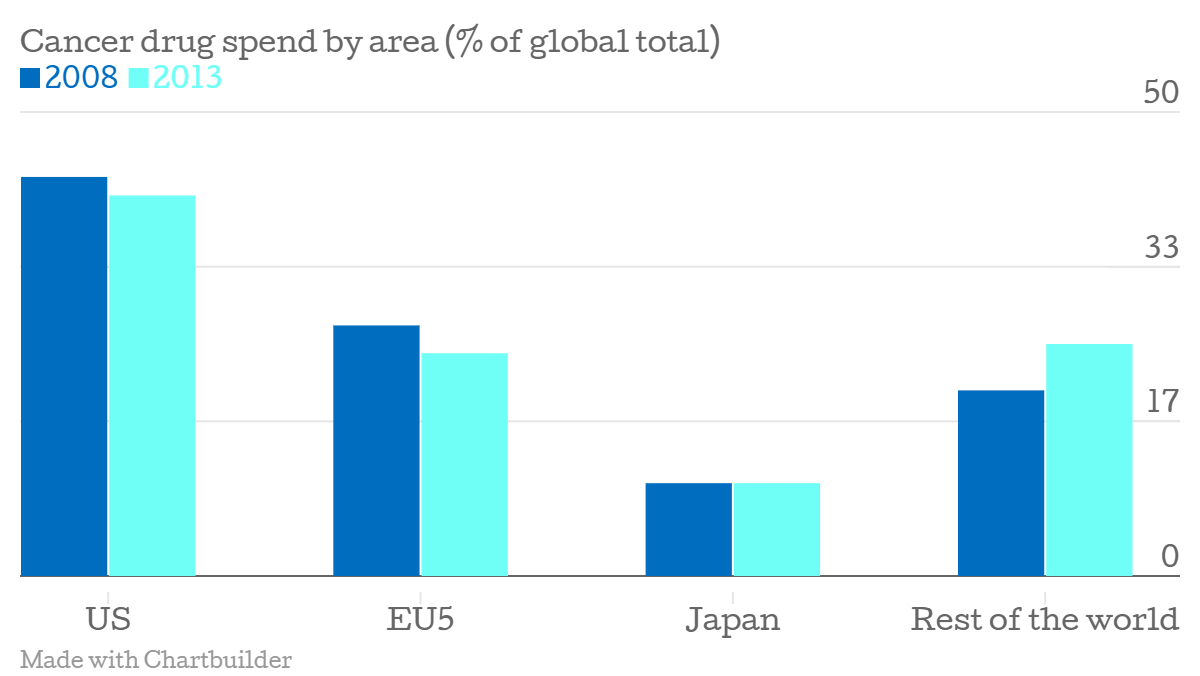
This falls in line with national spend on cancer drugs as a proportion of the global total, with the US  coming first, with 42.2 per cent, followed by the five biggest economies in Europe – Germany, France, Britain, Spain and Italy (EU5). 
UK losing out

In the case of the UK, a Cancer Drugs Fund has been set up to allow greater spend on treatments for the disease than would be allowed under normal NHS conditions, but it is still unable to purchase many of the new medicines that come to market. 
 
In fact, its ability to invest in new treatments is diminishing – earlier this year, the government earmarked 16 cancer drugs for ejection from the fund, on the grounds that they were not cost-effective enough to warrant provision on the NHS. 
 
This reflects a shifting global trend, which can be seen in the graph above – over the five-year period, the dominant forces in drug manufacture have been losing out to the rest of the world. 

Share this article

  • Facebook
  • X
  • LinkedIn
  • WhatsApp
  • Email

Similarly tagged content:

Sections

  • News

Categories

  • Tech

Trending Articles

  • Ratcliffe’s Ineos saves Runcorn plant

  • Mike Ashley’s Frasers offers to pay personal shoppers in Harvey Nichols takeover

  • Can debt-ridden Morrisons become a Big Four supermarket again?

  • Amazon says it buys books in bulk to ‘improve products’

  • Burnham predicted to raise taxes for ‘fundamental’ cost of living support

More from Morning Wire

  • Leeds NHS Innovation to Accelerate Global Adoption of AI-enabled Pathology for Cancer Diagnostics Through Epredia Partnership

    Business Wire
  • Astrazeneca share price tumbles on $400bn megamerger talks

    Investing
    Astrazeneca headquarters with logo, reflecting commitment to reduce US medicine prices after Trump administration pressure
  • Mary Kay’s Pink Changing Lives® Program Turns Purpose Into Measurable Impact for Women Around the World

    Business Wire
  • ‘Absurd’: Government seeks quantum tech chief – no experience necessary

    Tech
    Advanced quantum computer with intricate circuits and glowing interface, illustrating cutting-edge technology innovations
  • Mary Kay Accelerates Beauty Innovation and Digital Transformation

    Business Wire
  • Cycle Pharmaceuticals Selects Forma Life Sciences to Establish U.S. Commercial Supply for FDA-Approved CAVHANZA™ (nilotinib) Orally Disintegrating Tablets

    Business Wire
  • ILiAD Biotechnologies Expands Board of Directors and Appoints Chief Business Officer

    Business Wire
  • The Expensify Visa® Commercial Card Brings New Proactive Spend Controls to 14 Countries

    Business Wire
MorningWire

Independent European business, markets and political news for decision-makers.

Morning Briefing

Europe

  • Germany
  • France
  • EU Institutions
  • Europe

Business

  • Markets
  • Business
  • Economy
  • Regulation
  • Competition
  • Public Affairs

Editorial

  • Opinion
  • Editorial Policy
  • Corrections
  • Contact

Company

  • About Morning Wire
  • Privacy Policy
  • Terms of Use
  • Cookie Policy
© 2026 Morning Wire Ltd · Published by Morning Wire Media, Bahnhofstrasse 65, 8001 Zürich, Switzerland
Privacy · Terms · Cookies · Facebook