ECB meeting preview: What traders should expect from it

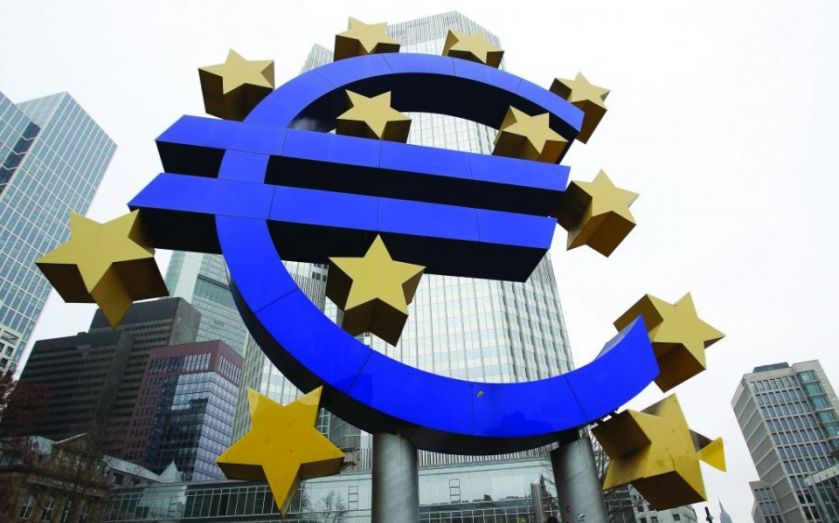
Despite a range of economic indicators suggesting that the Eurozone economy has finally begun to turn a corner, markets had an uncertain start to the week. Although the currency bloc’s unemployment rate slipped to 11.2 per cent in January and a flash estimate of inflation came in at a better-than-expected -0.3 per cent in February, France’s Cac 40 index closed down 0.69 per cent at 4,917.32 and Italy’s FTSE MIB fell by 0.18 per cent. While Germany’s Dax and Spain’s Ibex put in positive performances, reports from the Spanish economy minister that talks over a third Greek bailout were ongoing (hastily denied by European authorities) weighed on sentiment.
But some traders will be keeping their power dry for the coming European Central Bank (ECB) meeting, taking place in Cyprus this Thursday. Alongside the release of updated macroeconomic forecasts for the Eurozone, many analysts expect ECB president Mario Draghi to provide more details about the central bank’s quantitative easing (QE) programme, first announced in January. As Justin Knight, head of European rates strategy at UBS, wrote in a note yesterday, “important unknowns about the programme persist. The answers to them could determine whether [bond] yields ultimately rise or fall beyond the initial few months of purchases.”
HOW QE WILL BE UNROLLED
Ever since Draghi first announced the ECB’s €60bn a month bond-buying programme in January, the yields on government bonds across the Eurozone have plummeted. According to analysis by Bloomberg last week, 88 of the 346 securities on the Bloomberg Eurozone Sovereign Bond Index now have negative yields, with Eurozone bonds making up about 80 per cent of the $2.35 trillion of negative-yielding assets in the Bloomberg Global Developed Sovereign Bond Index.
Draghi has already said that the ECB will buy bonds with negative yields alongside a host of other announcements, but any further details could have a significant impact.
UBS’s Knight notes that most of the public discussion has been concerned with the total amount of bonds the ECB could purchase. But the programme’s effectiveness will depend on the way the ECB conducts the purchases on a day-to-day basis.
So what should we look out for? Knight suggests that “there is a decent chance” of yields rising “in the middle and later stages of the announced programme period, as well as rising… in the first few months of the programme for other reasons.”
Why? UBS argues that “many investors seem to be overweight of European duration in anticipation of the programme,” and expects these bonds to be sold “into the Eurosystem bid, to the extent that yields rise in the first month or two.”
Beyond that, it’s technical, but broadly what’s important is how scarce bonds become later on in the programme. And it comes down to whether the ECB will prioritise achieving its purchase targets over its wish to minimise price distortion in the bond markets. In the context of a market in which, over time, the natural sellers of government bonds will become scarce (regulatory requirements require many pension funds and insurance companies to hold them, for example), UBS suggests that the ECB will err on the side of caution. It could potentially decide to extend the QE programme beyond September 2016 instead of rushing to buy bonds more quickly.
Knight also suggests that, depending on how the ECB directs national central banks in their purchases, “monetary policy could look quite different in different parts of the monetary union”. If, for example, the ECB elects not to tightly guide purchases, “the market impact could be quite diverse as it would depend on which bonds a central bank decides to buy (for whatever reason) and how it buys them.”
INFLATION AND GROWTH
The European authorities are also set to revise their growth and inflation projections from their last official release in December 2014. Timo del Carpio, European economist at RBC Capital Markets, expects to see “considerable downward revisions” to the ECB’s 0.7 per cent forecast for the HICP measure of inflation over 2015 – more than likely bringing it closer to RBC’s forecast of 0.0 per cent for the year as a whole.
This will validate the ECB’s January QE announcement, says del Carpio. “Low inflation is not the only requirement to say we are in deflationary territory, but it is a necessary precondition, especially if the trend solidifies over a long period of time”, he says.
But even if QE is effective, warns del Carpio, the move upwards will be “a very slow grind”, and “the threat of inflation expectations becoming anchored at this low level remains a clear and present risk”.
On the other hand, Eurozone growth should be revised upwards: “the Eurozone does seem to be benefiting from short-term tailwinds, including weak oil and energy prices, weak inflation overall, and the delayed effects of monetary policy, but longer-term structural challenges are still there”, he notes.
For David Buik, market commentator at Panmure Gordon, “there is little doubt that the promise of ECB QE, a falling euro, and the falling oil price are together acting to reflate consumer demand – giving the zone a short-term boost to growth.” But, he warns, Europe will need to “make hay while the sun shines” to see any hope of long-term prosperity. “Without significant reforms to the supply-side of these economies, poor demographics and inflexible economic structures will always win out.” And as ever, Greece remains a risk. The ECB – despite being an independent central bank – holds the keys to the stability of the Greek banking system, and as such, will arguably determine whether Greece remains in the Eurozone. Expect questions of Draghi on Thursday.